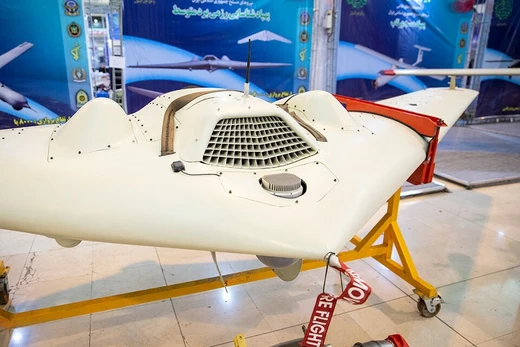
Selex ES Falco
Italian tactical ISTAR UAV family, unarmed except for the Astore variant.

Charles J. Sharp · CC BY-SA 4.0
The Falco—Italian for "hawk"—is a family of tactical unmanned aerial vehicles built by Selex ES, now part of Leonardo, with roots in Galileo Avionica of Italy. These drones operate at medium altitude and endurance, focusing on intelligence, surveillance, target acquisition, and reconnaissance (ISTAR). They carry various payloads, such as high-resolution sensors. A bigger version, the Falco EVO, can handle heavier loads. Neither variant is weaponized by design, but an armed derivative called Astore, based on the Falco EVO, carries two Turkish Roketsan Cirit 70 mm laser-guided missiles alongside its ISTAR gear. As of 2026, the Bangladesh Air Force is the only confirmed user of the armed Falco family.
Development began with a first flight in December 2003, and platform qualification wrapped up by late October 2004 after over 40 hours of testing at Sardinia’s Salto di Quirra range. Flight control validation finished in September 2004, with onboard system testing planned for early 2005 and electro-optical sensor integration set for July 2005. Radar installation was scheduled for 2006. In January 2007, factory acceptance tests were completed, and the first production system was ready for its launch customer, believed to be Pakistan. The production model used a modified 80 hp (60 kW) engine from UAV Engines.
By March 2009, a modified version called Falco Evo—short for "evolution"—was on offer, with larger tail booms and wings that nearly doubled the wingspan to 12.5 meters and boosted payload from 70 kg to 100 kg. Its first flight was expected by mid-2010. Selex ES declined to name the customer, but Pakistan had ordered five systems, totaling 25 Falco UAVs plus spare flight units and ground control stations. Two systems were in service by March 2009, two more had been delivered, and final assembly of the last system was happening in Pakistan. In August 2009, the Falco completed flight tests with a Robonic MC2555LLR pneumatic catapult launcher. Pakistan began manufacturing the Falco at the Pakistan Aeronautical Complex in Kamra. Around September 2009, the first flight with a PicoSAR AESA synthetic aperture radar occurred. On 23 July 2012, the Falco Evo made its 40-minute maiden flight from Bulgaria’s Cheshnegirovo air base.
Quick Facts
- Aircraft Type
- Falco and Falco EVO: Unmanned surveillance and reconnaissance aerial vehicle / Astore: Tactical unmanned combat aerial vehicle
- National Origin
- Italy
- Manufacturer
- Selex ES / Pakistan Aeronautical Complex (since 2008) / Leonardo / Leonardo-Finmeccanica (since 2016)
- Designer
- Galileo Avionica
- Primary User
- Pakistan Air Force / Royal Saudi Air Force / Bangladesh Air Force
- Number Built
- ~50 production aircraft
- Introduction
- Falco: 2009
- First Flight
- Falco: December 2003 / Falco EVO : 2012
Facts from the source article.
Lore & Background
The Falco UAV's maiden flight took place in December 2003, and Galileo Avionica completed platform qualification in late October 2004 after over 40 hours of flight-testing at the Salto di Quirra test range in Sardinia. Validation of flight controls was completed in September 2004, with testing of onboard systems planned for early 2005 and integration of the electro-optical sensor suite for July 2005. Radar installation was scheduled to begin in 2006. In January 2007, Galileo Avionica finished factory acceptance tests and was ready to deliver the first production Falco UAV System to its launch customer, then believed to be Pakistan. The production version used a modified powerplant developing 80 hp (60 kW), supplied by UAV Engines.
In March 2009, a modified version named Falco Evo (evo meaning evolution) was offered, featuring larger tail booms and wings that almost double the wingspan to 12.5 m and increase payload from 70 kg to 100 kg. Its first flight was expected by mid-2010. Pakistan ordered five systems, including 25 Falco UAVs with spare flight units and ground control stations; two systems were in service by March 2009, two more had been delivered, and final assembly of the last system was undertaken in Pakistan. In August 2009, the Falco completed flight-tests launched by a Robonic MC2555LLR pneumatic launcher. Around September 2009, the first flight of a Falco carrying a high-resolution AESA synthetic aperture radar (SAR) sensor payload called PicoSAR was made. The Falco EVO successfully completed its 40-minute maiden flight from Cheshnegirovo air base in Bulgaria on 23 July 2012.
In August 2013, the Falco was chosen by the United Nations for deployment in the Democratic Republic of Congo to monitor armed groups and protect civilians. In September 2013, Selex ES announced a deal worth over €40 million to sell the Falco to an unnamed Middle Eastern country. In June 2023, the Falco was shown at the Paris Air Show fitted with a Brimstone missile. The Falco UAV system comprises a Ground Control Station, Ground Data Terminal, Ground Support Equipment, and four Falco UAVs housing user-specified payloads. The Falco is 17 ft long, 6 ft high, has a 24 ft wingspan, a top speed of 134 mph, a maximum altitude of around 16,400 ft, and endurance up to 14 hours. Sensors include the EOST 46 electro-optical/infrared turret, Gabbiano 20 multi-mode surveillance radar, and the PicoSAR radar. The Falco EVO has a payload capacity of up to 100 kg and extended endurance of up to 18 hours.
Reader's Guide
The Falco family represents a significant Italian contribution to tactical ISTAR UAVs, notable for its export success and adaptation by multiple nations. Pakistan became the first export customer in 2007 and began manufacturing the Falco under license at the Pakistan Aeronautical Complex in 2008, using the unarmed UAVs during 2009 security operations in the Swat Valley for locating ammunition dumps, bunkers, hide-outs, and other insurgent infrastructure. The United Nations' deployment of the Falco in the Democratic Republic of Congo in December 2013 marked the first use of spy drones in UN peacekeeping history, reflecting a major technological advancement in the organization's arsenal. The Falco's design emphasizes modular payload integration, including synthetic aperture radar, electronic warfare suites, and various sensors, while the later Astore variant adds limited strike capability with two Roketsan Cirit missiles. As of 2026, the Bangladesh Air Force is the only confirmed user of the armed Falco family UAVs. The Falco's operational history includes the loss of two Jordanian-operated Falco UAVs shot down by Syrian MiG-23 fighters in June 2017 near Daraa. The system's endurance, payload flexibility, and ability to operate from pneumatic launchers have made it a versatile platform for both military and peacekeeping missions.
Did You Know?
- The Falco's name means 'hawk' in Italian.
- The Falco EVO has a wingspan of 12.5 m, nearly double that of the original Falco.
- The United Nations first used spy drones in its history when it deployed the Falco in the Democratic Republic of Congo in December 2013.
- The Astore armed variant carries two Turkish-made Roketsan Cirit 70 mm laser-guided missiles.
The Hajjah Loss
On the third of February 2016, a Selex ES Falco unmanned aircraft, flying under the operational control of the United Arab Emirates Army, was brought down by Houthi forces over the northeastern Yemeni province of Hajjah. The incident placed the Falco among a growing list of coalition airframes lost during the Saudi-led intervention that had commenced in March of the previous year. By the time this particular drone was destroyed, the conflict had already claimed numerous fixed-wing jets, helicopters, and unmanned platforms from multiple coalition nations. The Falco's loss in Hajjah marked a notable moment in the campaign's second year, underscoring that even smaller, lower-profile unmanned systems remained vulnerable to the ground-based air defenses that Houthi fighters had employed throughout the war. The incident was recorded alongside other UAE unmanned losses in the same period, including Schiebel Camcopter S-100 units destroyed in Dhubab and Al-Abdiyah, illustrating a sustained pattern of attrition affecting the coalition's drone fleet across multiple provinces.
The Coalition's Aerial Campaign
Since the launch of Operation Decisive Storm on 25 March 2015, the Saudi-led coalition has conducted sustained air operations against Houthi and allied government forces in Yemen. The opening strikes alone destroyed Yemeni Air Force assets at Sanaa International Airport and Al Anad Air Base, including Su-22 fighters, Mi-8 helicopters, and utility aircraft. Over the following months and years, the conflict produced a steady stream of losses on both sides. Coalition aircraft of every category—fixed-wing combat jets, attack helicopters, transport planes, and unmanned reconnaissance drones—have been lost to either mechanical failure or enemy action. Nations contributing airpower have included Saudi Arabia, the United Arab Emirates, Morocco, Sudan, and the United States, with losses ranging from F-15s and F-16s to Apache helicopters and various small UAVs. The Selex ES Falco, operated by the UAE Army, fits within this broader pattern of attrition that has characterized the aerial dimension of the Yemeni civil war throughout its duration.
UAE Unmanned Platform Attrition
The United Arab Emirates Army and Air Force have suffered a recurring series of losses among their unmanned aerial vehicles during the Yemen intervention. Beginning in August 2015, a Schiebel Camcopter S-100 was shot down by Houthi forces in Dhubab, followed by a second Camcopter S-100 lost in Al-Abdiyah in October of that year. A third Camcopter was reported destroyed in Dhubab in February 2016, just days before the Selex ES Falco was brought down in Hajjah on 3 February. In September 2016, a CAIG Wing Loong I drone was shot down by Houthi fighters, with wreckage photographs subsequently displayed. The pattern continued into 2017, when an MQ-1B was lost in February. The Falco's destruction in northeastern Yemen thus represents one node in a chain of unmanned platform losses spanning multiple provinces and at least two years of operations. Each incident was attributed by Houthi sources to their own ground-based defenses, though the coalition occasionally offered alternative explanations for individual losses.
Contested Attribution and the Threat Landscape
A defining feature of the Yemeni air war has been the persistent disagreement over how individual aircraft were lost. Houthi forces routinely claimed credit for shooting down coalition jets, helicopters, and drones, while coalition officials often attributed the same incidents to technical malfunctions or mechanical failures. The Selex ES Falco lost in Hajjah in February 2016 was explicitly credited as a Houthi kill, consistent with their broader pattern of claiming responsibility for unmanned platform losses. Similar disputes surrounded the fate of multiple Apache helicopters, where Saudi officials cited technical issues while Yemeni sources insisted on anti-aircraft fire. The threat environment in which the Falco operated was one in which Houthi fighters had demonstrated the ability to engage a wide spectrum of targets—from low-flying combat aircraft to small reconnaissance drones—using a mix of anti-aircraft artillery, MANPADS, and other ground-based systems. The Falco's loss in Hajjah, situated among the terrain of northeastern Yemen, reflected the operational challenges of flying unmanned assets in an environment where such defenses were widely dispersed.
Gallery

Frequently Asked Questions
What is the Selex ES Falco?
The Falco (Italian for 'hawk') is a family of Italian tactical unmanned aerial vehicles developed by Selex ES, the company now folded into Leonardo, with design lineage tracing back to Galileo Avionica. It is built for medium-altitude, long-endurance reconnaissance rather than strike work.
What role does the Falco actually perform?
Its core mission is ISTAR—gathering intelligence, conducting surveillance, acquiring targets, and performing reconnaissance from the air. It does this by carrying high-resolution electro-optical and other sensor payloads, and the larger Falco EVO variant can accommodate even heavier sensor suites.
What are the Falco's key size and speed figures?
The airframe stretches 6.2 metres in length and the Falco EVO variant spans 12.5 metres wingtip to wingtip. It can take off at up to 650 kg and cruises at a top speed of roughly 134 mph.
Is the Falco a weapons platform?
No—neither the standard Falco nor the Falco EVO is designed to carry ordnance. However, an armed spin-off called the Astore, derived from the Falco EVO airframe, can launch two Turkish-made Roketsan Cirit 70 mm laser-guided missiles.
When did the Falco first take to the sky?
The type made its maiden flight in December 2003, and full platform qualification was completed in late October 2004, just over a year later.
More in Military Drones of Asia, Europe and the Americas 1-24
Spotted an error? Know more?
Reader corrections go straight into our review queue. Suggest an edit · How this site is sourced