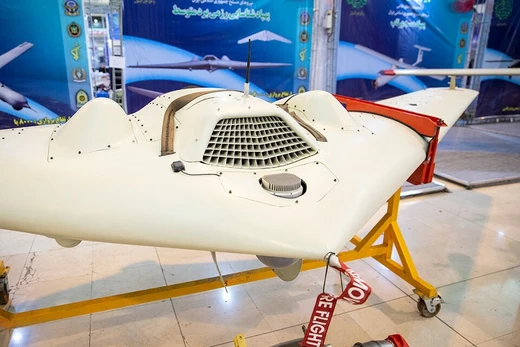
Tupolev Tu-123
Early Soviet expendable supersonic strategic reconnaissance drone.

The Tupolev Tu-123 Yastreb (Hawk), also designated DBR-1, was one of the earliest Soviet reconnaissance drones, developed beginning in 1960 and introduced into active service in 1964. It was a long-range, high-altitude supersonic strategic unmanned reconnaissance aircraft, conceptually similar to the United States' D-21, and carried both film cameras and SIGINT payloads.
Quick Facts
- National Origin
- Soviet Union
- Manufacturer
- Tupolev
- First Flight
- 1960
- Introduction
- 1964
- Retired
- 1979
- Produced
- 1964–1972
- Number Built
- 52
Facts from the source article.
Lore & Background
The Tu-123 was a development of the proposed Tupolev Tu-121 supersonic nuclear-armed cruise missile program. After that project was cancelled in favor of ballistic missiles, the design was modified for high-altitude reconnaissance. The project was officially launched on 16 August 1960 under the designation DBR-1, with the Tupolev Design Bureau designation I123K, later changed to Tu-123. Factory testing was completed in September 1961, and flight tests by December 1963. The new UAV entered active service on 23 May 1964. Mass production at Voronezh Factory Number 64 produced 52 units from 1964 to 1972.
The Tu-123 was ground-launched with JATO boosting and powered in flight by a KR-15 afterburning turbojet, a lower-cost, short-life, expendable version of the R-15 engine used on the twin-engine, Mach 3-class Mikoyan-Gurevich MiG-25 Foxbat interceptor. The drone itself was expendable, parachuting its payload to the ground for recovery. Its form was reminiscent of a big dart.
The Tu-123 served with Soviet Air Force intelligence units stationed in the western border military districts until 1979. It theoretically had the range to cover all of Central and Western Europe, and performed well in training exercises. However, the expense of operating an expendable system was unsatisfactory, leading to the development of the Tu-139 Yastreb 2, a reusable version that could land on unprepared airstrips, though it was never put into production. The Tu-123 was gradually removed from service and replaced by the MiG-25R, a reconnaissance version of the Foxbat.
Reader's Guide
The Tu-123 Yastreb represents an early Soviet attempt to field a long-range, high-altitude supersonic strategic reconnaissance drone, filling a niche similar to that of the American D-21. Its development from a cancelled nuclear-armed cruise missile program illustrates the adaptation of existing missile technology to reconnaissance needs during the Cold War. The drone's expendable nature, while simplifying recovery of its film and SIGINT payloads via parachute, proved costly in operational use. This expense drove the development of the reusable Tu-139 Yastreb 2, which never entered production. The Tu-123's service life from 1964 to 1979 was limited to Soviet Air Force intelligence units in western border districts, where it theoretically could cover all of Central and Western Europe. Its eventual replacement by the MiG-25R reconnaissance aircraft underscores the shift toward manned platforms for such missions. With only 52 units built, the Tu-123 remains a notable but relatively obscure early milestone in Soviet unmanned reconnaissance aviation.
Did You Know?
- The Tu-123 was developed from the cancelled Tupolev Tu-121 supersonic nuclear-armed cruise missile program.
- It was ground-launched with JATO boosting and used an expendable KR-15 afterburning turbojet engine.
- The drone parachuted its payload to the ground for recovery, while the airframe itself was expendable.
- Only 52 units were manufactured between 1964 and 1972 at Voronezh Factory Number 64.
More in Military Drones of Asia, Europe and the Americas 1-24
Spotted an error? Know more?
Reader corrections go straight into our review queue. Suggest an edit · How this site is sourced