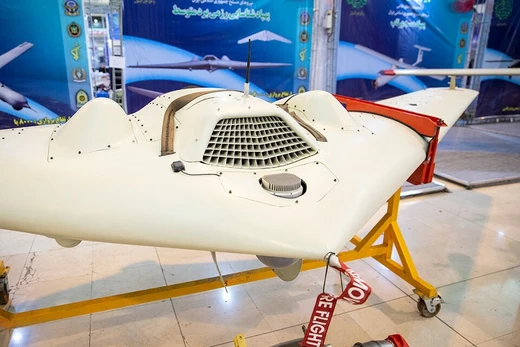
Terminal Autonomy AQ-400 Scythe
Low-cost Ukrainian one-way attack drone designed for mass production.

The AQ-400 Scythe is a one-way attack drone produced by the Ukrainian company Terminal Autonomy, which was founded in mid-2022 by two veterans of the British and Australian militaries and a Ukrainian engineer. The company, originally called One Way Aerospace, focuses on low-cost, domestically built kamikaze drones. The AQ-400 was first shown in spring 2023, and the Ukrainian Armed Forces received the first batch in December 2023. Initial production aimed for 100 units per month, scaling to 500 per month by the second quarter of 2024, with a long-term goal of 1,000 monthly. In July 2026, a factory in Kyiv that made the AQ-400 and the AQ-100 Bayonet was destroyed by a Russian ballistic missile.
The drone is designed for quick assembly, mass production, and low cost. Its fuselage uses milled plywood sheets from civilian furniture factories, a more scalable material than 3-D printing or fiberglass. No technical training is needed for manufacturing, allowing production without skilled labor. While some parts come from abroad, the focus is on maximizing Ukrainian production. It has two sets of wings (forward and rear) with a 2.3-meter wingspan, and 30 fully assembled Scythes can fit in one shipping container. Takeoff can be from short airstrips using its tricycle landing gear, or from a catapult with rocket boosters. The drone weighs 100 kg, with a 43 kg payload, including a 32 kg warhead that can be thermobaric or hold two 122 mm artillery shells. Using a standard gas engine and pusher propeller, it cruises at 144 km/h, reaches a top speed of 200 km/h, has a 6.5-hour endurance, and a strike range of 750 km. With different engine options, range can extend to 900 km, or payload can increase to 70 kg at a reduced range.
For guidance at low altitude, it uses a laser altimeter to fly at 30 meters, reducing the impact of electronic warfare that jams GPS until close to the target. At high altitudes of 3,000 meters, it navigates with a visual positioning system using roads and landmarks. A video link option allows an operator to manually guide the drone to moving targets, but this adds cost and works only at shorter ranges. The basic airframe costs USD $15,000, rising to $30,000 with a guidance system and other features; for comparison, a Russian Shahed-136 costs around $20,000.
Quick Facts
- Is Missile
- yes
- Wars
- Russian invasion of Ukraine
- Design Date
- 2022-2023
- Manufacturer
- Terminal Autonomy
- Unit Cost
- USD$30,000
- Production Date
- 2023-present
- Service
- 2023–present
- Weight
- 100 kg
- Wingspan
- 2.3 m
- Speed
- 200 km/h
- Vehicle Range
- 750 km
- Filling
- 43 kg
Facts from the source article.
Lore & Background
Terminal Autonomy, previously named One Way Aerospace, was founded in mid-2022 by two veterans of the British and Australian militaries and a Ukrainian engineer to develop various low-cost, domestically produced kamikaze drones. The AQ-400 was first demonstrated in spring 2023, and the Armed Forces of Ukraine received the first batch in December 2023. Initial plans were to produce 100 units per month, scaling up to 500 per month in Q2 2024, with a goal of 1,000 units monthly. In July 2026, a factory producing AQ-400 and AQ-100 Bayonet drones in Kyiv was destroyed by a Russian ballistic missile.
The AQ-400 is characterized by swift assembly, mass production capabilities, and cost-effectiveness. The fuselage is made from milled sheets of plywood from civilian furniture factories, a more scalable alternative than 3-D printing or fiberglass. Technical training is not required, allowing manufacture at scale without skilled labor. Although some components are sourced from abroad, the focus is on maximizing production within Ukraine's borders. It has two sets of wings, one forward and one rear, with a wingspan of 2.3 m; 30 fully-assembled Scythes can be stacked in one shipping container. Takeoff is achieved from short airstrips using its own tricycle landing gear or from a catapult using rocket boosters. Overall weight is 100 kg with a 43 kg payload, of which 32 kg is the warhead, which can be thermobaric or hold two 122 mm artillery shells. Using the standard gas engine and pusher propeller, the AQ-400 has a cruise speed of 144 km/h, a top speed of 200 km/h, endurance of 6.5 hours, and a strike range of 750 km; depending on the engine option, range could be increased as far as 900 km, or payload increased to 70 kg at a reduced range.
Guidance at low altitude uses a laser altimeter to approach at 30 m to minimize the effects of electronic warfare that jam GPS navigation until very close to the target. At high altitudes of 3,000 m, it navigates with a visual positioning system using roads and other visible landmarks. A video link option is available so an operator can manually guide the drone to hit moving targets, but this adds costs and only works at shorter ranges. The basic Scythe airframe costs USD$15,000, which increases to USD$30,000 with a guidance system and other features; this compares to around USD$20,000 for a Shahed-136 one-way attack munition used by Russia. Swarms can use a leader-follower method, where one lead drone carrying a navigation system is followed by nine basic drones, which help saturate the target area and draw off enemy defenses from the lethal version.
Reader's Guide
The AQ-400 Scythe represents a significant development in low-cost, mass-produced one-way attack drones, designed specifically to address the needs of Ukraine during the Russian invasion. Its use of plywood from civilian furniture factories and lack of requirement for skilled labor enable rapid scaling of production, with initial plans to reach 1,000 units per month. The drone's cost-effectiveness—ranging from USD$15,000 for a basic airframe to USD$30,000 with guidance—makes it cheaper than the Russian Shahed-136, allowing Ukraine to field large numbers. The swarm tactic, using a leader-follower method where one guided drone leads nine basic ones, is intended to saturate target areas and draw off enemy defenses, overwhelming air defenses and exhausting expensive interceptors over time. The destruction of a production factory in Kyiv in July 2026 highlights the vulnerability of such manufacturing facilities, but the design's emphasis on domestic production and scalability suggests resilience. The AQ-400's guidance systems, including laser altimeter for low-altitude approach and visual positioning at high altitude, are designed to counter electronic warfare, while the optional video link enables manual guidance against moving targets at shorter ranges. Its legacy lies in demonstrating how a nation under invasion can rapidly develop and deploy cost-effective, mass-produced drones to counter a larger adversary's air defense systems.
Did You Know?
- The AQ-400 Scythe's fuselage is made from milled sheets of plywood sourced from civilian furniture factories.
- The basic airframe costs USD$15,000, while a fully equipped version costs USD$30,000.
- A swarm tactic uses one lead drone with navigation followed by nine basic drones to saturate targets.
More in Military Drones of Asia, Europe and the Americas 1-24
Spotted an error? Know more?
Reader corrections go straight into our review queue. Suggest an edit · How this site is sourced