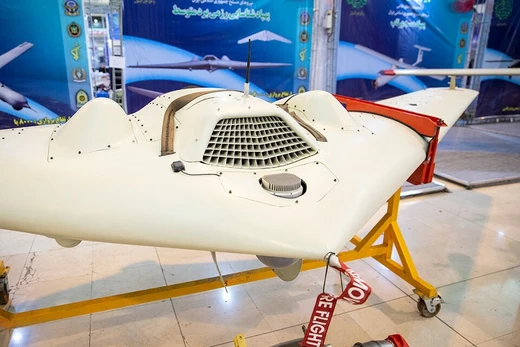
Peklo
Ukrainian jet-powered loitering munition combining drone and cruise missile traits.

Peklo is a Ukrainian long-range loitering munition, also referred to as a missile-drone, developed during the Russian invasion of Ukraine. It blends features of a kamikaze drone and a cruise missile, powered by a jet engine.
The weapon was created by the Ukrainian Defense Industry and likely builds on the Palianytsia missile-drone, another system developed during the war. Its remote-controlled turbojet engine allows subsonic speeds up to 700 km/h (Mach 0.57) and a maximum range of 700 km. Reports indicate that up to 70% of its components are domestically produced, though supply chain issues may persist.
Public details remain limited due to wartime secrecy. Media analysis of photographs suggests the warhead weighs no more than 50 kg, based on the fuselage size. Analysts disagree on the launch method: Ukrainian outlet Defence Express believes it uses a ground-based system, while the BBC concludes it can be launched from aircraft.
Development took under a year, and the weapon had five successful deployments before the first batch was delivered. On 6 December 2024, Ukrainian Armed Forces Day, President Volodymyr Zelenskyy unveiled the drone in a ceremony. One hundred units had been manufactured in the three months prior to that first delivery to Ukrainian forces.
Quick Facts
- Origin
- Ukraine
- Is Missile
- Yes
- Service
- 2024
- Wars
- Russo-Ukrainian War
- Engine
- turbojet
Facts from the source article.
Lore & Background
Peklo was developed by the Ukrainian Defense Industry and is presumably based on the Palianytsia missile-drone, also developed during the Russian invasion. It is equipped with a remote-controlled turbojet engine, enabling subsonic speeds of up to 700 km/h and a maximum range of 700 km. The weapon is reported to be composed of up to 70% domestically produced components, though it may still face supply chain issues.
Details of the missile are sparse due to a general reluctance to reveal too much information to the adversary in the war. Photo image analysis by the media indicates that the weight of the warhead may not be more than 50 kg due to the fuselage. However, the media arrived at different conclusions on the launching mechanism: Ukrainian media Defence Express concluded it is likely a land-based system, while the BBC determined it can be launched from aircraft.
The development of the missile took less than a year and it had five successful deployments prior to the delivery of the first batch. On 6 December 2024, the Ukrainian Armed Forces Day, the drone was unveiled by President Volodymyr Zelenskyy in a ceremony, and 100 units had been manufactured in the three months prior to the first batch being delivered to Ukrainian forces.
Reader's Guide
Peklo represents a notable addition to Ukraine's domestic drone arsenal during the Russian invasion, reflecting a rapid development cycle of under a year. Its combination of a jet engine with loitering and cruise missile characteristics offers a distinct capability for long-range strikes. The weapon's significance is underscored by its unveiling on Ukrainian Armed Forces Day by President Zelenskyy, with 100 units already produced and delivered. The reliance on up to 70% domestically produced components highlights efforts to reduce dependency on foreign supply chains, though potential supply chain issues remain. The uncertainty over its launch mechanism—whether land-based or aircraft-launched—and the limited public details due to operational security reflect the wartime context. Five successful deployments before the first batch delivery suggest operational viability, positioning Peklo as a potentially impactful system in the ongoing conflict.
Did You Know?
- It is equipped with a jet engine and can reach speeds of up to 700 km/h.
- The drone was unveiled by President Volodymyr Zelenskyy on 6 December 2024.
- The warhead weight may not be more than 50 kg based on photo image analysis.
More in Military Drones of Asia, Europe and the Americas 1-24
Spotted an error? Know more?
Reader corrections go straight into our review queue. Suggest an edit · How this site is sourced