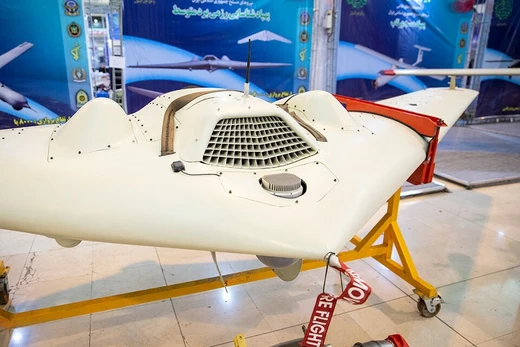
Liutyi
Ukrainian one-way attack drone developed as a Shahed 136 analogue.

The Antonov An-196 Liutyi (also written as Lyutyi or Liutiy) is a Ukrainian one-way attack drone developed by Ukroboronprom in October 2022. It was designed as a counterpart to the Russian Shahed 136. During the Russian invasion of Ukraine, the Liutyi has been used to strike targets inside Russia, including oil refineries, industrial sites, and military airfields.
On 25 November 2024, a Liutyi with an upgraded 75 kg warhead hit a Russian oil refinery in Saratov, over 600 km from the Ukrainian border. On 5 July 2025, at least two drones attacked the VNIIR-Progress plant in Cheboksary, about 975 km away, which produces components for Su-34 fighter-bombers, S-300 systems, T-90M and T-14 tanks, and submarines. On 13 October 2025, another strike on the Saratov refinery was reported, with the commander using the call sign “Casper,” belonging to the commander of the 1st Battalion of Ukraine’s 14th Regiment of Unmanned Aerial Systems. On 31 October 2025, a strike used the call sign “Fidel,” associated with the co-founder of the 1st Center of the Unmanned Systems Forces. On 14 December 2025, a Liutyi struck a Lukoil-operated offshore oil platform in the Caspian Sea. In February 2026, the Lukoil refinery in Ukhta, Komi Republic, about 1,700 km from Ukraine, was attacked. On 5 May 2026, two Liutyi drones and a Flamingo missile hit the VNIIR-PROGRESS plant in Cheboksary, which produces electronic components for Shahed drone antenna and guidance systems. On 21 July 2026, a two-way variant of the Liutyi, equipped with air-to-surface missiles comparable in size to MAM bombs, was shown at the Farnborough International Airshow, adapting it as a multi-purpose UCAV similar to the Bayraktar TB2.
The Liutyi is operated by the Armed Forces of Ukraine.
Quick Facts
- Origin
- Ukraine
- Is Missile
- Yes
- Designer
- Antonov ASTC
- Design Date
- October 2022
- Unit Cost
- $200,000
- Weight
- 250 -
- Length
- 4.4 m
- Wingspan
- 6.7 m
- Filling Weight
- 50–75 kg
- Engine
- 4-valve air-cooled box engine
- Vehicle Range
- 1,000 -
- Guidance
- Artificial intelligence, satellite navigation, INS
Facts from the source article.
Lore & Background
The Liutyi was developed by Ukroboronprom in October 2022 as a Ukrainian analogue to the Russian-fielded Shahed 136 one-way attack drone. During the Russian invasion of Ukraine, it has been used by Ukraine for strikes on Russian territory, targeting oil refineries, industrial facilities, and military airfields. On 25 November 2024, a Liutyi fitted with an upgraded 75 kg warhead struck a Russian oil refinery in Saratov at a range of more than 600 km from the Ukrainian border. On 5 July 2025, at least two UAVs attacked VNIIR-Progress in Cheboksary, about 975 km from the border, a facility manufacturing components for Su-34 fighter-bombers, S-300 systems, T-90M and T-14 tanks, and submarines. On 13 October 2025, a strike against the Saratov refinery was reported, with the strike commander using the call sign 'Casper', associated with the Commander of the 1st Battalion of Ukraine's 14th Regiment of Unmanned Aerial Systems. On 31 October 2025, another strike was reported with the commander's call sign 'Fidel', used by the Co-Founder of the 1st Center of the Unmanned Systems Forces. On 14 December 2025, a Liutyi struck a Lukoil-operated offshore oil platform in the Caspian Sea. In February 2026, the Lukoil oil refinery in Ukhta, about 1,700 km from the border, was attacked. On 5 May 2026, two Liutyi drones (along with a Flamingo missile) struck the VNIIR-PROGRESS plant in Cheboksary, which produced electronic components for Shahed drone antenna and guidance systems. On 21 July 2026, a two-way variant of the Liutyi equipped with air-to-surface missiles comparable in size to MAM bombs was unveiled at the Farnborough International Airshow, adapting it as a multi-purpose UCAV similar to the Bayraktar TB2.
Reader's Guide
The Liutyi represents a significant Ukrainian development in one-way attack drones, directly modeled on the Russian Shahed 136 but adapted for Ukrainian strategic strikes deep into Russian territory. Its operational history demonstrates a progressive increase in range and payload capability, from a 600 km strike in November 2024 to a 1,700 km attack in February 2026. The drone has been used against high-value targets including oil refineries, military component factories, and offshore platforms, indicating a deliberate campaign to disrupt Russian energy and defense infrastructure. The involvement of named commanders with call signs 'Casper' and 'Fidel' from Ukraine's 14th Regiment of Unmanned Aerial Systems (later the 1st Center of the Unmanned Systems Forces) highlights the organizational structure behind these operations. The unveiling of a two-way variant in July 2026 suggests an evolution from a single-use munition to a reusable platform capable of precision strikes, potentially extending its utility beyond the initial one-way attack role. The Liutyi's legacy lies in its demonstration of Ukraine's ability to develop and deploy long-range strike capabilities against strategic targets, mirroring and countering Russian drone tactics while expanding the operational reach of Ukrainian forces.
Did You Know?
- The Liutyi was developed by Ukroboronprom in October 2022 as an analogue to the Russian Shahed 136.
- A two-way variant of the Liutyi equipped with air-to-surface missiles was unveiled on 21 July 2026 at the Farnborough International Airshow.
- The drone has been used to strike targets as far as 1,700 km from the Ukrainian border, including the Lukoil refinery in Ukhta.
More in Military Drones of Asia, Europe and the Americas 1-24
Spotted an error? Know more?
Reader corrections go straight into our review queue. Suggest an edit · How this site is sourced