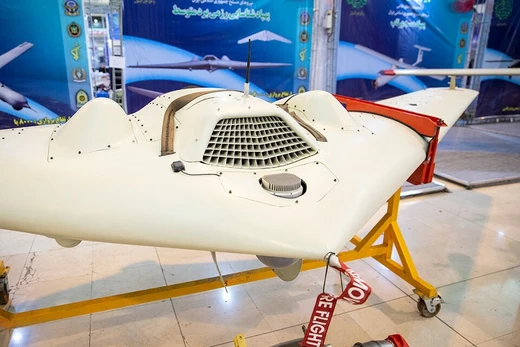
GIDS Shahpar
Pakistani UAV family with autonomous takeoff and landing capability.

The GIDS Shahpar is a Pakistani-made family of unmanned aerial vehicles, produced by Global Industrial Defence Solutions and operated by the country's military. After finishing its testing and qualification phase, the drone is now in active production. AERO, one of the seven companies in the GIDS consortium, handles the sensor suite—a multi-sensor turret called the Zumr-1 (EP)—at a facility near Islamabad. According to an AERO engineer, the only components not manufactured in Pakistan are the engine and tyres. The airframe uses a pusher engine design with canard foreplanes positioned ahead of the wings.
The Shahpar can autonomously take off and land on a runway or deploy a parachute for landing. It carries payloads for reconnaissance and day-or-night surveillance. Its avionics can geo-reference and geo-point ground targets. The hardware meets military Environmental Standard 810F, and the ground equipment supports mission planning, simulation, management, control, and debriefing for the crew.
Operationally, the first Shahpar fleet entered service with the Pakistan Air Force and Pakistan Army in 2013, alongside the Burraq UCAV. Each flight unit consists of five aircraft, one communications station, and one ground control station. Variants include the Shahpar, Shahpar-II, and Shahpar-III.
Quick Facts
- Aircraft Type
- Reconnaissance
- Manufacturer
- Global Industrial Defence Solutions
- Designer
- NESCOM
- Primary User
- Pakistan Air Force
- More Users
- Pakistan Army
- Number Built
- 50
- Construction Date
- ~2012
- Introduction
- 2012
- Developed Into
- Shahpar-2
Facts from the source article.
Lore & Background
The GIDS Shahpar was developed by Global Industrial Defence Solutions, a consortium of seven companies. According to an engineer of AERO (Advanced Engineering Research Organisation), one of the consortium members, the only parts of the Shahpar aircraft system not produced in Pakistan are the engine and tyres. The sensor suite, a multi-sensor turret designated 'Zumr-1 (EP)', is built at an AERO facility near Islamabad. The design features a pusher engine with canard foreplanes in front of the wings.
The Shahpar is designed to autonomously take off and land on a runway or deploy a parachute for landing. Payloads are available for reconnaissance and day/night surveillance. Targets on the ground can be geo-referenced and geo-pointed by the avionics. The military-standard hardware is built to Environmental Standard 810F. Ground equipment is capable of mission planning and simulation, mission management and control, as well as debriefing the ground crew.
The first fleet of Shahpars entered service with the Pakistan Air Force and Pakistan Army in 2013 along with the Burraq UCAV. Each flight is made up of five aircraft, a communications station and a ground control station. Variants include the Shahpar, Shahpar-II, and Shahpar-III.
Reader's Guide
The GIDS Shahpar represents a significant step in Pakistan's indigenous unmanned aerial vehicle capabilities, being built by a consortium of seven companies with most components produced domestically. Its entry into service alongside the Burraq UCAV in 2013 marked the operational debut of a Pakistani-designed UAV family. The Shahpar's design emphasizes autonomy, with the ability to take off and land on a runway without pilot intervention or to deploy a parachute for landing. Its military-standard hardware, built to Environmental Standard 810F, and ground equipment supporting mission planning, simulation, management, control, and debriefing, indicate a comprehensive system approach. The sensor suite, the Zumr-1 (EP) multi-sensor turret, is produced locally near Islamabad, underscoring the effort to reduce reliance on foreign components. The Shahpar family includes three variants—Shahpar, Shahpar-II, and Shahpar-III—though details on their differences are not specified. The aircraft's role in reconnaissance and day/night surveillance, combined with geo-referencing and geo-pointing capabilities, positions it as a tactical asset for the Pakistani military.
More in Military Drones of Asia, Europe and the Americas 1-24
Spotted an error? Know more?
Reader corrections go straight into our review queue. Suggest an edit · How this site is sourced