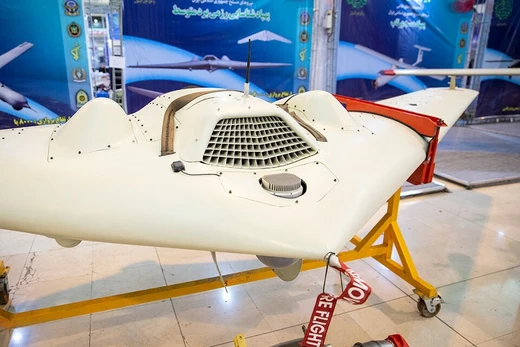
GIDS Shahpar-III
Pakistan's third-generation MALE UCAV, a contender to the MQ-9 Reaper.

The GIDS Shahpar-III is a medium-altitude, long-endurance unmanned combat aerial vehicle developed by NESCOM and sold by GIDS. As the latest addition to the Shahpar family, it is built to rival platforms such as the MQ-9 Reaper.
The drone emerged from Pakistan’s push to strengthen its domestic aerospace industry. GIDS first hinted at the Shahpar-III in a future roadmap on its website, where it was listed as a Group-4+ UCAV. Later, models and technology demonstrators appeared at international defense shows like IDEF-2023. Development reportedly cost around US$100 million.
At the IDEAS-24 exhibition in November 2024, GIDS CEO Asad Kamal and Pakistan’s army chief General Asim Munir publicly unveiled the Shahpar-III. GIDS again classified it as a Group-4+ UCAV and stated it was designed to compete with drones in the same class, including the MQ-9 Reaper.
The aircraft uses domestically produced flight control systems and avionics, including a 1553 architecture dual-redundant flight control computer for improved reliability. It can perform intelligence, surveillance, and reconnaissance (ISR), intelligence, surveillance, target acquisition, and reconnaissance (ISTAR), close air support (CAS), and maritime missions. It can carry Pakistani-made munitions such as Barq missiles and Al Battaar laser-guided bombs, though other weapons can also be integrated.
As of 2026, the Pakistan Air Force is integrating the Shahpar-III as a future operator.
Two variants exist: the Shahpar-III with a 140 hp engine, and the Shahpar-III with a more powerful 170 hp engine. The specifications listed are for the 170 hp configuration.
Quick Facts
- Aircraft Type
- UCAV
- Aircraft Role
- Strike/ISR
- Manufacturer
- GIDS
- Designer
- NESCOM
- Introduction
- November 2024
- First Flight
- 2023
- Predecessors
- GIDS Shahpar-2
Facts from the source article.
Lore & Background
The Shahpar-III is a further result of Pakistan's ongoing effort to enhance its local defence industry, particularly in aerospace. Its existence was revealed in a future roadmap presented by GIDS on its website where it was categorized as a group-4+ UCAV. Over time, GIDS displayed models and technology demonstrators of it in various international defense exhibitions including IDEF-2023. Its development cost around a US$100 million.
During the IDEAS-24 expo in November 2024, GIDS CEO Asad Kamal and Pakistan Army chief General Asim Munir unveiled the Shahpar-III marking its first public appearance. It was classified by GIDS as a Group-4+ UCAV and reportedly developed to compete with similar drones of its category like the MQ-9 Reaper. The Shahpar-III features domestic flight control systems and avionics and is equipped with a 1553 architecture dual-redundant flight control computer enhancing its reliability. Being a UCAV, it can be deployed in a variety of roles with ISR, ISTAR, CAS and maritime roles among them. It can be armed with several Pakistani-sourced munitions like the Barq missiles and Al Battaar laser-guided bombs though other munitions can also be integrated onto it.
Reader's Guide
The Shahpar-III represents a significant step in Pakistan's indigenous unmanned combat aerial vehicle development, positioning itself as a direct competitor to established platforms such as the MQ-9 Reaper. Its classification as a Group-4+ UCAV places it in the upper tier of drone categories, indicating advanced capabilities in endurance, payload, and mission flexibility. The aircraft's domestic flight control systems and dual-redundant flight control computer underscore a focus on reliability and self-sufficiency in defense technology. With a development cost of approximately US$100 million, the program reflects a substantial national investment. The Shahpar-III's ability to perform ISR, ISTAR, close air support, and maritime roles, combined with its integration of Pakistani-sourced munitions like Barq missiles and Al Battaar laser-guided bombs, demonstrates an effort to create a versatile, multirole platform. Its public unveiling at IDEAS-24 by senior military and industry figures signals its importance to Pakistan's strategic defense posture. The existence of two engine variants (140 hp and 170 hp) suggests ongoing refinement to meet different operational requirements. As of 2026, the Pakistan Air Force is integrating the Shahpar-III, marking its transition from development to operational service.
Did You Know?
- The Shahpar-III was unveiled at the IDEAS-24 expo in November 2024 by GIDS CEO Asad Kamal and Pakistan Army chief General Asim Munir.
- Its development cost was around US$100 million.
- It can be armed with Barq missiles and Al Battaar laser-guided bombs, among other munitions.
More in Military Drones of Asia, Europe and the Americas 1-24
Spotted an error? Know more?
Reader corrections go straight into our review queue. Suggest an edit · How this site is sourced