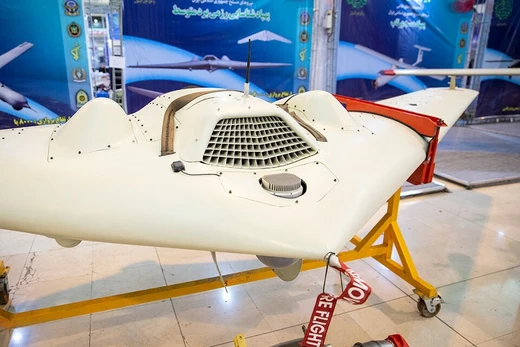
Athlon Avia A1-CM Furia
Ukrainian hand-launched reconnaissance UAV with precision laser designation capability.

The Athlon Avia A1-CM Furia is a Ukrainian hand-launched reconnaissance drone. It is operated from a portable, rectangular ground station roughly the size of a guitar case. First flown in 2014, it entered service with Ukraine’s Air Guard in 2015 and the Armed Forces in 2020, and has been used during the 2022 Russian invasion.
Its upgraded variant, the A1-CMX, can merge visual map data with GPS and GLONASS coordinates in real time. It can also project a laser designator onto a 2x2 meter target area from up to 7 kilometers away, even in poor weather. The Ukrainian Ministry of Defence has called the CMX a new “Wunderwaffe” for its ability to provide final guidance corrections to M982 Excalibur artillery shells.
The airframe is based on the RVJet RC plane by RangeVideo. Examination of downed units posted on Russian social media in August 2023 revealed custom FPGA and NVIDIA chips on tailor-made boards, industrial-grade ball bearings, multiple 830/905 nm laser rangefinders and designators, and precision motors and stepper motors from Northrop Grumman, Honeywell, L-3 Technologies, and ABB. Features include a multi-band long-range digital radio, backup gyroscopes, dedicated satellite reception chipsets, and a secondary high-resolution IR camera. Most electronics are enclosed in individual hardened shock-proof casings with Mu-metal EMI and RFI shielding. Members of the Russian hacker group Killnet described the hardware as “severely impressive,” citing “high quality” and “an obvious technological advantage.”
According to General Yevhen Moisiuk, the A1-CMX is an “absolute game changer” that allows spotted targets to be destroyed in under 15 minutes with a 95% probability. During the first half of the counter-offensive in the Robotyne region alone, the drone is claimed to have assisted in precision strikes destroying over 43 Russian tanks and 181 other armored and support vehicles.
Quick Facts
- Aircraft Type
- Reconnaissance UAV
- National Origin
- Ukraine
- Manufacturer
- Athlon Avia
- Primary User
- Armed Forces of Ukraine
- Introduction
- 2020
- First Flight
- 2014
Facts from the source article.
Lore & Background
The A1-CM Furia made its first flight in 2014 and was commissioned by the Air Guard of Ukraine in 2015, followed by the Armed Forces of Ukraine in 2020. Its airframe is based on the RVJet RC plane by RangeVideo. The UAV is controlled using a dedicated rectangular, guitar-case-sized portable station. During the 2022 Russian invasion of Ukraine, the A1-CM Furia saw active service.
A later modification, the A1-CMX, was developed and described by the Ukrainian Ministry of Defence as able to correlate and pinpoint visual map data with GPS and GLONASS coordinates in real time. It can reliably beam a laser target designator up to 7 km away onto a 2x2 m area, even in harsh weather conditions. The CMX version was dubbed a new 'Wunderwaffe' in the fight against Russia due to its ability to give final guidance correction to M982 Excalibur artillery shells.
Analysis of destroyed versions that appeared on Russian social-network VK at the end of August 2023 revealed custom FPGA and NVIDIA chips on tailor-made motherboards and daughterboards, expensive industrial-grade ball-bearings, multiple 830/905 nm laser range finders and laser designators, and precision electric motors and stepper-motors from Northrop Grumman Corporation, Honeywell International Inc., L-3 Technologies, and ABB. Features included multi-band long-range digital radio, backup gyroscopes, designated chipsets for satellite reception, and a secondary high-resolution IR camera. Almost all electronic parts were enclosed in individual hardened shock-proof casings with Mu-metal EMI and RFI shielding. Members of the Russian hacker-group Killnet commented that they were 'severely impressed' and attributed 'high quality' and 'an obvious technological advantage'.
Reader's Guide
The A1-CM Furia and its A1-CMX modification represent a significant evolution in Ukrainian battlefield reconnaissance and precision strike capability. The A1-CMX was described by General Yevhen Moisiuk as an 'absolute game changer' that 'leads to spotted targets getting destroyed in under 15 minutes at a 95% probability'. This claim is supported by reported statistics: during the first half of the Counter-Offensive in the Robotyne region alone, the A1-CMX was claimed to have assisted in precision strikes that destroyed over 43 Russian tanks and 181 assorted armored and support vehicles. The system's ability to provide final guidance correction to M982 Excalibur artillery shells, even in harsh weather, gave it a unique role in the conflict. The technical sophistication revealed by analysis of destroyed units—including custom electronics, industrial-grade components from major Western defense contractors, and extensive shielding—indicates a high level of engineering investment. The recognition by Russian hacker-group Killnet of the system's 'obvious technological advantage' underscores its perceived effectiveness. The A1-CMX's integration of laser designation with satellite navigation and real-time data correlation marks it as a force multiplier in the ongoing conflict.
Did You Know?
- The A1-CMX can beam a laser target designator up to 7 km onto a 2x2 m area in harsh weather.
- Members of Russian hacker-group Killnet described the A1-CMX as having 'an obvious technological advantage'.
More in Military Drones of Asia, Europe and the Americas 1-24
Spotted an error? Know more?
Reader corrections go straight into our review queue. Suggest an edit · How this site is sourced