
Motorola 88000
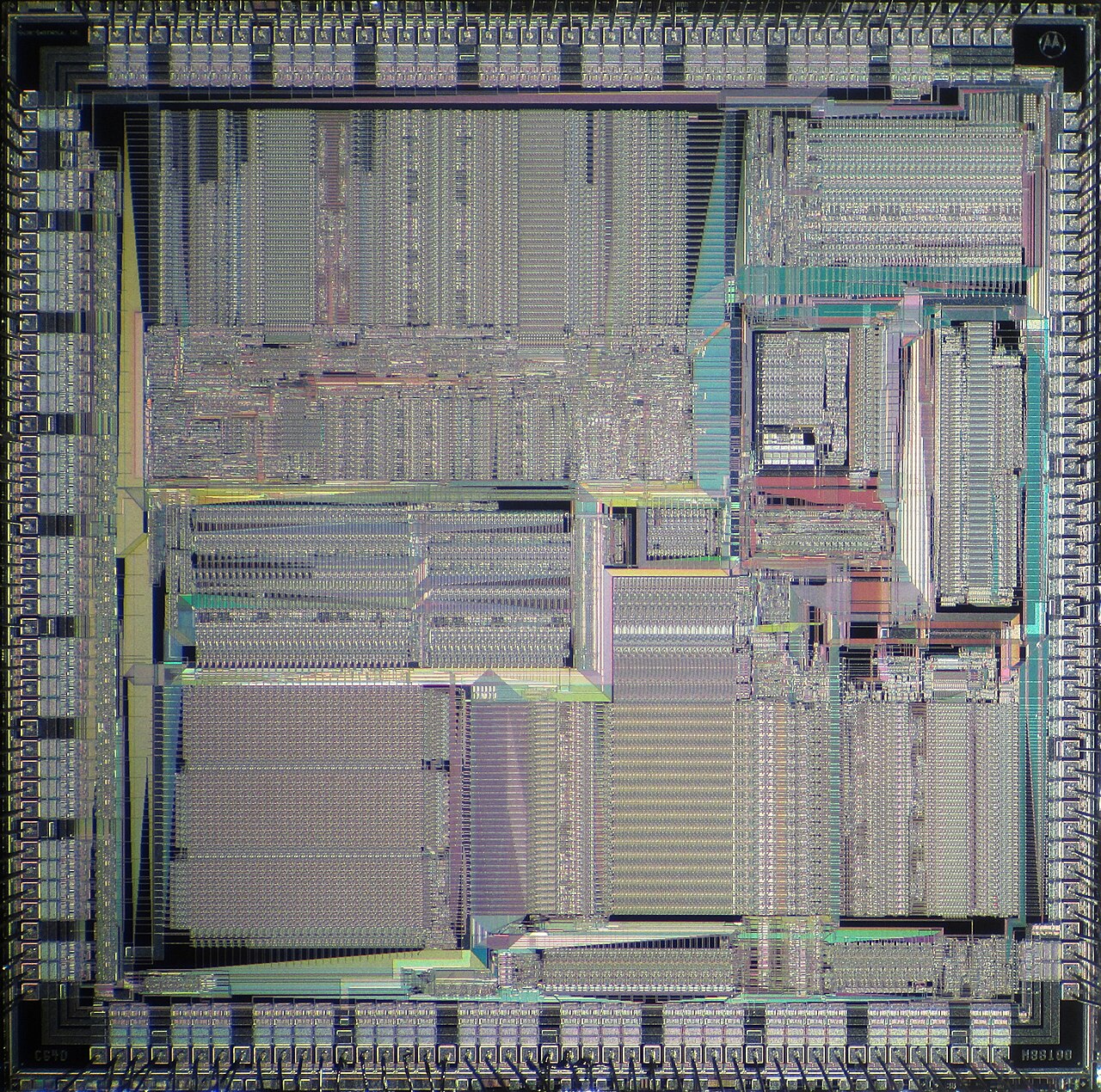
Motorola's late RISC contender, overshadowed by PowerPC.

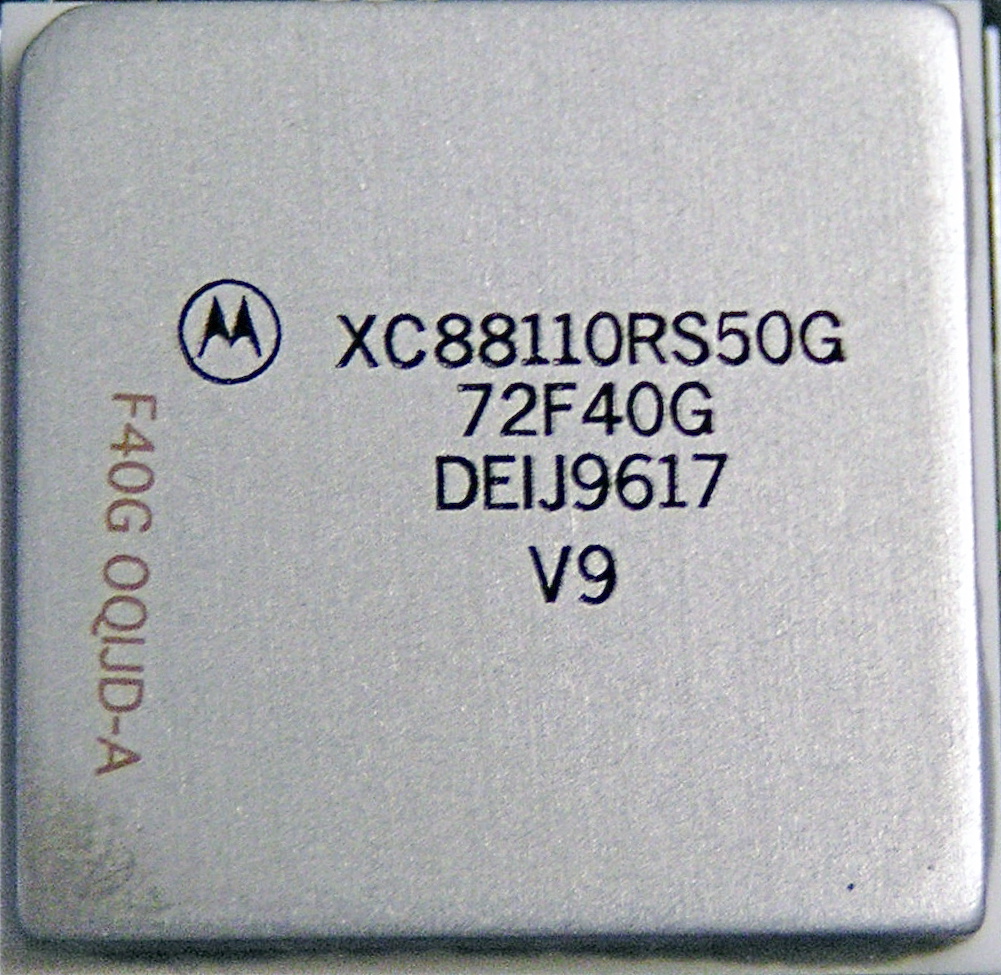
Pauli Rautakorpi · CC BY 3.0
The Motorola 88000, also known as the m88k, is a RISC instruction set architecture created by Mitch Alsup at Motorola in the 1980s. Its first implementation, the MC88100, was released in 1988, arriving about two years after competing RISC architectures like SPARC, MIPS, and ARM. Because of this late market entry and significant delays in bringing out the second-generation MC88110, the m88k saw only limited adoption, primarily within the MVME platform and embedded controller systems. When Motorola joined the AIM alliance in 1991 to develop the PowerPC, all further work on the 88000 was stopped.
In the early 1980s, Motorola was in a strong position. Its recently launched 68000 microprocessor easily outperformed other chips on the market, and its 32-bit design was a natural fit for the growing workstation market. Intel was not aggressively pursuing 32-bit processors, and other companies like National Semiconductor fumbled their releases, leaving Motorola in control of nearly all the non-Intel market. At the time, Intel held about 80% of the overall computer market, while Motorola had 90% of the rest.
The RISC concept emerged in the early 1980s, sparking intense debate over whether its longer machine language programs would actually slow performance due to extra memory accesses. This debate ended by the mid-1980s when the first RISC-based workstations appeared. A Sun-3/80 running a 20 MHz Motorola 68030 delivered about 3 MIPS, while a 16 MHz SPARC-based Sun-4/260 delivered 10 MIPS. Hewlett-Packard, DEC, and other major vendors all began moving to RISC platforms. This market shift threatened to lock Motorola out of the workstation market, one of its strongest and most profitable areas. Apple was Motorola's only major customer outside of workstations; other 68000 users like Atari and Commodore were struggling as the market standardized on IBM PC compatibles.
RISC designs were a deliberate attempt to tailor the processor to the operations compilers actually used, especially for C on Unix workstations. The IBM 801 project had shown that compilers rarely used most available instructions, preferring the simplest, fastest versions. The circuitry for the unused instructions added overhead even to the simplest version.
Quick Facts
- Designer
- Motorola
- Bits
- 32-bit
- Introduced
- 1988
- Design
- RISC
- Encoding
- Fixed
- Branching
- Compare and branch
- Endianness
- Bi
- Extensions
- Graphics instructions (88110 only)
- Open
- No
- Gpr
- 32 32-bit
- Fpr
- 32 80-bit (88110 only)
Facts from the source article.
Lore & Background
Motorola entered the 1980s in a position of strength with the 68000, which easily outperformed any other microprocessor and controlled 90% of the non-Intel market. The introduction of the RISC concept in the early 1980s sparked intense debate over whether it would improve performance or slow execution through additional memory accesses. That debate ended by the mid-1980s when the first RISC-based workstations emerged: a 20 MHz Motorola 68030 delivered about 3 MIPS, while a 16 MHz SPARC delivered 10 MIPS. This shift threatened to lock Motorola out of the lucrative workstation market.
Motorola's design approach consciously tailored the processor to compiler behavior, taking notes from the CDC 6600 supercomputer. It adopted scoreboarding, which allowed the CPU to examine instruction register use and immediately dispatch those not dependent on incomplete calculations, improving usage by up to 35%. The design used separate data and instruction address buses, costing 128 pins on the P-bus. Internally there were three 32-bit buses. The design also included built-in support for specialized co-processors called special function units (SFUs), with SFU1 being the floating point unit. Branch and jump instructions incorporated a delayed branch option (.n).
As a side-effect of complexity, the CPU did not fit on a single chip. The MC88100 packaged the ALU and FPU together, while the MC88200 contained the MMU and 16 KB static RAM cache. A practical 88000 system could not be built without at least one MC88200. Aimed at the high-end market, it was claimed to be the fastest 32-bit processor at release. Motorola marketed it strictly to high-end applications while suggesting the 68k series would continue in workstations, but most potential customers ignored it.
Reader's Guide
The 88000's significance lies primarily in its role as a transitional design that failed to gain market traction despite strong technical specifications. Its late arrival in 1988, two years after competing RISC architectures, placed it at a disadvantage from the start. The extensive delays in releasing the second-generation MC88110 until 1992 further eroded interest; companies such as NeXT, Apple Computer and Apollo Computer had examined the 88000 series but all gave up by the time the 88110 was available. An attempt to popularize the system through the 88open group, similar to Sun's efforts with SPARC, appears to have failed in any practical sense. When Motorola joined the AIM alliance in 1991 to develop the PowerPC, further development of the 88000 ended. The architecture contributed some features—such as a compatible bus interface—to the new PowerPC design, offering an upgrade path for existing customers. The 88000 thus stands as a technically capable but commercially unsuccessful RISC processor, ultimately abandoned in favor of the PowerPC.
Did You Know?
- The 88000 design adopted the scoreboarding concept from the CDC 6600 supercomputer.
- The MC88100 and MC88200 each contained 750,000 transistors.
- The 88000 set aside blocks of 256 instructions for use by co-processors called special function units (SFUs).
Architectural Vision: Borrowing from the Supercomputer Era
The Motorola 88000 was conceived with a singular ambition: to become the fastest microprocessor on the planet. Rather than simply copying existing RISC designs already in the market, the team led by Mitch Alsup looked backward to the CDC 66000 supercomputer and borrowed its scoreboard mechanism. This allowed the processor to examine register dependencies and immediately dispatch instructions whose data was already available, reordering execution to keep the pipeline busy while others waited on memory. That reordering could boost throughput by roughly 35 percent. The chip also featured separate instruction and data address buses, a costly choice that consumed 128 pins on the P-bus, justified by the observation that only about a third of operations actually touched memory. Caches and memory management units sat outside the core, with up to four controllers attachable to each bus. Perhaps most forward-thinking was the special function unit framework: 256 reserved instruction slots let designers bolt on custom co-processors without breaking software compatibility, with the floating-point unit already occupying the first slot.
A Cornered Giant: Why Motorola Had No Choice
Motorola walked into the 1980s riding the coattails of the 68000, a 32-bit workhorse that dominated the non-Intel segment of the market. With Intel holding roughly 80 percent of overall computer sales, Motorola effectively controlled the remaining 20 percent, and its 68000 was the natural choice for emerging Unix workstations. Then the RISC revolution arrived. Early in the decade, industry pundits argued fiercely over whether simpler instruction sets could truly outperform complex ones, but by the mid-1980s the debate was settled: a 16 MHz SPARC in a Sun-4/260 delivered ten MIPS while a 20 MHz 68030 in a Sun-3/80 managed only three. Hewlett-Packard, DEC, and other major vendors pivoted toward RISC platforms. For Motorola, the workstation segment was one of its most lucrative strongholds, and losing it would be catastrophic. Apple remained its only major customer outside that space, while other 68000 users like Atari and Commodore were struggling in a market consolidating around IBM PC compatibles. The 88000 was, in essence, a survival play.
From '78000' to 88000: A Late Arrival
By 1987, word had spread through the industry that Motorola was building its own RISC processor. Trade press dubbed it the '78000,' a playful nod to the beloved 68000 that had defined the company's previous decade. When the chip finally shipped in April 1988 under the official name 88000 (or m88k in shorthand), it was already two years behind the SPARC, MIPS, and ARM processors that had established themselves in the market. The MC88100, the first commercial version, carried the weight of an ambitious but complex design. That complexity had a tangible cost: the processor could not be fabricated on a single die, unlike its 68030 predecessor from just a year earlier. The design philosophy explicitly avoided the word 'RISC' in Motorola's own documentation, preferring to describe single-cycle operations and large register files as hallmarks of their approach. The stated goal was not to match existing RISC chips but to surpass them all, making the 88000 the most powerful processor available.
A Promising Start, a Quiet End
Despite its impressive architectural pedigree, the 88000 never found a broad audience. The two-year head start enjoyed by SPARC, MIPS, and ARM meant that by the time the MC88100 reached the market, those competing architectures already had established software ecosystems and vendor commitments. Motorola's own delays in shipping the second-generation MC88110 compounded the problem, leaving the m88k largely confined to the company's internal MVME embedded platform and niche controller applications. The processor simply could not break out of Motorola's own product lines to attract the third-party vendors and operating system support it needed to compete. The final blow came in 1991, when Motorola entered the AIM alliance alongside Apple and IBM to co-develop the PowerPC architecture. That partnership redirected the company's engineering resources and strategic focus away from the 88000, and further development of the m88k line effectively ceased. What had been conceived as the world's fastest microprocessor became a footnote in the broader RISC wars, remembered primarily for its elegant scoreboard design and the ambition that drove its creation.
Gallery
Frequently Asked Questions
What is the Motorola 88000 and who designed it?
The Motorola 88000, nicknamed m88k, is a RISC instruction set architecture that Mitch Alsup developed at Motorola during the 1980s. It was meant to be the company's in-house answer to the wave of new RISC designs appearing from other chipmakers.
When did the Motorola 88000 launch and how did it compare to its rivals?
The first silicon, the MC88100, shipped in 1988, roughly two years after SPARC, MIPS, and ARM had already entered the market. That late arrival, compounded by long delays on the second-generation MC88110, prevented the architecture from building a serious installed base.
What were the headline specs of the MC88100?
The MC88100 contained 750,000 transistors and operated at 20 MHz, with a 25 MHz variant also offered. At its 20 MHz rating it produced around 34,000 Dhrystones or 17 VUPS of throughput.
Where was the Motorola 88000 actually used in the wild?
Deployment stayed narrow, centered on Motorola's MVME single-board computer platform and assorted embedded-controller applications. It never achieved a foothold in the broader workstation or server segments.
What ultimately killed the Motorola 88000 project?
In 1991 Motorola joined the AIM alliance to co-develop the PowerPC, and every remaining 88000 initiative was terminated as a direct consequence. The m88k is now remembered mainly as a late, overshadowed RISC contender that never got the chance to compete on equal footing.
More in Microprocessors, Part 3 1-24
Spotted an error? Know more?
Reader corrections go straight into our review queue. Suggest an edit · How this site is sourced