
Motorola 68020
Motorola's fully 32-bit microprocessor, released in 1984.

Pauli Rautakorpi · CC BY 3.0
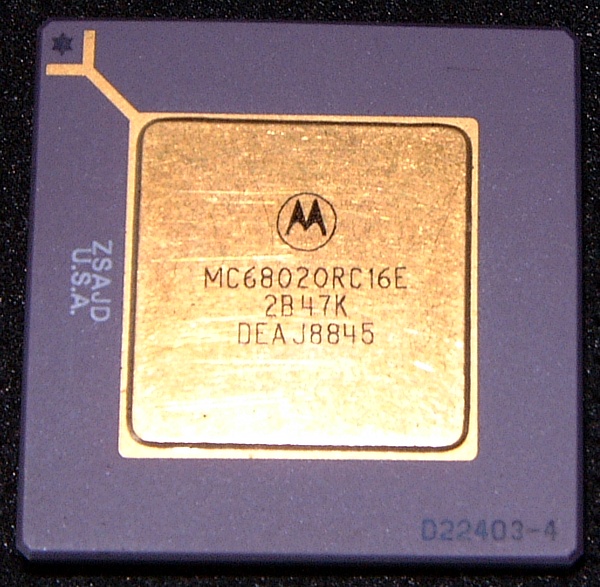
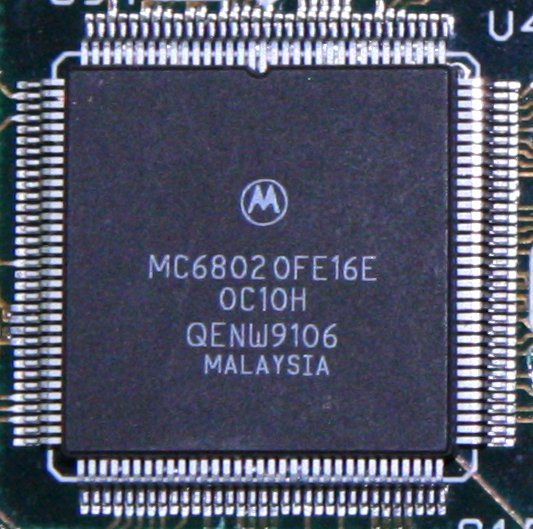
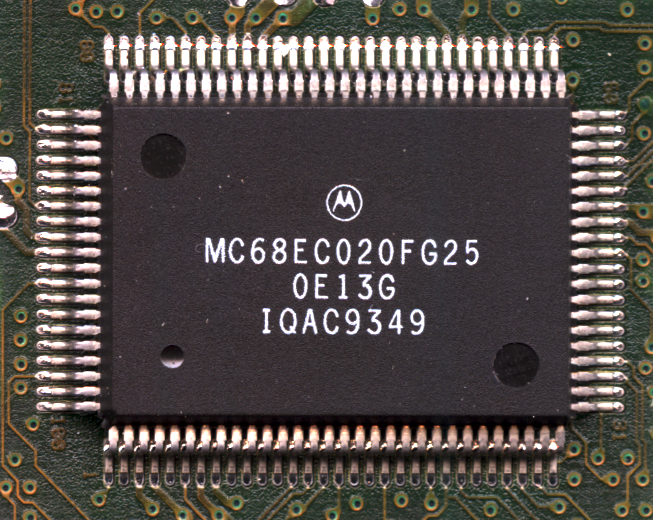
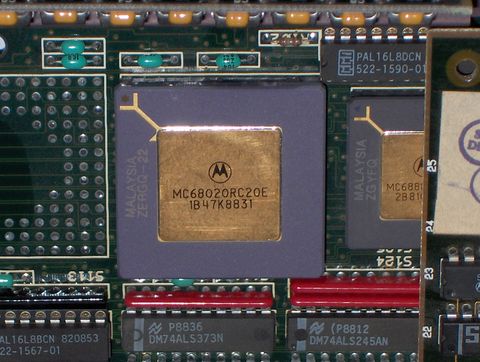
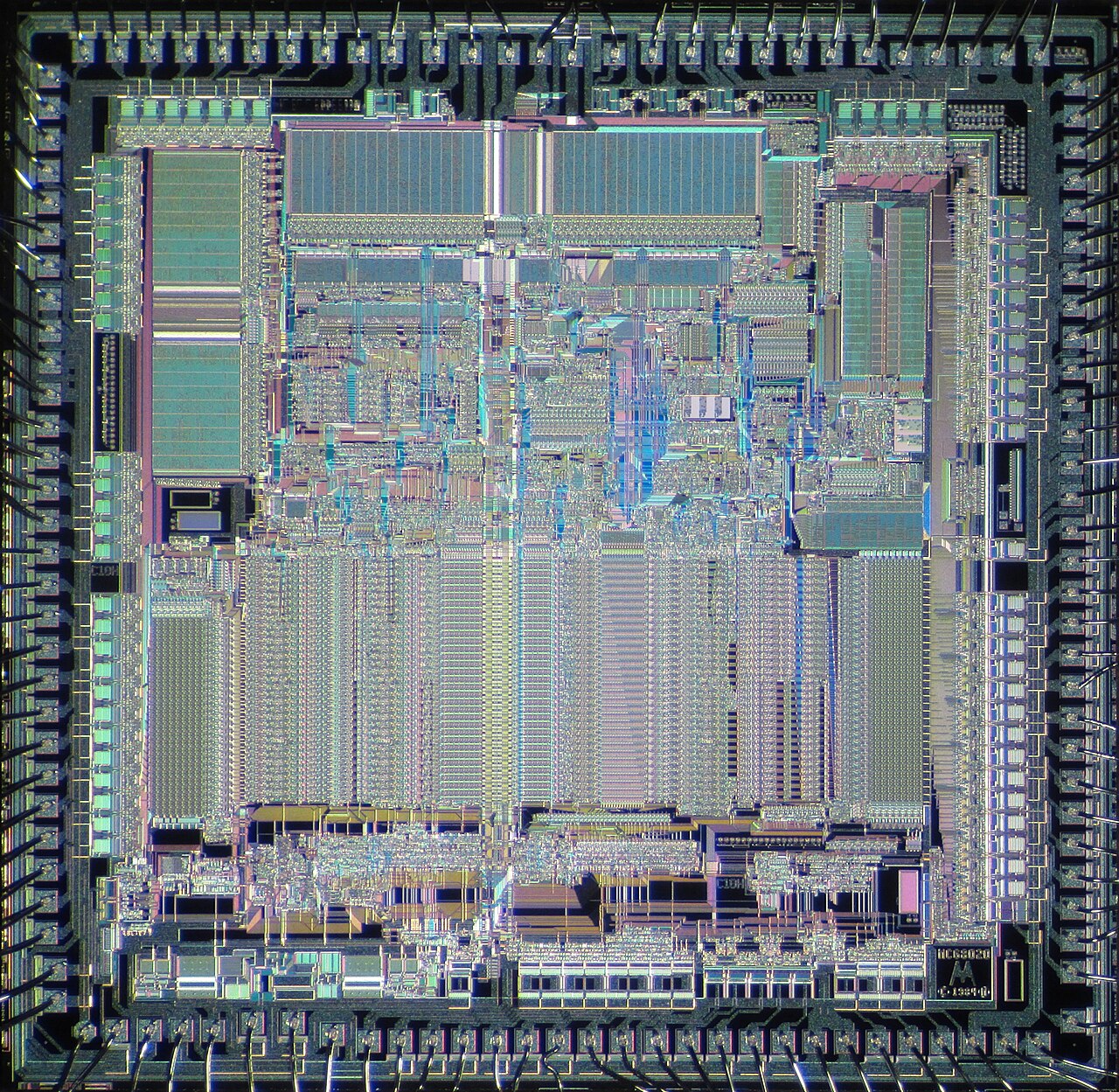
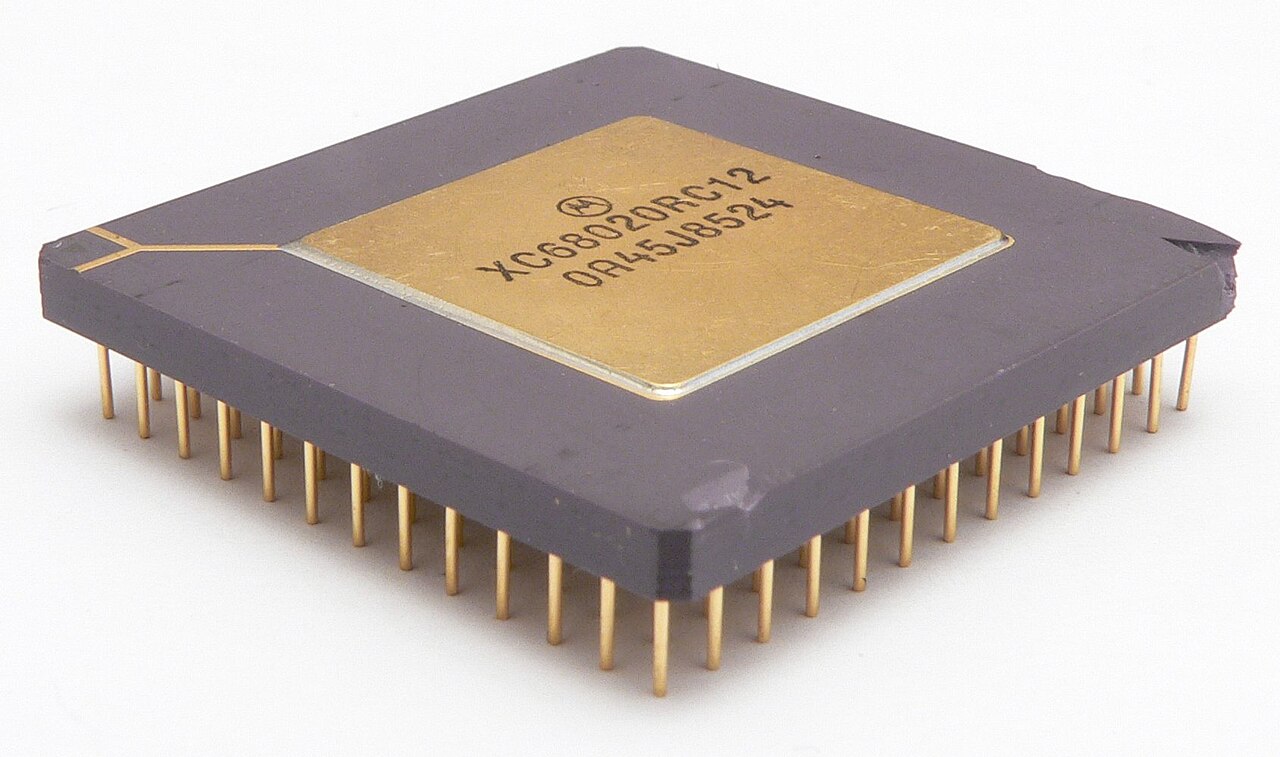
The Motorola 68020 is a 32-bit microprocessor released by Motorola in 1984. It is often referred to as the '020', pronounced 'oh-two-oh' or 'oh-twenty'. A lower-cost version, the 68EC020, was also made available. The 68020 was notable for its fully 32-bit internal and external data and address buses, a significant advancement over earlier 680x0 models.
Quick Facts
- Designfirm
- Motorola
- Arch
- Motorola 68000 series
- Data-Width
- 32 bits
- Slowest
- 12.5
- Slow-Unit
- MHz
- Fastest
- 33
- Transistors
- ~200,000577
- Variant
- 68EC020
- Predecessor
- Motorola 68010
- Successor
- Motorola 68030
Facts from the source article.
Lore & Background
The 68020 emerged from customer feedback during the development of the 68010, which pointed to a desire for a fully 32-bit implementation. The original 68000 had been a hybrid 16/32-bit design due to pin limitations of dual inline packages. By moving to a 169-pin pin grid array, the 68020 could accommodate 32-bit address and data buses, allowing faster data access and support for more than 16 MB of memory. The design also moved from NMOS to CMOS logic, though there was debate within Motorola about marketing this change due to a perception that 'CMOS equals bad'.
The design was completed in summer 1983 and announced in June 1984. However, production faced severe yield problems at the MOS-8 factory, where the yield was initially zero. After replacing the floor manager and addressing issues with a new tungsten silicide machine from Genus, volume deliveries began late that year. Workstation customers had already developed systems ready to use the 020 and the Motorola 68881 floating-point unit, and systems reached the market five or six months after the announcement.
The 68020 was in the market for a relatively short time. The Motorola 68030 was announced in September 1986 and began deliveries in summer 1987. Priced about the same as the 020, the 030 was significantly faster and quickly replaced the 020 in almost every use.
Reader's Guide
The 68020's significance lies in its introduction of a fully 32-bit architecture to the 68000 family, addressing the limitations of the earlier 16-bit data bus and 24-bit address bus. This allowed for faster memory access and larger addressable memory, which was becoming a limitation for Unix workstation users. The 020 also introduced a 32-bit ALU, enabling 32-bit operations in one clock cycle compared to the 68000's minimum of two. However, its market life was brief. The 68030, announced in September 1986, offered similar pricing but significantly higher performance, and could often serve as a drop-in replacement in designs using the 020. This led to the 030 quickly supplanting the 020 in almost every application. The first Macintosh using the 020, the Macintosh II, was released in March 1987, two years after the 020 became widely available. Only eighteen months later, the Macintosh IIx replaced it with the 030, offering 3.9 MIPS compared to the II's 2.6 at the same 16 MHz clock speed. The 020's production challenges at MOS-8, including a zero-yield period and the intervention of Bill Walker, highlight the difficulties of bringing advanced fabrication processes to volume production.
Did You Know?
- The 68020 was announced in June 1984 with a launch price of $487 each.
- Initial production yield at the MOS-8 factory was zero; volume deliveries began late in 1985 after production issues were resolved.
- The 68020 uses a 169-pin pin grid array, though only 114 pins were used in the design.
The Push Toward Full 32-Bit Architecture
The original 68000 was constrained by the physical limits of dual inline packages, which capped out at 64 pins. Motorola had to settle for 24 address pins and 16 data pins, capping addressable memory at 16 MB and forcing two bus cycles to read a single 32-bit word. When Motorola surveyed its customer base for future requirements, the feedback was unanimous: a fully 32-bit implementation was essential. Unix workstation buyers went further, stating they would purchase a floating-point unit for every machine if one were available. Meeting these demands meant abandoning the DIP entirely. By the early 1980s, the pin grid array had become the standard packaging for modern processors. Motorola selected a 169-pin layout for the new chip, ultimately utilizing only 114 of those positions. With 32 pins dedicated to both the address and data busses, the 020 could fetch data twice as quickly even without other architectural changes, and the expanded address space made virtual memory far more practical to implement.
The Zero-Yield Crisis at MOS-8
By the time the 020 was publicly released, the MOS-8 fabrication line was producing zero functional chips per wafer. Design lead Gary Johnson pinned the blame on floor manager Tom Felesi and decided to swap him out for Bill Walker, who had been running the older MOS-2 plant. Walker arrived on July 5, 1985, only to learn that Johnson had never actually told Felesi about the change, sparking a heated confrontation. Once the situation was resolved, Walker toured the facility and discovered it had devolved into something resembling an experimental R&D lab, cluttered with machinery used nowhere else in the company. One critical culprit was a tungsten silicide deposition unit from a vendor called Genus that simply refused to work. Walker flew to California to confront Genus's chief executive, who offered nothing but excuses. Walker slammed his hand on the desk hard enough to snap his watch band and declared he wanted the machine repaired that very day. Genus took the demand seriously. Walker also imposed a policy of calling production meetings at 6:30 AM, pulling them forward to 5:30 or even 4:30 when progress stalled. Volume deliveries finally began late that year.
A Brief but Significant Market Window
The 68020 hit the market in 1984 with a launch price of $487 per unit, roughly matching what the 68000 had cost at its own 1980 debut, though by that point the older chip had fallen to around $15. The New York Times treated the announcement as a lead story in its business section, hailing it as a "super chip." Motorola also produced a lower-cost variant designated the 68EC020. Despite the fanfare, the 020's commercial lifespan proved remarkably compressed. The Motorola 68030 was announced in September 1986 and began shipping in the summer of 1987. Priced at roughly the same level the 020 commanded at that time, the 030 delivered substantially higher performance and rapidly displaced the 020 in nearly every application. The 020's window of active market relevance was thus squeezed into barely three years, a vivid illustration of how quickly processor generations turned over in the mid-1980s.
The CMOS Gamble and Design Heritage
The 020 marked a fundamental shift in Motorola's fabrication philosophy. The original 68000 had been built using metal gates and enhancement-mode NMOS logic on 4-inch wafers, technology that was already dated even at its 1980 introduction. While smaller rivals like MOS Technology and Zilog had already adopted silicon gate depletion-mode NMOS on larger wafers, Motorola's team had deliberately chosen the older, proven process to minimize design risk. The move to modern techniques was deferred until after the 68000 reached the market, eventually materializing during the 68010 effort, a modest upgrade that added basic virtual memory support for the emerging Unix workstation segment. For the 020, Motorola transitioned to a CMOS layout built on the HMOS process licensed from Intel, fabricated on 5-inch wafers at the MOS-8 plant developed in partnership with Hitachi. The shift was commercially risky: prevailing industry wisdom held that CMOS cost roughly four times as much as NMOS, and a large segment of buyers equated the technology with inferior performance.
Gallery
Frequently Asked Questions
What is the Motorola 68020?
It is a 32-bit microprocessor that Motorola introduced in 1984, and fans typically call it the 'oh-two-oh.' The chip shipped in a 169-pin package and was offered at clock speeds ranging from 12 to 33 MHz.
How did the 68020 improve on the earlier 68000?
The 68020 moved both its internal and external data and address buses to a full 32-bit width, something the 16-bit 68000 generation could not do. That made it a genuine architectural step forward rather than merely a faster revision.
What was the 68020's launch price?
Motorola priced each 68020 at $487 when it hit the market in 1984. At that cost it was squarely aimed at workstations and high-end personal computers of the era.
Is there a lower-cost alternative to the 68020?
Yes, Motorola also produced the 68EC020 as a budget-friendly variant of the same core. It let designers get 68020-class performance without the full price tag of the standard part.
Why is the 68020 considered a milestone in microprocessor history?
It was among the first widely available parts to bring a true 32-bit architecture to desktop and workstation platforms in the mid-1980s. That transition helped pave the way for the 32-bit era that followed the 16-bit 68000 generation.
More in Microprocessors, Part 3 1-24
Spotted an error? Know more?
Reader corrections go straight into our review queue. Suggest an edit · How this site is sourced