
Motorola 68010
A 68000 successor adding virtualization and loop acceleration.

Seth Morabito · CC BY-SA 2.0
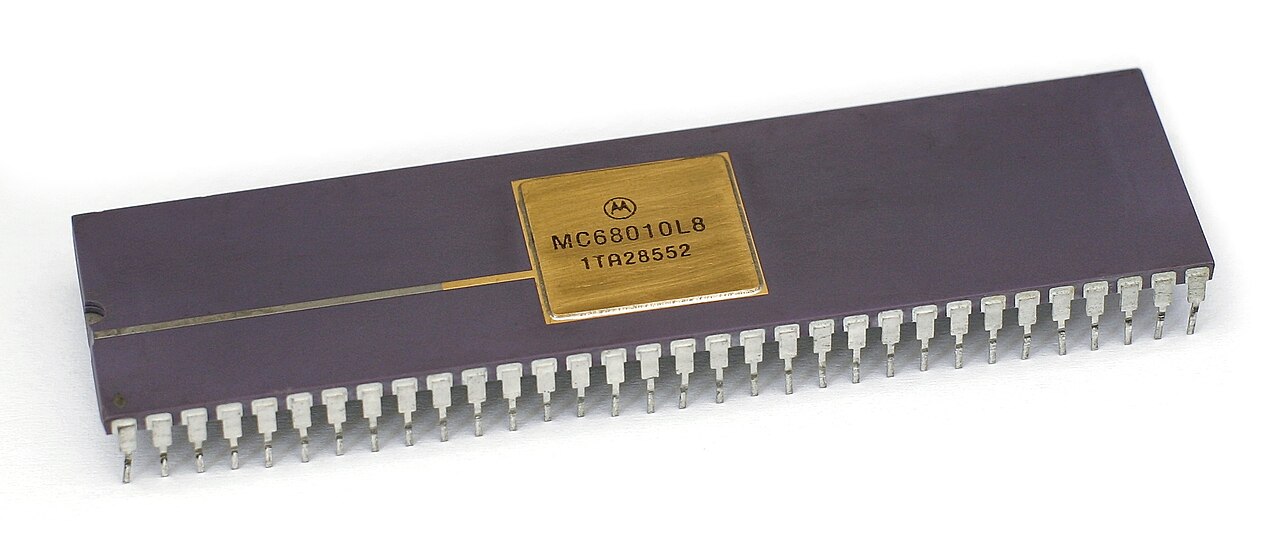
The Motorola MC68010 is a 16/32-bit microprocessor from Motorola, released in 1982 as a successor to the Motorola 68000. It added virtualization features, optimized loops, and fixed several small flaws of its predecessor, while remaining pin-compatible with the 68000.
Quick Facts
- Designfirm
- Motorola
- Produced-Start
- 1982
- Slowest
- 8
- Slow-Unit
- MHz
- Fastest
- 16.67
- Arch
- Motorola 68000 series
- Data-Width
- 16 bits
- Address-Width
- MC68010: 24 bitsMC68012: 31 bits
- Transistors
- 69,000
- Predecessor
- Motorola 68000
- Successor
- Motorola 68020
Facts from the source article.
Lore & Background
The 68010 and 68012 are completely user-mode compatible with the 68000, except that the MOVE from SR instruction traps in user mode, requiring a supervisor-mode trap handler to simulate the instruction. This change was made to meet the Popek and Goldberg virtualization requirements, allowing a new OS to run as guest without awareness. A new unprivileged MOVE from CCR instruction was added to compensate for the penalty of trapping user-mode MOVE from SR.
The 68010 can recover from bus faults and continue the faulting instruction, enabling virtual memory implementation. A 32-bit Vector Base Register (VBR) holds the base address for the exception vector table, unlike the 68000's fixed table at address zero. A 'loop mode' accelerates loops consisting of a loopable instruction and a DBcc instruction; the two-instruction mini-loop opcodes are prefetched and held in a 6-byte instruction cache, eliminating instruction opcode fetching during the loop and providing performance improvements averaging 50%.
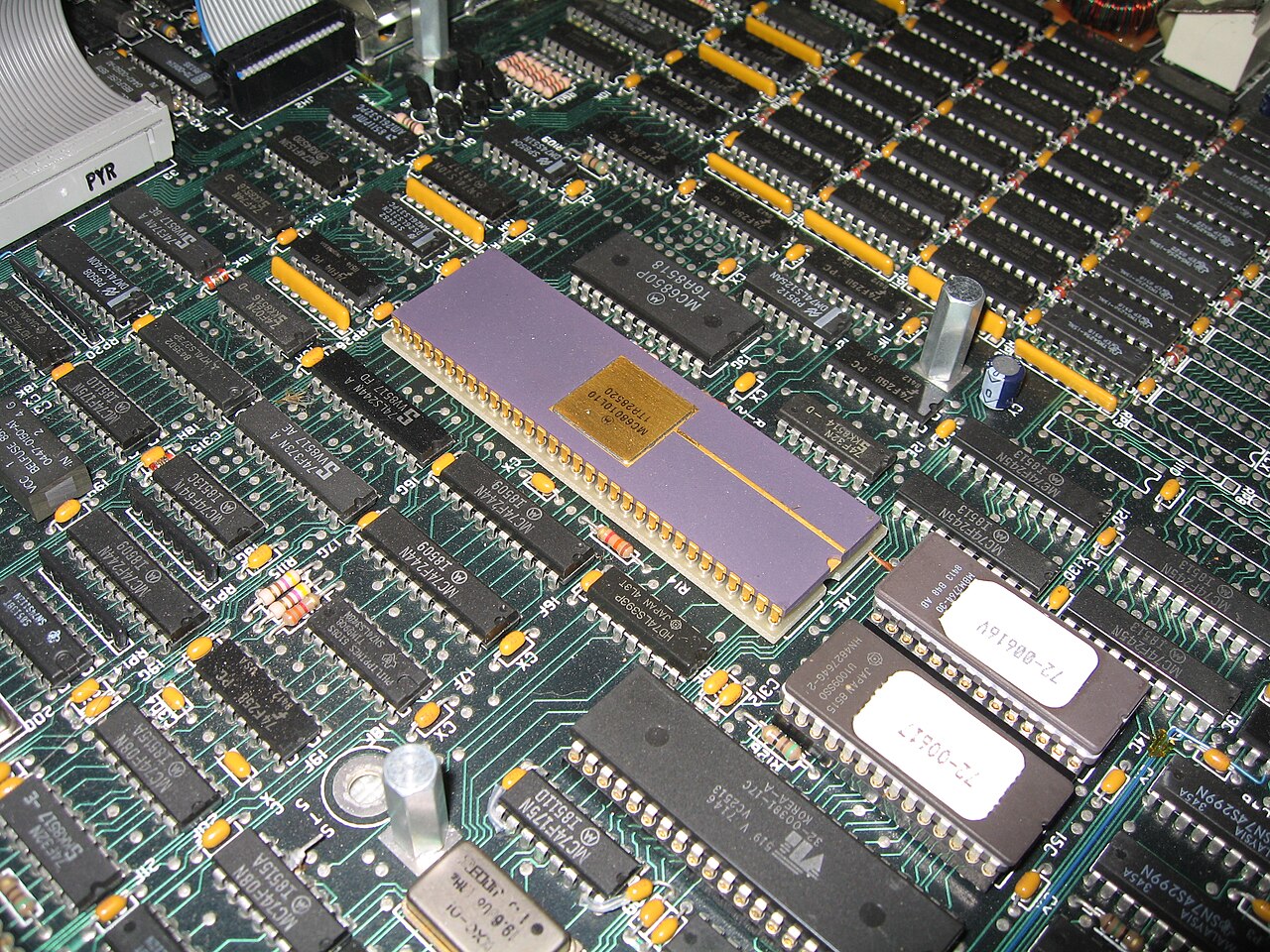
The 68010 could be used with the 68451 MMU, but aspects of its design, such as a 1-clock memory access penalty, made this configuration unpopular. Some vendors used their own MMU designs, such as Sun Microsystems in the Sun-2 workstation and Convergent Technologies in the AT&T UNIX PC/3B1.
Reader's Guide
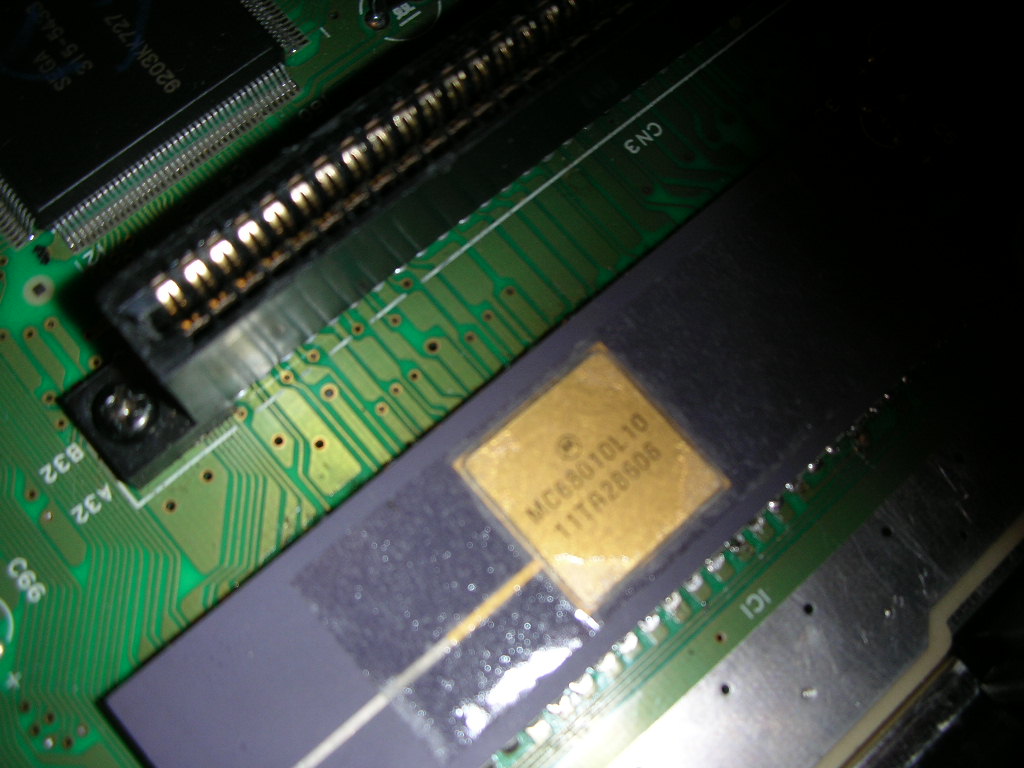
The 68010 was never as popular as the 68000 in the years when it was available. However, because of its small speed boost over the 68000 and its support for virtual memory, it can be found in a number of smaller Unix systems, both with the 68451 MMU (for example in the Torch Triple X) and with a custom MMU (such as the Sun-2 workstation, AT&T UNIX PC/3B1, Convergent Technologies MiniFrame, Plexus P/15 and P/20, NCR Tower XP, Apollo Computer's DN300 and DN320, and HP 9000 Model 310), as well as various research machines. Most other vendors (such as Apple Computer) stayed with the 68000 until the 68020 was introduced. The 68010 was used in some arcade games such as Marble Madness (1984) for the Atari System 1. Some owners of Amiga and Atari ST computers as well as Sega Genesis game consoles replaced their system's 68000 CPU with a 68010 to gain a small speed boost; in practice, the overall speed gain over a 68000 at the same frequency is less than 10%.
Did You Know?
- The 68010 and 68012 added virtualization features to meet the Popek and Goldberg requirements.
- A 'loop mode' accelerated two-instruction loops by caching opcodes, yielding average performance improvements of 50%.
- The 68010 was used in the Atari System 1 arcade game Marble Madness (1984).
Technical Identity and Key Improvements
The 68010 was a generation-one member of Motorola's 68000 family, designed as a 32-bit CISC microprocessor that was internally 16/32-bit and available with 8-, 16-, or 32-bit external interfaces. What set it apart from its predecessor, the 68000, was a focused set of enhancements aimed at memory management and arithmetic efficiency. Most notably, it introduced virtual memory support through restartable instructions, a capability that would prove critical for operating systems managing larger address spaces. The chip also featured a loop mode that accelerated string and memory library primitives, making repetitive data operations noticeably faster. Its multiply instruction was refined to consume 14 fewer clock ticks than the 68000's version, a small but meaningful gain in a CISC architecture where instruction timing directly affected performance. The closely related 68012 variant extended directly accessible memory to 2 GiB, pushing the boundary of what a single processor could address without additional hardware. Together, these refinements positioned the 68010 as a practical stepping stone between the original 68000 and the more ambitious fully 32-bit designs that followed.
The 68k Ecosystem and Industry Reach
During the 1980s and into the early 1990s, the 68000 family—of which the 68010 was a member—established itself as the primary rival to Intel's x86 processors in personal computing and workstations. The breadth of its adoption was remarkable: it powered the early Apple Macintosh, the Commodore Amiga, the Atari ST and Falcon, the Sega Genesis and Sega CD, the Sinclair QL, and the Sharp X68000. In the professional and server space, it was the processor of choice for AT&T's UNIX PC, Tandy's Model 16/16B/6000, Sun Microsystems' Sun-1, Sun-2, and Sun-3, the NeXT Computer and its successors, and early Silicon Graphics IRIS workstations. The family even found its way into the Palm Pilot on Palm OS 4.x and earlier, Texas Instruments' TI-89 and TI-92 calculators, and radiation-hardened versions in the Space Shuttle's critical control systems. This extraordinary range—from handheld devices to orbital spacecraft—underscored the architecture's versatility and the confidence the industry placed in it as a general-purpose computing foundation.
Architectural Lineage and Generational Progression
The 68010 occupied a specific and transitional position within Motorola's four-generation 68k lineage. As a generation-one chip, it shared the internally 16/32-bit design philosophy with the original 68000, the 68012, and their EC and SEC variants, all of which offered 8-, 16-, or 32-bit external interfaces. This generation represented the architecture's proving ground, establishing the CISC instruction set and register model that would carry forward. The next generation, the 68020 and 68030, moved to fully 32-bit internal operation, added a three-stage pipeline, an instruction cache, and unrestricted word and longword data access. Generation three, the 68040, introduced a six-stage pipeline, 4 KB split caches, and an on-chip floating-point unit. The final generation, the 68060, pushed further with a 10-stage pipeline, 8 KB caches, branch prediction, and a dual instruction pipeline. The 68010's role in this progression was that of a refinement and bridge—carrying forward the 68000's core design while adding the memory management and arithmetic improvements that made the architecture more competitive with x86 in the mid-1980s.
Legacy and the Transition to PowerPC
Motorola's development of the 68000 series architecture came to an end in 1994, marking the close of an era that had defined a generation of computing. The company replaced the CISC-based 68k line with PowerPC, a RISC architecture developed jointly with IBM and Apple Computer under the AIM alliance. This transition reflected a broader industry shift away from complex instruction sets toward the streamlined, high-throughput design philosophy of RISC processors. While no modern general-purpose computers today rely on 68000-series processors, the architecture's DNA persists in embedded systems, where derivatives continue to serve in specialized applications. The 68k family's influence also extended into adjacent fields: early Adobe PostScript interpreters were 68000-based, and the processors powered arcade boards from Sega, Capcom, and SNK, as well as video editing systems like the Quantel Paintbox and the MacroSystem Casablanca. The 68010, as a member of this family, contributed to a computing landscape that spanned desktops, game consoles, workstations, and spacecraft before the industry collectively pivoted toward new architectural paradigms.
Gallery
Frequently Asked Questions
What is the Motorola 68010?
The MC68010 is a 16/32-bit microprocessor that Motorola shipped in 1982 as the direct successor to the 68000. It kept the same pin layout as its predecessor while introducing virtual memory support and loop-optimization features.
What new capabilities did the 68010 bring over the 68000?
It added bus-fault recovery, which unlocked virtualization, and it accelerated loop execution through dedicated optimizations. It also corrected several minor design flaws that had been present in the original 68000.
Is the 68010 a drop-in replacement for the 68000?
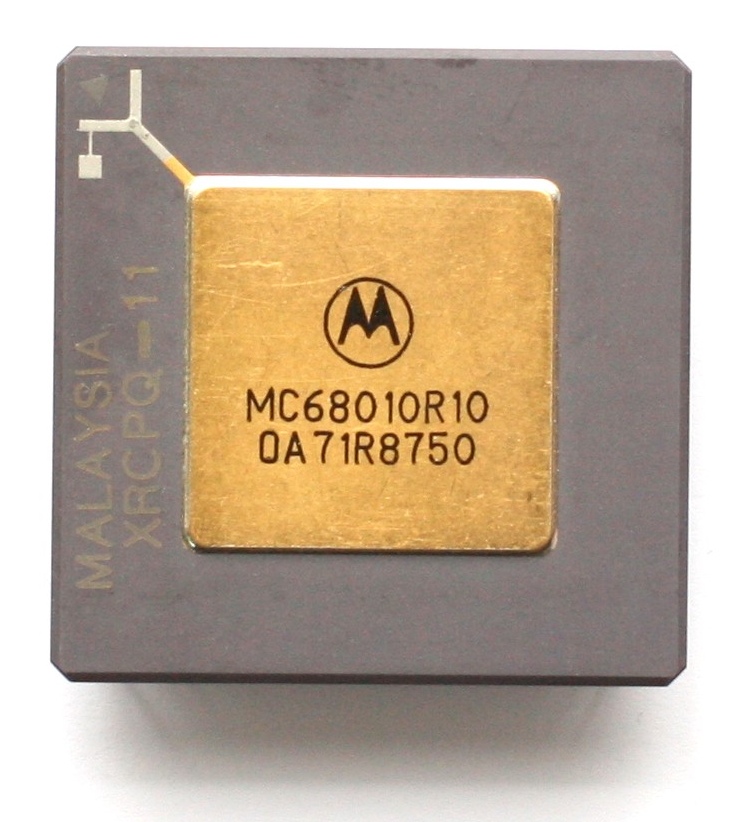
Yes—Motorola designed it to be fully pin-compatible with the 68000, so existing boards could accept the chip without any hardware redesign. It was offered in both DIP and PGA packages.
When did the Motorola 68010 hit the market?
It was released in 1982, placing it as the immediate next step in Motorola's 68k family right after the 68000.
Why is the 68010 considered important in microprocessor history?
It demonstrated that a processor could gain virtualization and performance improvements while remaining backward-compatible at the pin level. That upgrade philosophy shaped how later generations in the 68k line handled successive revisions.
More in Microprocessors, Part 3 1-24
Spotted an error? Know more?
Reader corrections go straight into our review queue. Suggest an edit · How this site is sourced