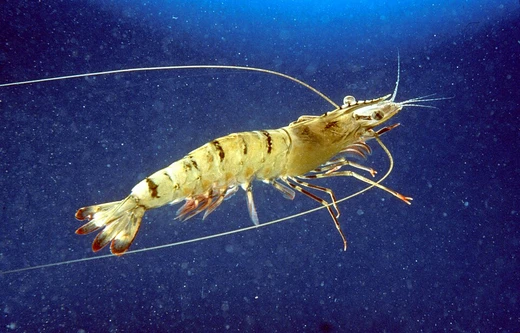
Saron marmoratus
A hunch-backed cleaner shrimp popular in the aquarium trade.

Saron marmoratus, called the marbled shrimp, is a cleaner shrimp from the family Hippolytidae. It lives in the Indo-Pacific and was spotted off Lebanon’s coast in 2013, likely after migrating through the Suez Canal from the Red Sea into the Mediterranean. Its easy care makes it a popular aquarium choice.
This shrimp has a hunched back. Its rostrum is slightly longer than its carapace and curves strongly backward, with one or two spines on its upper edge and three or four more on the carapace. The carapace’s lower edge has eight to ten long spines. Tufts of setae cover the carapace’s upper edge and the abdomen, thicker in females. Males have elongated claws longer than their body, while females have a brush-like setae structure on their first pair of legs. The legs show brown or blue bands. Body color varies—red, blue, or brown, mottled with brown or green.
Its range stretches from the Red Sea south to Madagascar and Mozambique, east through the Persian Gulf, India, and Southeast Asia across the southern Pacific to Australia and Hawaii. In 2013, specimens appeared near underwater caves off Lebanon, suggesting a Lessepsian migration from the Red Sea into the Levantine Sea.
It is occasionally seen on reefs but more often among coral and rubble in shallow lagoons. An inactive species, it relies on camouflage against encrusted surfaces. When threatened, it sneaks into hiding, but if danger is immediate, it darts away quickly and far. Nocturnal, it can shift body color to red at night for twilight camouflage. It is omnivorous, sifting fine substrate for detritus, plankton, and other food, and scavenges larger items like dead fish. It rarely forages below 12 meters and stays near reefs. It also eats coral and polyps.
The marbled shrimp is in high demand for aquariums, fetching good prices. European specimens usually come from the Red Sea; North American ones from Hawaii.
Quick Facts
- Genus
- Saron
- Species
- marmoratus
Facts from the source article.
Lore & Background
Saron marmoratus is a hunch-backed species of shrimp. Its rostrum is slightly longer than its carapace and strongly recurved, with 1 or 2 spines on its dorsal margin, followed by 3 or 4 spines on the carapace, and 8–10 long spines on the ventral margin. The dorsal margin of the carapace and abdomen have tufts of setae, denser in females. Males have elongated chelae longer than the body; females possess an obvious brush-like structure of setae on the first pair of legs. The legs feature brown or blue transverse bands. The ground color can be red, blue, or brown, mottled with brown or green.
It is occasionally seen on reefs but more frequently among coral and coral rubble in lagoons. It is quite inactive and relies on camouflage against encrusted substrate. When threatened, it quickly but stealthily swims into hiding, but can shoot off very quickly if immediate danger threatens. It is nocturnal and can vary its body color, turning primarily red at night to camouflage in twilight.
Saron marmoratus is an omnivore that sifts through fine substrate at night for organic detritus, plankton, and other edible items. It also scavenges on larger food items such as fish that fall to the sea bed. It normally does not forage below 12 m in depth and tends to remain close to reefs. It has also been known to feed on coral and polyps.
Reader's Guide
Saron marmoratus is in high demand for the aquarium hobby and fetches good prices in the marine aquarium trade. Specimens on the European market are usually collected from the Red Sea, while those for sale in North America are collected in Hawaii. Its popularity stems from its easy care requirements, making it a common choice for marine aquarists. The species is also notable for its Lessepsian migration: in 2013, specimens were observed close to underwater caves off the coast of Lebanon, indicating a likely expansion from the Red Sea through the Suez Canal into the Levantine Sea. This migration highlights the species' adaptability and the broader ecological changes in the Mediterranean. Its variable coloration and nocturnal habits add to its appeal, though its reliance on camouflage and inactive nature mean it is not a highly active display animal. The species' ability to scavenge and feed on detritus makes it a useful cleaner in aquarium settings.
Did You Know?
- Saron marmoratus is a hunch-backed species of shrimp with a strongly recurved rostrum.
- In 2013, specimens were observed off the coast of Lebanon, likely via Lessepsian migration through the Suez Canal.
Frequently Asked Questions
What is Saron marmoratus?
Saron marmoratus, commonly called the marbled shrimp, is a hunch-backed cleaner shrimp in the family Hippolytidae. It is distinguished by its strongly backward-curving rostrum, spiny carapace edges, and tufts of setae along the upper carapace margin.
Where is Saron marmoratus found in the wild?
Its native range spans the Indo-Pacific, including the Red Sea, Madagascar, Mozambique, the Persian Gulf, India, southeast Asia, Australia, and Hawaii. In 2013 it was also recorded off Lebanon's coast, most likely having migrated into the Mediterranean through the Suez Canal from the Red Sea.
What does Saron marmoratus eat?
It is an omnivore that consumes organic detritus, plankton, and larger items such as fish, coral pieces, and polyps. It typically forages in the infralittoral to sublittoral zone and generally stays above roughly 12 meters of depth.
How does Saron marmoratus behave at night?
The marbled shrimp is nocturnal and spends daytime hours largely inactive, relying on camouflage to stay hidden. At night it can shift its body coloration to a reddish tone, a notable behavioral trait for the species.
Is Saron marmoratus easy to keep in a home aquarium?
Yes, its relatively low-maintenance care needs make it a popular pick among marine aquarium hobbyists. It is a peaceful cleaner shrimp that generally adapts well to captive conditions.
More in Marine Shrimp, Part 3 1-24
Spotted an error? Know more?
Reader corrections go straight into our review queue. Suggest an edit · How this site is sourced