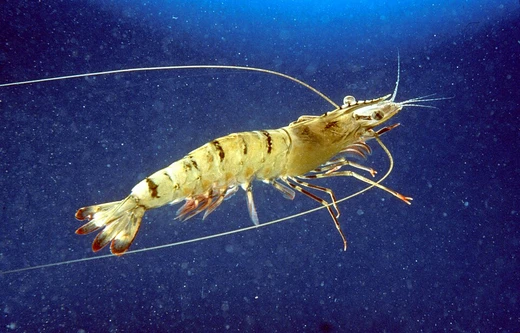
Allopontonia brockii
A small commensal shrimp of sea urchins in the Indo-Pacific.

Allopontonia brockii is a small shrimp that lives as a commensal on other animals, belonging to the family Palaemonidae. It is often mistaken for the crinoid squat lobster *Allogalathea elegans* because both have long claws, a similar cephalothorax shape, a slightly curved abdomen, and matching colors. However, *Allopontonia brockii* has a ridged, sharp rostrum with a notch, and its claws are smooth and lack spines. Its body ranges from light yellow to orange-red, with a wide whitish stripe that sometimes has a dark border. Adults reach a maximum length of 1 centimeter (0.4 inches).
This shrimp is found throughout the Indo-Pacific region, including the Red Sea, and along the eastern coast of the Pacific Ocean. It lives as a commensal on several species of sea urchins, such as those in the genera *Salmaciella*, *Salmacis*, *Asthenosoma*, and *Pseudoboletiana*. It is most commonly seen on the fire sea urchin *Asthenosoma varium*. The shrimp benefits by riding along as the urchin moves across the seafloor to feed, and it also eats any food particles that get caught on the urchin’s surface.
Quick Facts
- Genus
- Allopontonia
- Species
- brockii
Facts from the source article.
Lore & Background
Allopontonia brockii can be easily confused with Allogalathea elegans due to its long chelipeds, the visible shape of its cephalothorax, its abdomen slightly curved under the body, and its colours. However, it differs in that its rostrum is ridged, sharp, and notched, and its chelipeds are smooth without spines. The body coloration varies from light yellow to orange–red with a wide whitish longitudinal stripe sometimes lined with a dark border. It reaches a maximum length of 1 centimetre (0.4 in).
Reader's Guide
Allopontonia brockii is considered a commensal species associated with different species of sea urchins, including those of the genera Salmaciella, Salmacis, Asthenosoma, and Pseudoboletiana. It is usually observed on Asthenosoma varium, the fire sea urchin. The shrimp takes advantage of its host when it moves on the substratum to collect food during the way, and also benefits from potential food that may hang onto the sea urchin. Its distribution is widespread through the Indo-Pacific, including the Red Sea, and extends to the eastern coast of the Pacific Ocean. The species is part of the family Palaemonidae and is distinguished from similar-looking crustaceans by its rostrum and cheliped characteristics.
Did You Know?
- Allopontonia brockii can be confused with Allogalathea elegans due to similar body shape and coloration.
- Its rostrum is ridged, sharp, and notched, unlike the squat lobster it resembles.
- It is usually observed on the fire sea urchin Asthenosoma varium.
- The shrimp reaches a maximum length of only 1 centimetre (0.4 in).
More in Marine Shrimp, Part 3 1-24
Spotted an error? Know more?
Reader corrections go straight into our review queue. Suggest an edit · How this site is sourced