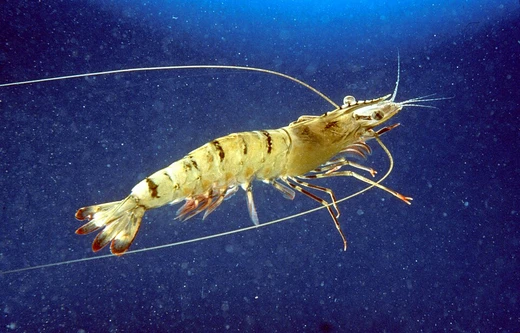
Pacific cleaner shrimp
A cleaner shrimp that removes parasites from fish.

The Pacific cleaner shrimp (Lysmata amboinensis) is an omnivorous shrimp species known for its symbiotic cleaning relationship with fish, eating parasites and dead tissue. It is a natural part of coral reef ecosystems, widespread across the tropics at depths of 5–40 metres, and is popular in home and public aquaria due to its striking colours and peaceful nature.
Quick Facts
- Genus
- Lysmata
- Species
- amboinensis
Facts from the source article.
Lore & Background
Lysmata amboinensis was described and named by Johannes Govertus de Man in 1888, and in the same year was also described as Hippolysmata vittata var. amboinensis, now considered a synonym. The shrimp has a long larval stage with 14 identified moult stages over 5–6 months, and unusual sexual maturation: each shrimp starts as male but becomes a functional hermaphrodite after several moults, a form unique among decapod crustaceans. Mature shrimp are pale with longitudinal bands on the carapace—one central white band flanked by wider scarlet red bands—and have long white antennae. They are commonly called skunk cleaner shrimp, white-banded cleaner shrimp, or scarlet cleaner shrimp in the aquarium trade.
Reader's Guide
Lysmata amboinensis is significant in both natural and captive settings. In the wild, it forms symbiotic cleaning relationships with client fish, performing a rocking dance to signal services at cleaning stations, and is often found in caves with moray eels for protection. In captivity, it is popular in home and public aquaria, sometimes used in touch pools where visitors can experience cleaning. Despite regular spawning, the species remains difficult to culture; the cycle from spawning to adult takes about 6 months with high larval mortality, so most sold are wild-caught. This has raised concern about removal from reefs, though no evidence of negative effects currently exists. Its cleaning services aid wound healing in fish, and it has been suggested as potentially useful to aquaculture. The shrimp is socially monogamous in captivity, with pairs showing aggression that can kill others if kept in groups larger than two; whether this occurs in the wild is unknown.
Did You Know?
- Each shrimp starts as male and becomes a functional hermaphrodite, a form called protandric simultaneous hermaphroditism unique among decapod crustaceans.
- The shrimp performs a rocking dance from side to side to signal cleaning services to approaching fish.
- In captivity, pairs are socially monogamous and may kill other shrimp if kept in groups larger than two.
- The species was described by Johannes Govertus de Man in 1888.
A Striking Form in the Shrimp World
Stenopus hispidus occupies a distinctive niche among marine crustaceans, classified as a shrimp-like decapod within the infraorder Stenopodidea. Over the years, aquarists and marine biologists have known it by several colorful common names—coral banded shrimp, banded boxer shrimp, and banded cleaner shrimp—each reflecting a different facet of its appearance or behavior. The animal reaches a modest total length of just sixty millimetres, yet its visual impact is anything but small. Beneath a transparent ground colour, the carapace, abdomen, and the notably enlarged third pereiopod display bold red-and-white banding, while the remaining appendages and the long antennae remain a clean white. Spines line the carapace, abdomen, and those prominent third legs, giving the shrimp a bristly silhouette against the reef. Perhaps most remarkable is a trait rarely seen in the invertebrate world: S. hispidus can recognize and detect members of its own species, a capacity most likely mediated by chemical signals rather than sight or sound.
A Citizen of Three Oceans
Few invertebrates boast a range as sweeping as that of Stenopus hispidus. The species enjoys a pan-tropical distribution that stretches well into certain temperate waters, making it a resident of all three major ocean basins. In the Atlantic, its footprint spans from the coastal waters off Canada and West Africa all the way south to Brazil, and it also thrives in the warm shallows of the Gulf of Mexico. Across the Indian Ocean, individuals have been recorded near Madagascar, along the coasts of India and Sri Lanka, and throughout the island chains of Southeast Asia. The Pacific range is equally impressive, extending from the waters off Eastern China southward to Australia, where the shrimp can be found as far south as Sydney, and even into New Zealand's territorial seas. Regardless of which ocean basin it inhabits, S. hispidus consistently favours coral reef environments, living below the intertidal zone and tolerating depths of up to two hundred and ten metres. This extraordinary breadth of distribution underscores the species' adaptability across a wide spectrum of tropical and subtropical reef ecosystems.
The Dance That Feeds a Reef
The most celebrated behaviour of Stenopus hispidus is its cleaning service, a symbiotic interaction that has made it a familiar sight on tropical reefs worldwide. The shrimp advertises its availability to passing fish through a deliberate, slow waving of its long white antennae. This display, often described as a dance, involves the animal remaining anchored near its home site on the reef while whipping its antennae out in a rhythmic side-to-side motion. The behaviour was first documented in a laboratory setting, and researchers now understand it functions as a clear signal to surrounding fish: the shrimp is ready to offer cleaning and, in return, to feed. Once a client approaches, S. hispidus deploys its three pairs of claws to meticulously pick parasites, fungal growths, and damaged tissue from the fish's body. In this way, a single small crustacean plays a disproportionately important role in reef health, acting as a mobile clinic that benefits both itself and the larger animals it tends.
Pair Bonds and Reef Territories
Beyond its cleaning trade, Stenopus hispidus exhibits a social structure that stands out in the crustacean world. The species is monogamous, meaning individuals form lasting pair bonds rather than seeking multiple mating partners. Within these pairs, females are typically the larger of the two, a pattern of sexual size dimorphism that is common but not universal among marine invertebrates. Each pair claims and defends a home territory measuring roughly one to two metres in diameter, a modest but well-defined patch of reef that serves as both shelter and the stage for the shrimp's cleaning displays. The pair remains close to this anchor point, using it as the base from which they extend their antennae to attract clients. This territorial fidelity, combined with monogamy, suggests a stable, low-mobility lifestyle for a creature that otherwise spends much of its time in active, animated display. Together, these traits paint a picture of a small, spiny shrimp leading a surprisingly committed and place-attached existence on the coral reef.
Frequently Asked Questions
Who is Pacific cleaner shrimp?
The Pacific cleaner shrimp (Lysmata amboinensis) is a small, brightly coloured marine crustacean that grows to roughly 5–6 cm in length. It is a well-known resident of tropical Indo-Pacific reefs, instantly recognisable by its bold red-and-white striped body.
What is Pacific cleaner shrimp's role in the reef?
It functions as a mobile cleaning station, picking parasites, mucus, and shed skin off the bodies of client fish in exchange for a meal. This mutualistic interaction keeps its fish partners healthier and helps sustain the broader coral-reef food web.
How does Pacific cleaner shrimp reproduce?
It practises protandric simultaneous hermaphroditism, so every individual can produce both sperm and eggs and will eventually shift into a male role. A single female may release 200 to 500 eggs per spawning, and the larvae pass through fourteen distinct developmental stages over five to six months before settling onto the reef.
Where and at what depth can you find Pacific cleaner shrimp?
It is widespread across tropical Pacific and Indian Ocean waters, typically inhabiting coral reefs between 5 and 40 metres below the surface. It favours crevices and overhangs where it can establish a cleaning station and wait for fish to approach.
Why is Pacific cleaner shrimp so popular in home and public aquariums?
Its vivid red-and-white colouring, compact size, and gentle temperament make it a visually striking yet low-impact addition to reef tanks. Hobbyists also appreciate its active foraging, which can help keep tank mates free of nuisance parasites.
More in Marine Shrimp, Part 3 1-24
Spotted an error? Know more?
Reader corrections go straight into our review queue. Suggest an edit · How this site is sourced