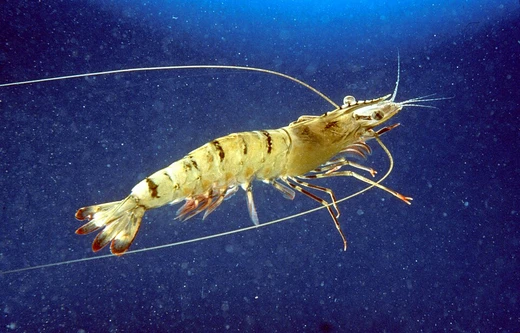
Ancylomenes magnificus
A cleaner shrimp of the Western Pacific, symbiotic with corals and anemones.

The magnificent anemone shrimp, *Ancylomenes magnificus*, is a cleaner shrimp found in the Western Pacific Ocean, living at depths between 3 and 29 metres. It is often seen on stony coral, the coral *Catalaphyllia*, and the sea anemone *Dofleinia armata*.
As an arthropod, its body is segmented and bilaterally symmetrical. A hard external skeleton made of chitin, which it sheds periodically through molting, covers its body. The shrimp has a compressed form made up of a cephalothorax (head and thorax fused together) and an elongated abdomen. It has five pairs of walking legs, two pairs of antennae, a mandible, and three pairs of maxillipeds. Most individuals have a transparent body, but the carapace and abdominal segments are marked with bands of white specks outlined in red. The tail and a hump on the abdomen are also white.
Like other shrimps in the family Palaemonidae, *A. magnificus* has separate sexes. After the female molts, her exoskeleton is soft, allowing the male to transfer a spermatophore to it. The female then produces a large number of eggs, which she carries under her abdomen until they hatch. The young emerge as larvae and go through several transformations to become adults. This species grows to about 2.5 centimetres (1 inch) in size.
Shrimps are generally scavengers, feeding on detritus, or filter feeders that consume small food particles. *A. magnificus* uses its mouth to take in food, which is then broken down by chitinous teeth lining its stomach. The stomach connects to digestive glands that secrete enzymes to absorb nutrients, and digestion ends at the anus.
Like many cleaner shrimps in the infraorder Caridea, *A. magnificus* forms symbiotic relationships with sponges, cnidarians, mollusks, fish, and other species. These are usually mutualistic: the shrimp provides cleaning services and excretes nitrogen, while its partner offers protection from predators and sometimes a food source. Because *A. magnificus* is relatively small and vulnerable on its own, it relies on other organisms like sea anemones or stony corals to live.
Quick Facts
- Genus
- Ancylomenes
- Species
- magnificus
Facts from the source article.
Lore & Background
Ancylomenes magnificus is an arthropod with a segmented, bilaterally symmetrical body covered by a hard exoskeleton made of chitin, which it periodically molts through ecdysis. Its compressed body consists of a cephalothorax (head and thorax) attached to an elongated abdomen. It has five pairs of pereiopods, two pairs of antennae, a mandible, and three pairs of maxillipeds. Most individuals have a transparent body, except for bands of white specks outlined in red on the carapace and abdominal segments; the tail and the hump on the abdomen are also white.
As a gonochoric species in the family Palaemonidae, reproduction occurs after the female molts, when her exoskeleton is soft. The male then transfers a spermatophore to her exoskeleton, enabling her to produce a large number of eggs, which she carries under her abdomen until they hatch. The eggs develop into larvae that undergo a series of transformations to become adult shrimp, growing up to 2.5 cm (1 in.) in size.
Feeding involves a mouth that ingests food, which is broken down by chitinous teeth lining the stomach. The stomach connects to digestive glands that secrete enzymes to absorb nutrients, with digestion ending at the anus. As a cleaner shrimp, A. magnificus engages in mutualistic symbiotic relationships with sponges, cnidarians, mollusks, fish, and other species, providing cleaning services and nitrogen excretion while receiving protection and sometimes food. Due to its small size and vulnerability, it relies on organisms such as sea anemones or stony corals for habitat.
Reader's Guide
Ancylomenes magnificus holds significance as a cleaner shrimp in the Western Pacific, contributing to the health of its host organisms through mutualistic relationships. The species is commonly associated with stony coral, Catalaphyllia, and the sea anemone Dofleinia armata, where it finds protection and food. Its role in cleaning services and nitrogen excretion benefits its hosts, while the shrimp gains safety from predators. This interdependence highlights the ecological importance of cleaner shrimps within their environments. The species' transparent body with distinctive white and red markings aids in identification. Its reproductive strategy, involving spermatophore transfer after molting and maternal egg carriage, ensures population continuity. As a relatively small and vulnerable organism, A. magnificus exemplifies the necessity of symbiotic partnerships for survival in marine ecosystems. The species' presence at depths of 3–29 metres indicates its adaptability to shallow reef environments. Its feeding mechanism, utilizing chitinous teeth and digestive glands, reflects typical crustacean digestion. Overall, A. magnificus serves as a model for understanding mutualism and the ecological roles of cleaner shrimps.
Did You Know?
- Ancylomenes magnificus is also known as the magnificent anemone shrimp.
- It is found in the Western Pacific Ocean at depths of 3–29 metres (10–95 ft).
More in Marine Shrimp, Part 3 1-24
Spotted an error? Know more?
Reader corrections go straight into our review queue. Suggest an edit · How this site is sourced