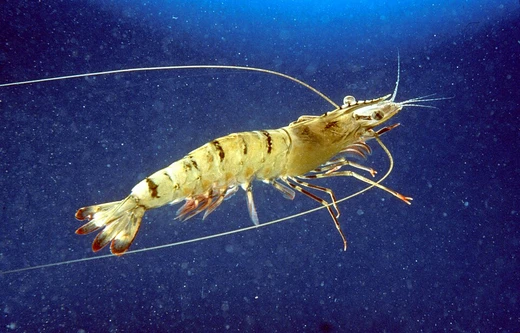
Paracrangon
Deep-sea shrimp lacking second pereopods, with a defensive cataleptic posture.

Paracrangon is a genus of deep-sea shrimp belonging to the family Crangonidae, inhabiting the Pacific coasts of North America, Asia, and Australia. These shrimp are set apart by several unique traits, most notably the complete absence of their second pair of pereopods—a feature not seen in related groups. They also have a partially flexible abdomen that lets them curl into a defensive cataleptic posture, and their carapace is covered in long spines. Paracrangon species are distinct among crangonid shrimp and are almost certainly descended from a single common ancestor. With the exception of the type species, Paracrangon echinata, all species in this genus are quite rare.
**Appearance** Because Paracrangon species lack second pereopods—limbs typically used for grooming—they are often found covered in detritus, hydroids, and bryozoans, which may help them blend into their surroundings. In some species, like P. furcata and P. ostlingos, the second pereopods are entirely missing; in others, only small buds remain. Their bodies are slightly flattened from side to side, with free eyes and a slender, nearly upright rostrum. The carapace is heavily sculpted, and the entire body is covered in short, curved setae. The cataleptic posture, also seen in a few other shrimp, involves flexing the abdomen upward at roughly a 45-degree angle, exposing the spines to ward off predators.
**Species** The genus includes these species: P. abei, P. areolata, P. australis, P. echinata, P. furcata, P. okutanii, and P. ostlingos.
**Paracrangon echinata** Also called the horned or spiked shrimp, Paracrangon echinata is the most common and widespread species. It is usually brownish with darker spots and is most closely related to P. abei. This shrimp lives at depths from the sublittoral zone down to 1,380 meters (4,530 feet). It was first described from Puget Sound in the Salish Sea, but its range extends along the North American Pacific coast from Alaska south to La Jolla, California, and in Asian waters it occurs in the Sea of Japan, the Sea of Okhotsk, and the Korea Strait. Its first pereopods have unusually long pollexes that articulate with the palms, and its third pair of pereopods are very fine, serving a sensory role similar to antennae—used to detect prey and probe the surroundings.
**Feeding habits** A 2011 study showed that P. echinata is a lie-in-wait predator.
Quick Facts
- Taxon
- Paracrangon
- Type Species
- Paracrangon echinada
- Type Species Authority
- Dana, 1852
Facts from the source article.
Lore & Background
Paracrangon species lack their second pereopods, and as they are often used for grooming, their absence may explain why they are frequently found covered with detritus, hydroids, and bryozoans. This may help them camouflage themselves in their surroundings. In some species (P. furcata, P. ostlingos), the second pereiopods are completely absent, while in all other species they are represented by small buds. Paracrangon species are slightly compressed laterally, have free eyes, and an elongated rostrum that is relatively slender and sub-erect. Their carapaces are strongly sculptured, and their bodies are covered with short, curved setae. The cataleptic posture, also assumed by some other shrimp, is a defensive posture in which the abdomen of the shrimp is flexed upwards at nearly a 45° degree angle, exposing their spines to any predators.
Reader's Guide
Paracrangon echinata, also known as the horned or spiked shrimp, is the most common and widespread species of the genus. It is usually brownish in colour, with darker spots, and is most closely related to P. abei. It is found in water depths ranging from sublittoral to 1,380 metres (4,530 ft). It was first described from Puget Sound in the Salish sea, but is found along the North American Pacific coast as far north as Alaska but no farther south than La Jolla, California; and, in Asian waters, in the seas of Japan and Okhotsk as well as the strait of Korea. The pollexes on their first pereiopods are unusually long, and articulate with their palms. The third pair of pereipods is very fine, and serve a sensory function similar to antennae. They are used to detect prey and probe the shrimp's surroundings. A 2011 study found that P. echinata is a lie-in-wait predator, feeding on smaller organisms, primarily amphipods (which constitute over 40% of the diet), polychaetes, and other carideans. The shrimp first detects its prey with its thin pair of third pereiopods, then grabs the prey with its first pair. All species except Paracrangon echinata, the type species, are quite rare.
Did You Know?
- Paracrangon species lack second pereopods, which may explain why they are often covered with detritus, hydroids, and bryozoans.
- The cataleptic posture involves flexing the abdomen upward at nearly a 45° angle to expose spines to predators.
- Paracrangon echinata is the type species and the most common and widespread species of the genus.
- A 2011 study found that Paracrangon echinata is a lie-in-wait predator, with amphipods constituting over 40% of its diet.
More in Marine Shrimp, Part 3 1-24
Spotted an error? Know more?
Reader corrections go straight into our review queue. Suggest an edit · How this site is sourced