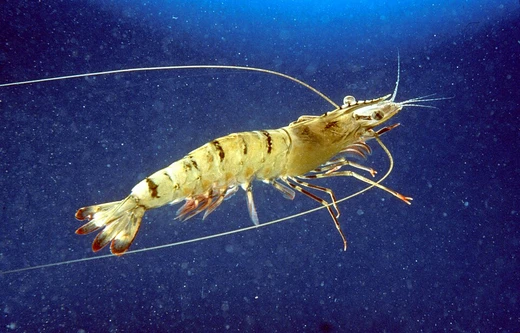
Peppermint shrimp
A common name for several visually similar Lysmata shrimp species.

In the marine aquarium hobby, "peppermint shrimp" is a catch-all term for several similar-looking species from the genus *Lysmata*. These shrimp are valued for cleaning up leftover food and for their cleaning behavior, and some are sought after to control outbreaks of *Aiptasia* anemones in reef tanks. Despite this common name, it does not point to a single species, and the label has often been used incorrectly in the trade.
The species most often called peppermint shrimp include:
- **Lysmata boggessi** – Regarded as the "true peppermint shrimp" by aquarists. Found in the Gulf of Mexico and western Atlantic, this is the only species in the group consistently shown—both in studies and in tanks—to eat *Aiptasia* anemones. - **Lysmata wurdemanni** – Once the standard peppermint shrimp, but now recognized as a group of hidden, closely related species. Many shrimp sold under this name were actually other species. It is not a reliable choice for *Aiptasia* control. - **Lysmata rathbunae** – Sometimes mistaken for a peppermint shrimp, especially in mixed shipments. It does not eat *Aiptasia* and is not used for pest management. - **Lysmata ankeri** and **Lysmata bahia** – Less common in the hobby but look similar to other peppermint shrimp. Their tendency to prey on *Aiptasia* is either inconsistent or not documented.
- Genus
- Lysmata
- Species most commonly referred to
- Lysmata boggessi, Lysmata wurdemanni, Lysmata rathbunae, Lysmata ankeri, Lysmata bahia
- Species considered true peppermint shrim
- Lysmata boggessi
- Native region of lysmata boggessi
- Gulf of Mexico and western Atlantic
- Species documented to consume aiptasia
- Lysmata boggessi
- Species not reliably associated with aip
- Lysmata wurdemanni
- Species not known to consume aiptasia
- Lysmata rathbunae
Lore & Background
The name peppermint shrimp has been widely misapplied within the aquarium hobby and trade, as it does not refer to a single species. Historically, Lysmata wurdemanni was referred to as the peppermint shrimp, but it is now known to comprise a complex of cryptic species, and many individuals formerly sold under that name were actually misidentified members of other species. Lysmata boggessi is considered the 'true peppermint shrimp' in the aquarium trade, native to the Gulf of Mexico and western Atlantic, and is the only species in this group consistently documented to consume Aiptasia anemones in both scientific studies and aquarium observations. Other species, such as Lysmata rathbunae, are occasionally misidentified as peppermint shrimp, particularly in mixed shipments, but are not known to consume Aiptasia. Lysmata ankeri and Lysmata bahia are less common in the trade but visually similar; their predatory behaviour toward Aiptasia is inconsistent or undocumented.
Reader's Guide
Peppermint shrimp are notable in the marine aquarium trade primarily for their scavenging and cleaning behaviour, and for the role some species play in pest control, specifically managing outbreaks of Aiptasia anemones in reef aquaria. The most significant species in this regard is Lysmata boggessi, the only one consistently documented to consume Aiptasia in both scientific studies and aquarium observations. This has led to its designation as the 'true peppermint shrimp' among hobbyists. However, the common name has been widely misapplied, causing confusion: many shrimp sold as peppermint shrimp are actually other species, such as Lysmata wurdemanni (which is not reliably associated with Aiptasia control) or Lysmata rathbunae (which does not consume Aiptasia). The legacy of this misapplication means that aquarists seeking effective Aiptasia control must carefully identify the species they acquire, as visual similarity among these Lysmata species does not guarantee the same pest-control behaviour. The inconsistent or undocumented predation by Lysmata ankeri and Lysmata bahia further underscores that the name alone is an unreliable indicator of function.
Did You Know?
- Peppermint shrimp is a common name for several visually similar species in the genus Lysmata.
- Lysmata wurdemanni was historically called peppermint shrimp but is now known to comprise a complex of cryptic species.
- Lysmata rathbunae is occasionally misidentified as a peppermint shrimp but is not known to consume Aiptasia.
Geography and Physical Setting
Isla Magueyes sits just fifty metres off the southwestern shore of Puerto Rico, a compact landmass of roughly 7.2 hectares wrapped in a ring of mangrove forest. The island's interior is dominated by dry scrub vegetation, and it is the dense stands of century plants—Agave americana, locally called maguey—that gave the isle its name. Beyond the mangrove fringe, the surrounding continental shelf is largely composed of coral reef, creating a rich underwater landscape that extends well past the shoreline. On the western tip, a cluster of buildings houses the Department of Marine Sciences at the University of Puerto Rico at Mayagüez, an institution widely regarded as a leading hub for tropical marine research in the Atlantic region. Its facilities include the Caribbean Coral Reef Institute, the ISER Caribe CIROM station, and collaborative ties with Sea Grant Puerto Rico. The island also hosts the Caribbean Coastal Ocean Observing System, or CARICOOS, which serves as the regional body coordinating coastal and ocean monitoring across Puerto Rico and the U.S. Virgin Islands.
The Iguana Colony and an Unplanned Sanctuary
In the 1950s, a zoo on Isla Magueyes shut its doors, and the Cuban iguanas it had housed were released onto the island. Over the decades, those animals multiplied into a free-ranging colony that now roams every corner of the isle. The situation is complicated: Cuban iguanas are endangered in their homeland and carry protection under the U.S. Endangered Species Act, yet on Isla Magueyes they are regarded as an invasive species, and there has been ongoing discussion about culling or reducing their numbers. To safeguard the iguanas, dogs, cats, and most visitors are prohibited from the island. That restriction has had an unexpected ecological side effect. With human and domestic-animal traffic largely eliminated, the isle has become an informal bird sanctuary where brown pelicans, cattle egrets, and herons are routinely spotted. The surrounding waters add further biodiversity, and research conducted here has uncovered sex-change behaviour in species such as the Bicolor Damselfish and the Nassau Grouper, as well as the description of a previously unknown peppermint shrimp, Lysmata jundalini. The iguana colony itself has served as a control group in studies of animal communication and evolutionary biology.
Institutional Origins and the Marine Mammal Era
Long before any laboratory was built, Isla Magueyes held cultural significance for the Igneri Neo-Indian peoples, whose artifacts—tools, household items, ornaments, idols, and shell disks crafted from snails, bivalves, and chitons—have been recovered from the island. The modern scientific era began in 1954, when Dr. Juan A. Rivero established the Isla Magueyes Marine Laboratories within the Institute of Marine Biology at what was then the College of Agricultural and Mechanical Arts, now the University of Puerto Rico at Mayagüez. That same year, Rivero and the university founded the Puerto Rico Zoological Garden on the isle, in La Parguera, Lajas, creating the first collection of live exotic animals in Puerto Rico for education and recreation. The zoo later moved to Mayagüez and reopened in 1984. From the 1950s through 1995, the island also served as a rehabilitation centre for marine mammals, many arriving already sick or injured. Its residents included bottlenose, Atlantic spotted, and Risso's dolphins, a baby sperm whale, West Indian manatees, and California sea lions. In 1957, Rivero founded the Association of Marine Laboratories of the Caribbean, with its first meeting held on the island.
Conservation, Coral Recovery, and Community Engagement
Isla Magueyes falls within the La Parguera Nature Reserve, a protected area whose ecosystem spans a remarkable range of habitats, from mangroves and seagrass beds to macroalgal communities, extensive coral reefs, emergent keys, and bioluminescent bays. Research carried out at the island's laboratories has documented the scarring that boat propellers inflict on seagrass beds and the resulting impact on organism abundance, tracked long-term declines in the Diadema antillarum sea-urchin population, and monitored ocean warming, acidification, and net ecosystem metabolic processes. ISER Caribe runs several projects aimed at coral ecosystem recovery and restoration, including the rearing of sea urchins, corals, and herbivorous crabs in its facilities. Beyond the laboratory, the organization reaches into the community: it offers nursery tours open to the general public, Montessori-style internships for local schools, and fiscal sponsorship groups, all part of a broader outreach and support programme designed to connect residents and visitors with the marine science happening on the isle.
Frequently Asked Questions
What exactly is a peppermint shrimp?
It is not a single species but a trade label applied to several visually similar shrimp in the genus Lysmata. The name covers at least five species, including L. boggessi, L. wurdemanni, L. rathbunae, L. ankeri, and L. bahia, and the term has frequently been used loosely or incorrectly in the aquarium market.
Which species do aquarists consider the 'true' peppermint shrimp?
Lysmata boggessi is the one most hobbyists point to when they mean the genuine peppermint shrimp. It is native to the Gulf of Mexico and the western Atlantic, and it is the species most consistently linked to the behaviors the common name implies.
Why do reef keepers add peppermint shrimp to their tanks?
They are prized as clean-up crew members that pick up leftover food and perform general cleaning duties. In addition, some are specifically introduced to help suppress populations of Aiptasia anemones, which are a persistent nuisance in reef systems.
Will every shrimp sold as a peppermint shrimp actually eat Aiptasia?
No. Lysmata boggessi is the species with documented Aiptasia consumption, while Lysmata wurdemanni has not been reliably shown to feed on them. Because the trade label is applied so broadly, a buyer can easily end up with a species that will not perform the expected anemone-control role.
Why is the common name 'peppermint shrimp' considered problematic?
It lumps multiple distinct Lysmata species under one label, which obscures real differences in behavior, diet, and origin. This mislabeling has led to incorrect expectations in the hobby, particularly around Aiptasia control, and makes it difficult for keepers to identify exactly which animal they are purchasing.
More in Marine Shrimp, Part 3 1-24
Spotted an error? Know more?
Reader corrections go straight into our review queue. Suggest an edit · How this site is sourced