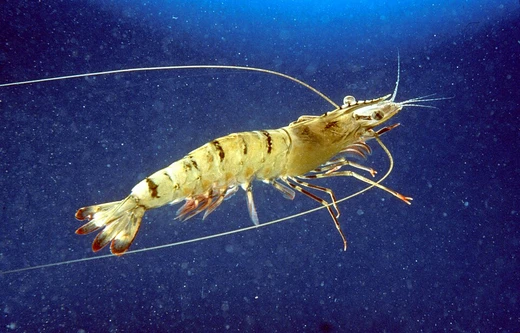
Common prawn
Largest native prawn around the British Isles, with studied hearing.

The common prawn (*Palaemon serratus*) lives in the Atlantic Ocean between Denmark and Mauritania, as well as in the Mediterranean and Black Seas. It is the largest native shrimp or prawn around the British Isles, typically reaching 100 millimetres in length. Its body is pinkish brown with reddish markings. The species can be identified by its upward-curving rostrum, which splits at the tip and has 6–7 teeth on the upper edge and 4–5 on the lower edge. Unlike similar species, the teeth on the upper side do not extend into the last third of the rostrum.
Individuals live 3–5 years, gathering in groups among rocky crevices at depths up to 40 metres. Females grow faster than males. The population is strongly seasonal, peaking in autumn. Various fish prey on them, including species from the families Mullidae, Moronidae, Sparidae, and Batrachoididae. Sometimes a bulge appears on the carapace over the gills, caused by an isopod parasite such as *Bopyrus squillarum*.
Its hearing has been studied in detail, unusual for an invertebrate. It can detect frequencies between 100 Hz and 3 kHz, with sensitivity comparable to that of generalist fish. Although the hearing range changes as the prawn grows, all individuals can hear tones at 500 Hz.
A small commercial fishery exists on the west coast of Great Britain, mainly from Cemaes Head to the Llŷn Peninsula in West Wales, and increasingly north into parts of Scotland. In Ireland, fishing began in Baltimore, County Cork in the 1970s and later expanded. The peak landing was 548 tonnes in 1999, with over 90% of the catch coming from Galway, Kerry, Cork, and Waterford. Current exploitation levels raise concerns about overfishing, and measures such as a minimum landing size are under consideration.
Quick Facts
- Genus
- Palaemon
- Species
- serratus
Facts from the source article.
Lore & Background
Palaemon serratus lives in groups in rocky crevices at depths of up to 40 metres. Females grow faster than males, and the population is highly seasonal, with a pronounced peak in the autumn. It is preyed upon by a variety of fish, including species of Mullidae, Moronidae, Sparidae and Batrachoididae. The shrimp can sometimes be found with a prominent bulge in its carapace over its gills, caused by an isopod parasite such as Bopyrus squillarum.
The species may be distinguished from other shrimp by its rostrum, which curves upward, is bifurcated at the tip, and has 6–7 teeth along its upper edge and 4–5 teeth on the lower edge. Other species may have a slightly curved rostrum, but the teeth on its dorsal surface continue into the distal third, which is untoothed in P. serratus. It is pinkish brown with reddish patterns.
Palaemon serratus is one of the few invertebrates to have its hearing studied in detail; it is sensitive to frequencies between 100 Hz and 3 kHz, with an acuity similar to that of generalist fish. While the hearing range changes as it grows, all individuals are capable of hearing tones at 500 Hz.
Reader's Guide
The common prawn supports a small commercial fishery on the west coast of Great Britain, chiefly in West Wales (Cemaes Head to the Llŷn Peninsula), extending increasingly north to include parts of Scotland. In Ireland, fishing began at Baltimore, County Cork in the 1970s and subsequently expanded. A peak landing of 548 t was recorded in 1999, and four counties—Galway, Kerry, Cork and Waterford—account for over 90% of the catch. There is now concern that current levels of exploitation may represent overfishing, and measures are being considered to limit the catch, such as a minimum landing size. The species' ecological role as prey for multiple fish families and its unique hearing sensitivity contribute to its significance in marine biology and fisheries management.
Did You Know?
- It is one of the few invertebrates whose hearing has been studied in detail, with sensitivity from 100 Hz to 3 kHz.
- A peak landing of 548 tonnes was recorded in 1999 for the Irish fishery.
- It can be parasitized by the isopod Bopyrus squillarum, causing a bulge in the carapace over the gills.
More in Marine Shrimp, Part 3 1-24
Spotted an error? Know more?
Reader corrections go straight into our review queue. Suggest an edit · How this site is sourced