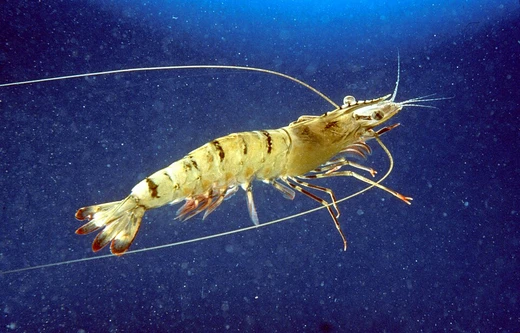
Parhippolyte uveae
A cave shrimp with variable color and behavior across its range.

Parhippolyte uveae, called the sugar cane shrimp, is a cave-dwelling shrimp in the family Barbouriidae. It lives in the Indian and western Pacific Oceans. This species is the type species for the genus Parhippolyte. English carcinologist Lancelot Alexander Borradaile described it using specimens that Arthur Willey collected in the south Pacific between 1895 and 1897.
This shrimp appears in two color forms. In Hawaii, it has red and white bands; elsewhere, it is bright red. It has long, slender legs and antennae.
Specimens have been collected from Aldabra in the western Indian Ocean, Kakaban Island and Halmahera in Indonesia, Tiniguiban Islet in the Philippines, the Loyalty Islands, Fiji, the Ellice Islands, and Oahu in Hawaii. It has also been recorded on the Mascarene Islands of Réunion and Mauritius.
The shrimp lives in anchialine pools and marine caves. In Hawaii, it inhabits lava tubes and caves, while on other islands it is found in more open areas. Its behavior varies by location. For instance, the population in the lagoon at Kakaban Island is photophobic and active only at night, whereas the one from Tiniguiban Islet in the Philippines is described as a "sun-lover." Adults feed at depths of 1–2 meters in the lagoon and are not found on the adjacent open reef. These differences in color and behavior suggest that *P. uveae* may actually consist of more than one cryptic species. Where it occurs, it is quite numerous and has been said to appear "in masses."
On Vatulele Island in Fiji, bright red populations live in a complex of anchialine grottoes and pools. Several legends explain their origin. Fijians call the shrimp *ura damudamu* ("red prawn") or *ura buta* ("cooked prawn"). The islanders treat the prawns with great respect and have a traditional practice of "calling" them with chants and clapping. It is taboo to kill or harm them, though local guides have been allowed to enter the pools to show them to tourists for some years.
*Parhippolyte uveae* is available in the aquarium trade and is said to be relatively easy to keep and breed. Some research is underway to establish breeding facilities for the trade. The shrimp has also appeared on a Fijian postage stamp, the first anchialine species to receive that honor.
Quick Facts
- Taxon
- Parhippolyte uvae
Facts from the source article.
Lore & Background
Parhippolyte uveae appears to have two colour forms: a red and white banded form found in Hawaii, while in other parts of its range this species is bright red. It has long slender legs and antennae. Specimens have been collected from Aldabra in the western Indian Ocean, Kakaban Island and Halmahera in Indonesia, Tiniguiban Islet in the Philippines, the Loyalty Islands, Fiji, Ellice Islands, and Oahu in Hawaii, as well as the Mascarene Islands of Réunion and Mauritius.
This species occurs in anchialine pools and marine caves. In Hawaii it inhabits lava pipes and caves, whereas on other islands it is found in more open areas. Its behaviour varies by location: the population in the lagoon at Kakaban Island appears photophobic and was only recorded active at night, while the population from Tiniguiban Islet in the Philippines were described as 'sun-lovers'. Adults feed at depths of 1–2 meters in the lagoon and are not found on the adjacent open reef. The differences in colouration and behaviour may indicate that P. uveae is made up of more than one cryptic species. Where it occurs, it is quite numerous and has been said to appear 'in masses'.
Reader's Guide
Parhippolyte uveae holds significance as the type species of its genus and as a subject of cultural traditions. On Vatulele Island in Fiji, populations of bright red P. uveae occur in a complex of anchialine grottoes and pools, where local legends explain their origin. The Fijians call it ura damudamu ('red prawn') or ura buta ('cooked prawn'), and islanders treat the prawns with great respect, practicing a traditional 'calling' using chants and clapping. It is taboo to kill or harm the prawns, though local guides have been allowed to enter the pools to show them to tourists for some years.
In the aquarium trade, P. uveae is available and said to be relatively easy to keep and breed, with research underway to establish breeding facilities. It has also been featured on a Fijian postage stamp, the first anchialine species so honored. The variations in colour and behaviour across its range suggest the possibility of cryptic species, adding to its biological interest.
Did You Know?
- Parhippolyte uveae was described by English carcinologist Lancelot Alexander Borradaile from specimens collected by Arthur Willey in the south Pacific in 1895–1897.
- It has two colour forms: red and white banded in Hawaii, and bright red elsewhere.
- On Vatulele Island in Fiji, it is called ura damudamu ('red prawn') or ura buta ('cooked prawn') and is protected by taboo.
- It was the first anchialine species to be featured on a postage stamp (Fiji).
Frequently Asked Questions
What is Parhippolyte uveae?
Parhippolyte uveae, commonly known as the sugar cane shrimp, is a cave-dwelling species in the family Barbouriidae. It inhabits marine environments across the Indian and western Pacific Oceans.
What does Parhippolyte uveae look like?
The shrimp appears in two distinct color forms: red-and-white banded specimens in Hawaii, and solid bright red individuals elsewhere in its range. It is also notable for its long, slender legs and antennae.
Where has Parhippolyte uveae been collected?
Specimens have been recorded from locations including Aldabra in the western Indian Ocean and Kakaban, among other sites across the Indian and western Pacific. The original type material came from the south Pacific, gathered by Arthur Willey between 1895 and 1897.
Who described Parhippolyte uveae and when?
English carcinologist Lancelot Alexander Borradaile formally described the species using specimens that Arthur Willey had collected in the south Pacific during 1895–1897.
Why is Parhippolyte uveae taxonomically significant?
It serves as the type species for the genus Parhippolyte, meaning the entire genus is anchored to this particular name. Its classification within the family Barbouriidae also helps define the boundaries of that cave-shrimp group.
More in Marine Shrimp, Part 3 1-24
Spotted an error? Know more?
Reader corrections go straight into our review queue. Suggest an edit · How this site is sourced