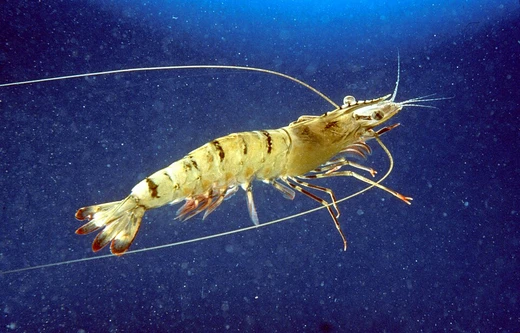
Crangon franciscorum
A key estuarine shrimp of San Francisco Bay.

Crangon franciscorum is a species of shrimp in the family Crangonidae, endemic to the brackish estuaries of California and found from Puget Sound in the north to San Diego, California in the south. It is especially abundant in San Francisco Bay, despite population fluctuations due to environmental stresses, and has been commercially fished from 1869 to the present.
Quick Facts
- Genus
- Crangon
- Species
- franciscorum
Facts from the source article.
Lore & Background
Crangon franciscorum is an important part of the estuarine food web in the greater San Francisco Bay, feeding on bivalves, amphipods, and foraminiferins, and serving as prey for fish such as striped bass, white sturgeon, Pacific tomcod, and shellfish like Dungeness crab. Its diet is heavily influenced by predator size, temperature-salinity preferences, and prey availability. The shrimp are short-lived, with males living up to 18 months and females up to 30 months; males spawn once, while longer-lived females spawn twice. Some evidence suggests the species may be protandrous hermaphrodites, with surviving males transforming into females after one year, which may account for the longer female lifespan.
The two most important natural environmental factors affecting the shrimp population are water temperature and salinity. They thrive in brackish water, preferring a salinity of 14 ppt when young and 24 ppt when ready to spawn, and a temperature of about 18 °C. Because these factors vary seasonally and with freshwater inflow from rainfall or drought, the shrimp migrate around the bay seeking optimal conditions. During heavy freshwater flows, mature females migrate to saltier parts of the central bay or out the Golden Gate to the Gulf of the Farallones, where they mate with males. Females incubate 2,000 to 8,000 eggs, and hatched young migrate back to shallower, less salty estuaries, gradually moving to deeper, cooler, more saline water as they mature.
Reader's Guide
Crangon franciscorum has been commercially fished from 1869 to the present and was by far the most common shrimp species in San Francisco Bay in the 19th century, accounting for about 90% of the shrimp catch from the 1870s to the 1930s. Its population has been heavily influenced by environmental stresses, including pollution and habitat loss. In the late 19th and early 20th centuries, San Francisco Bay became increasingly polluted; hydraulic mining during the Gold Rush introduced tens of millions of cubic meters of sediment annually into the Sacramento and San Joaquin Rivers, reducing water volume and changing tidal patterns until hydraulic mining was banned in 1884. The bay shrank as dikes were built for farmland and salt ponds, and areas were filled for real estate, such as San Francisco's Marina District, Treasure Island, and Foster City, with the vast majority of tidal marshes lost by the 1980s. The Central Valley Project (beginning 1933) and California State Water Project (beginning 1960) diverted water from the river systems, reducing annual freshwater inflow to about 40% of historic levels by the 1980s. Following prolonged droughts, the shrimp population declines, and after wet years it rebounds; in 1996, after two wet years, the population was 20 times larger than in 1980, following the severe drought of the late 1970s. The species is sensitive to pollution in estuaries, and in laboratory tests showed avoidance behavior when exposed to sewage.
Did You Know?
- Males live up to 18 months, while females live up to 30 months.
- In 1996, after two wet years, the shrimp population was 20 times larger than in 1980.
More in Marine Shrimp, Part 3 1-24
Spotted an error? Know more?
Reader corrections go straight into our review queue. Suggest an edit · How this site is sourced