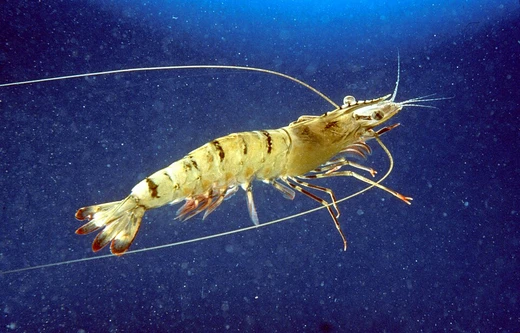
Lysmata debelius
A red cleaner shrimp with white antennae, popular in aquariums.

The fire shrimp, also known as the blood shrimp or scarlet cleaner shrimp, is a species of cleaner shrimp native to the Indo-Pacific. It is a common choice for home aquariums.
This shrimp was first formally described in 1983 by A. J. Bruce, who used specimens collected from Polillo Island in the Philippines. Its species name honors Helmut Debelius, the collector who sent the specimens to a zoologist for identification. A separate population from Ari Atoll in the Maldives was later classified as a distinct species, *L. splendida*, by Rudolf Burukovsky.
Adults reach a maximum length of about 3 centimeters (1.2 inches). Males and functional hermaphrodites look alike. The body is red, with bright white antennae and white tips on the third through fifth walking legs. White spots appear on the cephalothorax and legs; the presence of white dots on the abdomen is a trait that separates *L. splendida* from *L. debelius*.
In reef ecosystems, this shrimp acts as a cleaner, a role it shares with other *Lysmata* species such as *L. amboinensis*, *L. grabhami*, and *L. splendida*. It is a popular aquarium pet. Because it is a hermaphrodite, any two individuals can mate. The process of egg hatching, molting, and copulation follows the same pattern as in *L. wurdemanni*, producing a new batch of zoeae from each pair every week.
Quick Facts
- Genus
- Lysmata
- Species
- debelius
Facts from the source article.
Lore & Background
Lysmata debelius was first described by A. J. Bruce in 1983, based on type material from Polillo Island in the Philippines. The specific epithet commemorates Helmut Debelius, who had collected the specimens and sent them to a zoologist for identification. A divergent population from Ari Atoll in the Maldives was later described as a separate species, L. splendida, by Rudolf Burukovsky.
Lysmata debelius grows up to 3 centimetres (1.2 in) long, with males and functional hermaphrodites appearing similar. It has a red body, with conspicuous white antennae and white tips to the third to fifth pereiopods. There are white dots on the cephalothorax and legs; white dots on the abdomen distinguish L. splendida from L. debelius.
Lysmata debelius is one of a group of species in the genus Lysmata that has the role of a cleaner shrimp in reef ecosystems, alongside L. amboinensis, L. grabhami and L. splendida. It is a popular aquarium pet. Lysmata debelius is a hermaphrodite and therefore any two individuals may mate. The hatching of eggs, moulting, and copulation cycle is identical to that of L. wurdemanni, yielding weekly batches of zoeae from each pair.
Reader's Guide
Lysmata debelius is notable as a cleaner shrimp species indigenous to the Indo-Pacific, first described in 1983 from the Philippines. Its specific epithet honors Helmut Debelius, who collected the specimens. The species is popular in the aquarium trade under the common names fire shrimp, blood shrimp, or scarlet cleaner shrimp. It grows to 3 cm and is characterized by a red body with white antennae and white-tipped pereiopods. A divergent population from the Maldives was later described as a separate species, L. splendida, distinguished by white dots on the abdomen. Ecologically, L. debelius belongs to a group of cleaner shrimp in reef ecosystems, alongside L. amboinensis, L. grabhami, and L. splendida. Its reproductive biology is hermaphroditic, allowing any two individuals to mate, with a cycle identical to L. wurdemanni that produces weekly batches of zoeae. The species remains a popular aquarium pet, valued for its cleaning role and striking appearance.
Physical Form and Coloration
The Pacific cleaner shrimp grows to a body length of roughly 2.5 to 3 inches, trailing two pairs of long white antennae that extend another 3 to 5 inches beyond the body. The foremost antennal pair forks into two branches, giving the impression of three pairs altogether. The body and legs carry a pale amber wash, while the carapace bears a bold longitudinal pattern: a central white stripe bordered on each side by broader scarlet-red bands. Symmetrical white dots decorate the red tail. As a decapod, the shrimp possesses ten pairs of walking legs, the frontmost pair tipped with small pincers. White maxillipeds sit ahead of the walking legs and are used for gathering food, while paired pleopods tucked beneath the thorax handle swimming and egg brooding. Despite these vivid markings, laboratory experiments suggest the shrimp has only coarse vision and is colourblind, making it unlikely that it can perceive the striking patterns on its own body or on the tropical fish that surround it on the reef.
Reproduction and the Hermaphroditic Life Cycle
Every individual of this species begins its adult life as a male. After a series of moults it transforms into a functional hermaphrodite, able to act as either sex during a mating interaction. No pure female form exists in the species. This pattern, termed protandric simultaneous hermaphroditism, is unique among decapod crustaceans. A single spawning event yields between 200 and 500 eggs, initially greenish and clamped to the pleopods. Over the incubation period the eggs swell and lighten, with a few turning silver on the day they hatch. Hatching typically occurs around dusk, releasing larvae roughly 3 to 4 millimetres long into the open water column. The nauplii develop into zoeae and pass through 14 identified planktonic stages over five to six months, feeding on plankton and growing to about 2 centimetres. They then settle, metamorphose into a juvenile form, and reach full adulthood after additional moults spaced three to eight weeks apart.
The Cleaning Station and Symbiotic Partnerships
In the wild these shrimp do not form large colonies; they are more often encountered in pairs, sheltering in caves or along reef ledges at depths of 5 to 40 metres across tropical Indo-Pacific waters and the Red Sea. Their ecological role centres on a mutualistic cleaning relationship with larger fish. The shrimp feeds on parasites and dead tissue, while the client fish gains parasite removal and even accelerated wound healing. Cleaning organisms sometimes cluster at a single reef spot known as a cleaning station, where approaching fish are greeted with a side-to-side rocking display. The shrimp also shares cave dwellings with clients such as moray eels, gaining predator protection in return. In captivity, cleaning activity appears to peak at night, though it is unclear whether this timing reflects shrimp behaviour or host-fish habits. Researchers have proposed that this species could benefit aquaculture operations by reducing parasite loads on farmed fish.
Life in the Aquarium and Captive Social Dynamics
In home and public aquaria this species is widely kept under names such as skunk cleaner shrimp, white-banded cleaner shrimp, or scarlet cleaner shrimp, prized for its bold colouring, gentle temperament, and the visible cleaning behaviour it performs on tank-mates. It is regarded as safe for reef tanks because it tidies the substrate and removes parasites from fish without damaging corals. Socially, captive pairs display a form of monogamy: a mature hermaphroditic pair alternates moulting schedules, with mating occurring shortly after one individual moults. The shrimp that moults acts as the female and broods the fertilised eggs, while the other serves as the male. When the second shrimp moults, the roles reverse. If more than two individuals are housed together, the established pair has been observed killing the extras, underscoring a strict two-individual social structure. Whether this monogamy holds in the wild remains unconfirmed.
Frequently Asked Questions
What is Lysmata debelius?
Lysmata debelius is a small cleaner shrimp species native to the Indo-Pacific, commonly called the fire shrimp, blood shrimp, or scarlet cleaner shrimp. It is a popular choice for home saltwater aquariums because of its role in cleaning other fish.
What does Lysmata debelius look like?
Adults show a vivid red body paired with contrasting white antennae, which is where the "fire shrimp" nickname comes from. The bold coloration makes them easy to tell apart from other cleaner shrimp in a mixed reef tank.
How big does Lysmata debelius get?
Fully grown individuals reach a maximum length of about 3 centimetres (roughly 1.2 inches). That compact size is one reason they fit comfortably into smaller reef setups.
Why is it called Lysmata debelius?
The specific epithet honors Helmut Debelius, the collector who gathered the original specimens on Polillo Island in the Philippines and forwarded them to a zoologist for identification. A. J. Bruce formally described the species in 1983 and chose the name as a tribute to Debelius.
Is Lysmata debelius the same as Lysmata splendida?
No. A population originally collected from Ari Atoll in the Maldives was later separated and described as a distinct species, L. splendida, by Rudolf Burukovsky. The two are closely related but are now treated as separate taxa.
More in Marine Shrimp, Part 3 1-24
Spotted an error? Know more?
Reader corrections go straight into our review queue. Suggest an edit · How this site is sourced