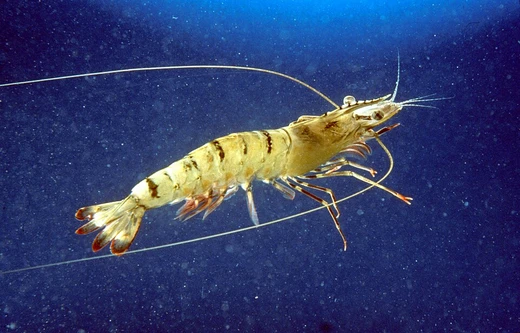
Zenopontonia soror
A colour-changing shrimp that lives on starfish.

Zenopontonia soror, also called the starfish shrimp or seastar shrimp, is a medium-sized shrimp from the family Palaemonidae. It grows to about 1.5 cm (0.6 in) long. Its rostrum is short and broad, curving downward, with ten or eleven teeth on the upper side. The shrimp is covered in small white spots, but its main color matches the starfish it lives on: blue on *Linckia laevigata*, two-toned bright red with a pale dorsal streak on *Acanthaster*, and a less speckled, clear color on *Culcita*—sometimes with a transparent dorsal streak in blue, maroon, white, yellow, or pale green. It can be confused with the imperial shrimp (*Zenopontonia rex*), but that species hosts on sea cucumbers or large molluscs.
This shrimp is found in shallow tropical waters of the Indo-Pacific, from the Red Sea to New Caledonia, French Polynesia, Mayotte, and Reunion. It lives on coral reefs down to about 30 m (100 ft).
Always found with a starfish, usually on its underside, *Zenopontonia soror* seems to prefer *Acanthaster* but also appears on *Culcita*, *Choriaster*, *Protoreaster*, *Echinaster*, *Halityle*, and *Linckia*, and possibly other starfish species. It detects a potential host through chemical cues in the water. It does not stay on one starfish forever; if separated, it searches for another of the same species. Up to about fifty shrimp may share a single host. They feed on mucus the starfish secretes and gain protection from predators because of the host’s carnivorous nature.
Quick Facts
- Genus
- Zenopontonia
- Species
- soror
Facts from the source article.
Lore & Background
Zenopontonia soror has a short, broad rostrum that curves downwards and is liberally covered with small white spots. Its main colour mimics that of its host starfish: on Linckia laevigata it is blue; on Acanthaster it is two-coloured, bright red with a pale dorsal streak; on Culcita it is a less-speckled, clear colour, sometimes with a transparent dorsal streak, blue or maroon, or sometimes white, yellow or pale green. It could be mistaken for the imperial shrimp (Zenopontonia rex), but that species uses a sea cucumber or large mollusc as a host.
The shrimp is always found in association with a starfish, usually on the undersurface. Acanthaster seems to be its favourite host, but it has also been found on Culcita, Choriaster, Protoreaster, Echinaster, Halityle and Linckia, and may also be associated with other starfish species. The shrimp appears to recognise a potential host by chemical cues in the water. It does not necessarily remain on a single starfish permanently, but if separated from its host, will search for another starfish of the same species.
Reader's Guide
Zenopontonia soror is significant as a specialized commensal shrimp that lives exclusively in association with starfish. Its ability to change colour to match its host—ranging from blue on Linckia laevigata to two-coloured red on Acanthaster—demonstrates a remarkable adaptation for camouflage. The shrimp feeds on mucus secreted by the starfish and benefits from the protection provided by its carnivorous host. Up to about fifty individual shrimps have been found on a single host, indicating that it can form dense aggregations. The species is found on coral reefs in the shallow tropical Indo-Pacific, from the Red Sea to New Caledonia, French Polynesia, Mayotte and Reunion, at depths down to about 30 m. Its reliance on chemical cues to locate a host and its tendency to seek another starfish of the same species if separated highlight its specialized ecological niche. The shrimp is often mistaken for the imperial shrimp (Zenopontonia rex), but that species associates with sea cucumbers or large molluscs instead of starfish.
Did You Know?
- Zenopontonia soror can change its colour to match that of its host starfish.
- It is found on coral reefs at depths down to about 30 m.
Frequently Asked Questions
What is Zenopontonia soror?
It is a small commensal shrimp in the family Palaemonidae, popularly nicknamed the starfish or seastar shrimp because it spends its life attached to starfish hosts on tropical reefs. Its body is dusted with tiny white spots, and its overall hue shifts to mirror whichever starfish species it inhabits.
How big does Zenopontonia soror get?
Adults reach roughly 1.5 cm (about 0.6 inches) in total length, placing it in the medium-sized range for the Palaemonidae family. Its rostrum is notably short and broad, curving downward with ten or eleven teeth along the dorsal edge.
How does Zenopontonia soror match the colour of its host starfish?
The shrimp's base colouration tracks the starfish it lives on: blue on Linckia laevigata, vivid two-toned red with a pale dorsal stripe on Acanthaster, and a clearer, less speckled tone on Culcita. On Culcita hosts the dorsal streak can appear in blue, maroon, white, yellow, or pale green.
Where is Zenopontonia soror found in the wild?
Its range spans the tropical Indo-Pacific, stretching from the Red Sea eastward to New Caledonia, French Polynesia, Mayotte, and Réunion. It is typically encountered at depths down to about 30 m (100 ft) on reef flats and shallow slopes.
How many Zenopontonia soror can share a single starfish?
A single host starfish can support a colony of up to roughly fifty individuals at once. This dense grouping is part of the shrimp's commensal strategy, letting it feed and shelter directly on the starfish's surface.
More in Marine Shrimp, Part 2 1-24
Spotted an error? Know more?
Reader corrections go straight into our review queue. Suggest an edit · How this site is sourced