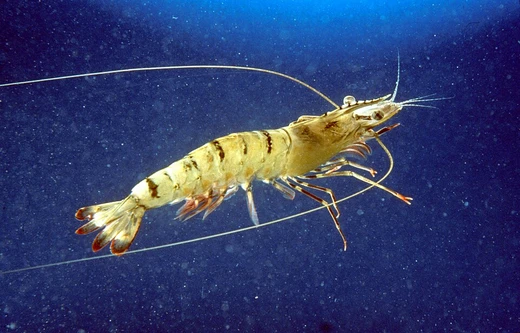
Periclimenes yucatanicus
A Caribbean cleaner shrimp that lives among sea anemone tentacles.

The spotted cleaner shrimp (*Periclimenes yucatanicus*) is a Caribbean cleaner shrimp that dwells within the tentacles of various sea anemones. To attract fish, it sways its body and waves its antennae, then feeds on dead tissue, algae, and parasites from its clients. Reaching about 2.5 cm (1 in) in length, its transparent body is marked with brown and white saddle-like patterns, while its chelae and legs feature bold red, purple, and white stripes. Two pairs of long white antennae are banded in black. This shrimp occurs down to depths of roughly 24 m (79 ft) across the Caribbean Sea, southern Florida, the Bahamas, and as far south as Colombia. Breeding occurs in summer, with females brooding eggs under their abdomens in July and August. After hatching, larvae pass through several planktonic stages before settling on the seabed and metamorphosing into adults. The shrimp associates closely with sea anemones such as *Condylactis gigantea*, *Lebrunia danae*, *Bartholomea lucida*, or *Bartholomea annulata*, with up to six individuals sometimes sharing one anemone. It attracts passing reef fish by swishing its antennae; when a fish poses motionless beside the anemone, the shrimp emerges to remove external parasites and loose skin, even entering the fish’s mouth and cleaning behind its gill covers without being eaten. In the US Virgin Islands, it has also been found with the sea anemone *Rhodactis sanctithomae*—a previously unrecognized symbiont—and on the tentacles of the jellyfish *Cassiopea*.
Quick Facts
- Taxon
- Periclimenes yucatanicus
Facts from the source article.
Lore & Background
The spotted cleaner shrimp grows to a length of about 2.5 cm (1 in). It has a transparent body patterned with brown and white saddle shaped markings. The chelae and legs are boldly striped in red, purple and white, and there are two pairs of long white antennae banded in black. It is found at depths down to about 24 metres (79 ft) in the Caribbean Sea, southern Florida, the Bahamas, and as far south as Colombia. Breeding takes place in the summer, and females have been seen brooding eggs under their abdomens in July and August. After hatching, the larvae pass through several planktonic larval stages before settling on the seabed and undergoing metamorphosis into the adult form.
Reader's Guide
The spotted cleaner shrimp lives in close association with sea anemones, specifically Condylactis gigantea, Lebrunia danae, Bartholomea lucida, or Bartholomea annulata. It lives among the tentacles, and up to six individual shrimps have been seen on one sea anemone. It swishes its antennae around in the water to attract the attention of passing reef fish. When a fish poses motionless beside the anemone, the shrimp emerges from the tentacles and removes and feeds on external parasites and flakes of loose skin from the fish. It even enters the mouths of fishes and cleans behind their gill covers, apparently with no likelihood that it will get eaten. The shrimp has also been found associated with the sea anemone Rhodactis sanctithomae in the US Virgin Islands, a species of anemone not previously recognised as a symbiont species. Also in the Virgin Islands, it has been seen on the tentacles of the jellyfish Cassiopea. This cleaning behavior is significant for reef fish health and illustrates a complex symbiotic relationship.
Did You Know?
- It lives among the tentacles of several species of sea anemones, including Condylactis gigantea.
- It has been observed on the tentacles of the jellyfish Cassiopea in the US Virgin Islands.
Frequently Asked Questions
What is Periclimenes yucatanicus?
It is a small Caribbean cleaner shrimp, commonly known as the spotted cleaner shrimp, that makes its home nestled among the tentacles of sea anemones. It plays a mutualistic role by picking parasites and dead tissue off visiting fish.
Where can you find Periclimenes yucatanicus in the wild?
This species ranges across the Caribbean Sea, from southern Florida and the Bahamas down as far as Colombia, and is found at depths reaching about 24 metres (79 ft). It typically hangs out in and around sea anemones within that range.
How does Periclimenes yucatanicus attract clients to clean?
The shrimp actively advertises itself by swaying its body and waving its long antennae to draw in nearby fish. Once a client approaches, it feeds on parasites, algae, and dead tissue from the fish's body.
How large does Periclimenes yucatanicus grow?
Adults reach a maximum length of roughly 2.5 centimetres (about 1 inch), making it a very small species of cleaner shrimp.
What does Periclimenes yucatanicus look like?
Its transparent body carries brown and white saddle-like markings, while its chelae and legs show bold red, purple, and white stripes. Two pairs of long white antennae banded in black extend from its head, adding to its striking appearance.
More in Marine Shrimp, Part 2 1-24
Spotted an error? Know more?
Reader corrections go straight into our review queue. Suggest an edit · How this site is sourced