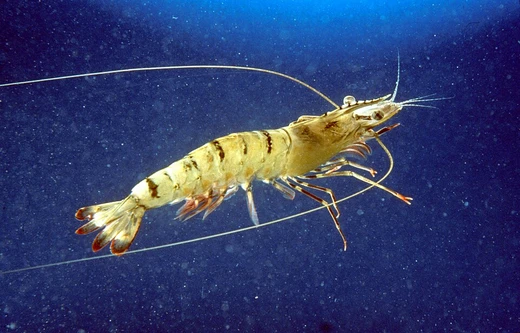
Palaemon paludosus
A keystone freshwater shrimp from the southeastern United States.

Palaemon paludosus, also called the ghost shrimp, glass shrimp, or eastern grass shrimp, is a freshwater shrimp native to the southeastern United States. It plays a key role in its ecosystem and is a common choice for home aquariums.
This shrimp grows up to 2.5 cm long and is mostly see-through. By adjusting pigment granules in its body, it can blend into its surroundings. It closely resembles P. kadiakensis, but the arrangement of spines on its tail section sets them apart.
The species is widespread in southern states east of the Appalachian Mountains. It also appears in Louisiana, where it may not be native, and there are scattered reports from Texas and California. Its spread is linked to reduced predation risk in complex habitats like beds of Polygonum plants.
Palaemon paludosus lives in fresh or slightly brackish water, usually in lakes. Nocturnal by nature, it hides among plants during the day and comes out at night to feed on plankton. It is an important food source for birds and fish such as black bass, and is considered a keystone species. It reproduces sexually, and individuals die after the spawning season. The parasitic isopod Probopyrus pandalicola uses it as a host, causing female shrimp to become sterile and altering male sexual traits.
Males mate with multiple females, and wild populations typically have more females than males—about 0.78 males per female. Breeding season depends on water temperature, and a female can lay up to 85 eggs per clutch.
These shrimp are omnivores, feeding mainly on algae, aquatic insects, and diatoms like Fragilaria and Nivicula. They do most of their eating at night.
In the aquarium trade, they are popular for their unique look and ease of care, making them a good choice for beginners. They help keep tanks free of algae and will also eat leftover food. It is best to keep them in groups; up to 20 can fit comfortably in a 5-gallon tank, though the ideal ratio is about three shrimp per gallon.
Quick Facts
- Taxon
- Palaemonetes paludosus
Facts from the source article.
Lore & Background
Palaemon paludosus is largely transparent and can manipulate pigment granules in its body to produce effective camouflage against its background. It is very similar to P. kadiakensis, from which it can be distinguished by the arrangement of spines on the telson. The species is common in southern states east of the Appalachian Mountains, also found in Louisiana where it may not be native, with scattered records from Texas and California. Its distribution is due to decreased susceptibility to predation because of complexity in higher habitats in Polygonum beds.
Reader's Guide
Palaemon paludosus lives in fresh water or slightly brackish water, usually in lakes. It is nocturnal, remaining hidden among vegetation by day and emerging at night to feed on plankton. It is an important prey item for birds and fishes such as black bass, and may be considered a keystone species. They reproduce sexually, are polygynous, and die after the spawning season is complete. Breeding season varies with water temperature. They are also used as host by a parasitic isopod, Probopyrus pandalicola, which makes female shrimp sterile and affects the growth of male sex characteristics. In the aquarium trade, they are recommended for beginners because they are easy to care for and keep tanks algae-free, eating algae and leftover food. It is recommended to keep groups of up to 20 individuals in a 5-gallon tank, with an ideal ratio of about 3 shrimp per gallon.
Did You Know?
- Palaemon paludosus can produce effective camouflage by manipulating pigment granules in its body.
- It is used as a host by the parasitic isopod Probopyrus pandalicola, which makes female shrimp sterile.
- The species is nocturnal and feeds mainly on algae and aquatic insects.
Frequently Asked Questions
Who is Palaemon paludosus?
Palaemon paludosus is a tiny, largely transparent freshwater shrimp native to the southeastern United States east of the Appalachian range. It is widely known by nicknames such as ghost shrimp, glass shrimp, and eastern grass shrimp, and it reaches a maximum length of about 2.5 cm.
What are Palaemon paludosus's powers or ecological role?
This shrimp can redistribute pigment granules across its body to match surrounding substrates and vegetation, giving it a living-camouflage ability. Ecologically it acts as a keystone species, processing organic matter and serving as a crucial prey link for many aquatic predators in southeastern streams and ponds.
How does Palaemon paludosus's life cycle end?
A single female can produce up to 85 eggs per clutch, and the resulting juveniles grow into the next generation of see-through shrimp in the same waterways. In the wild the cycle simply repeats season after season, with populations persisting through successive broods in their native southeastern habitats.
Why is Palaemon paludosus important to hobbyists and ecosystems?
As a keystone organism it helps sustain food webs and water quality in its native freshwater habitats. In the aquarium trade it is one of the most popular small shrimp, with hobbyists generally stocking around three individuals per gallon and keeping groups of up to 20 in a five-gallon tank.
How do I tell Palaemon paludosus apart from the look-alike P. kadiakensis?
The two species are nearly identical in size and glassy transparency, making them easy to confuse at a glance. The reliable distinguishing feature is the arrangement of spines on the tail section (telson and uropods), which differs between the two and is best checked under magnification.
More in Marine Shrimp, Part 2 1-24
Spotted an error? Know more?
Reader corrections go straight into our review queue. Suggest an edit · How this site is sourced