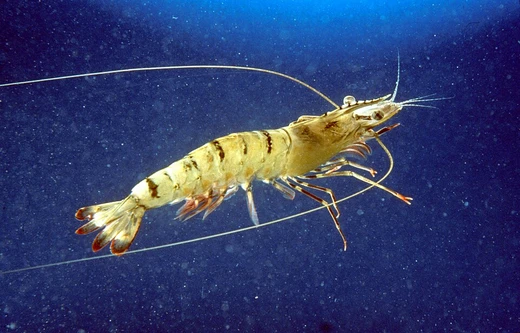
Periclimenes dardanicola
A white shrimp associated with sea anemones on hermit crab shells.

Here is the rewritten encyclopedia entry:
In the western Pacific Ocean lives a small shrimp, *Periclimenes dardanicola*. It makes its home on sea anemones that themselves live on the gastropod shells carried by hermit crabs. This shrimp is mostly white, with a carapace length reaching up to 4 mm. It was formally named by Alexander J. Bruce and Junji Okuno in 2006. The species is one of the rare examples of an ecological link between two different decapod crustaceans.
Quick Facts
- Taxon
- Periclimenes dardanicola
Facts from the source article.
Lore & Background
Periclimenes dardanicola grows to a carapace length of 2–4 millimetres (0.08–0.16 in), and can be distinguished from related species, including the similar Periclimenes parvus, by the form of the carapace and by the relative lengths of the parts of the first pereiopod. The animal is chiefly white, with red along the edges of the carapace and the abdominal somites. The legs are transparent yellow, with red bands.
Ecologically, P. dardanicola is associated with the sea anemone Calliactis, which is carried by hermit crabs of the genus Dardanus, including Dardanus arrosor, D. crassimanus, D. lagopodes and D. pedunculatus. This is one of the few examples of ecological associations between two species of decapod crustaceans.
Although only formally described in 2006, this species has been recognized as distinct since 1993, and has been featured in illustrated popular science books from 1986 onwards. Its members were formerly considered part of Periclimenes parvus, which is now considered to only occur at its type locality, off the island of New Britain, Papua New Guinea. The specific epithet dardanicola refers to the species' association with members of the genus Dardanus, with 'dardani-' referring to the genus, and 'cola' being the Latin word for 'dweller'.
Reader's Guide
Periclimenes dardanicola is significant as a rare example of an ecological association between two species of decapod crustaceans, linking shrimp, sea anemones, and hermit crabs. Its formal description in 2006 by Alexander J. Bruce and Junji Okuno resolved a long-standing confusion with Periclimenes parvus, which is now restricted to a single location off New Britain, Papua New Guinea. The species had been recognized as distinct since 1993 and even appeared in popular science books from 1986, indicating its prior informal recognition. Its distribution spans Suruga Bay (Japan), Vietnam, and Borneo (Indonesia), all in the western Pacific Ocean. The shrimp's white body with red markings and transparent yellow legs, along with its small size (carapace up to 4 mm), make it a distinctive member of its genus. The specific name dardanicola highlights its dependence on Dardanus hermit crabs, which carry the sea anemones that host the shrimp. This intricate symbiosis underscores the complexity of marine ecosystems and the importance of taxonomic clarity in understanding biodiversity.
Did You Know?
- The species was recognized as distinct since 1993 and featured in popular science books from 1986.
- Its specific epithet dardanicola means 'dweller of Dardanus', referring to its association with hermit crabs of that genus.
Physical Description & Distinguishing Features
Periclimenes dardanicola is a remarkably small crustacean, reaching a maximum carapace length of just two to four millimetres, roughly a sixteenth of an inch. Despite its diminutive size, the shrimp displays a striking colour palette that sets it apart visually. Its body is predominantly white, but the margins of the carapace and the individual abdominal segments are edged in red, creating a delicate contrast. The appendages add another layer of visual interest: the legs are a translucent yellow, interrupted by bands of red. When taxonomists need to separate P. dardanicola from its close relative Periclimenes parvus, they look to two key morphological features. The overall shape of the carapace differs between the two species, and the proportional lengths of the segments making up the first pereiopod—the first pair of walking legs—provide a reliable diagnostic distinction. These subtle anatomical differences, combined with the colour pattern, allow researchers to confidently identify specimens in the field and in collections.
Ecological Niche & Symbiotic Community
The ecological story of Periclimenes dardanicola is one of remarkable interdependence among three very different marine animals. This shrimp does not simply occupy open water; instead, it is tightly associated with the sea anemone Calliactis. In turn, these anemones are not free-living on the seafloor but are carried on the gastropod shells of hermit crabs belonging to the genus Dardanus. Bruce and Okuno documented associations with at least four Dardanus species: D. arrosor, D. crassimanus, D. lagopodes, and D. pedunculatus. What makes this arrangement particularly noteworthy in the broader context of marine biology is that it represents one of the very few known cases in which two species of decapod crustaceans maintain a sustained ecological partnership. The shrimp, the anemone, and the hermit crab form a compact, mobile microhabitat in which each participant occupies a distinct niche, and the tiny white-and-red shrimp is the smallest and most specialised member of the trio.
Taxonomic History & the Meaning Behind the Name
Although the formal scientific description of Periclimenes dardanicola was not published until 2006, when Alexander J. Bruce and Junji Okuno gave the species its binomial name, the animal had been known to researchers and the public for considerably longer. As early as 1986, specimens of what would later be recognised as this species appeared in illustrated popular science books, and by 1993 taxonomists were treating it as a distinct entity separate from its closest relative. For years, however, it had been lumped together with Periclimenes parvus. That older name is now restricted to a much narrower range, with P. parvus considered to occur only at its type locality off the island of New Britain in Papua New Guinea. The specific epithet chosen by Bruce and Okuno is itself a clue to the shrimp's biology: "dardani-" honours the genus Dardanus, the hermit crabs whose shells host the anemones the shrimp depends on, while "cola" is the Latin word meaning "dweller." Together, the name essentially reads "dweller with Dardanus."
Geographic Distribution Across the Western Pacific
Periclimenes dardanicola is a species of the western Pacific Ocean, and the geographic record of where it has been collected traces a broad arc across that region. Documented localities include Suruga Bay on the coast of Japan, waters off Vietnam, and the island of Borneo in Indonesia. These collection sites span a considerable distance, suggesting the species is not confined to a single reef system but is distributed across multiple marine environments in the western Pacific. The presence of the shrimp in each of these locations is, of course, contingent on the presence of its host community—the Dardanus hermit crabs carrying Calliactis anemones—so the distribution of P. dardanicola is effectively a subset of wherever that particular three-part association occurs. Despite being formally described only in 2006 and remaining a very small, easily overlooked organism at just a few millimetres long, the species has managed to establish a recognisable footprint across at least three distinct national waters in the region, from East Asia through Southeast Asia to the Indonesian archipelago.
Frequently Asked Questions
What is Periclimenes dardanicola?
Periclimenes dardanicola is a tiny, mostly white shrimp native to the western Pacific that shelters on sea anemones growing atop hermit crab shells. It was formally described by Bruce and Okuno in 2006, after being recognized as a separate species back in 1993.
Where does Periclimenes dardanicola live?
This shrimp occupies a very specific niche: sea anemones that are attached to the gastropod shells carried by hermit crabs. Its range is in the western Pacific Ocean.
How big is Periclimenes dardanicola?
The carapace measures between 2 and 4 mm (about 0.08–0.16 in), so the entire animal is only a few millimeters long. It is one of the smallest shrimp species known.
Who named Periclimenes dardanicola and when?
Marine biologists Alexander J. Bruce and Junji Okuno gave the species its formal name in 2006. The animal had already been set apart from a closely related species—whose type locality is off New Britain, Papua New Guinea—by 1993.
Why is Periclimenes dardanicola considered ecologically important?
It is one of the rare documented cases where two different decapod crustaceans form a direct ecological connection in the wild. The shrimp, the anemone, and the hermit crab create a layered symbiotic chain that is unusual in marine biology.
More in Marine Shrimp, Part 2 1-24
Spotted an error? Know more?
Reader corrections go straight into our review queue. Suggest an edit · How this site is sourced