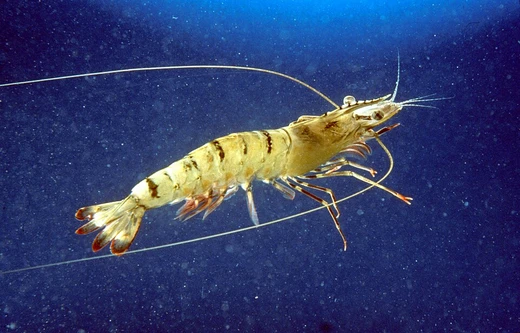
Palaemon macrodactylus
A broadly invasive shrimp native to East Asia.

Palaemon macrodactylus belongs to the shrimp family Palaemonidae. Its native range covers Japan, Korea, northern China, and the Far East region of Russia in the northwestern Pacific Ocean. The first recorded introduction outside this range occurred in 1957, when the species was accidentally brought to San Francisco Bay, USA. It is now considered an invasive species in California, where it is very abundant, and has also been found in the US states of Washington, Oregon, Virginia, Connecticut, and New York. In the early 2000s, it appeared in Australia and Argentina; the Argentine introduction is thought to have happened via ballast water discharge from a US ship in Mar del Plata harbor, marking its first report on the southwestern Atlantic coast. Along Europe’s Atlantic coasts, it occurs in southwestern Spain, southeastern England, France, Belgium, and the Netherlands. Its invasive success is attributed to its colonization of northeastern Pacific estuaries and coasts.
The species tolerates moderate salinity and lives in brackish water, which helps it occupy a wide range of habitats worldwide. Temperature strongly influences its spread: it affects female reproduction rates and the timing and length of the breeding season, which is optimal between 15 and 27 °C (59–81 °F). The main mode of introduction is shipping, especially through ballast water discharge. Local shipping to suitable, uncolonized regions with favorable temperatures effectively establishes new populations, and infra-regional shipping further expands its territory. Despite its broad native range and high reproductive potential, it is listed as a threatened species in the China Red Data Book. Natural larval dispersal is possible but statistically less likely.
Males measure 9.7 to 13.5 mm (0.38–0.53 in) in length. Ovigerous females (those bearing eggs) are about 16.5 to 19 mm (0.65–0.75 in) long and carry 150 to 2,000 eggs. Non-ovigerous females are typically 11.8 to 14.1 mm (0.46–0.56 in) long. Females are generally larger than males and have red spots on the body with white longitudinal stripes along the back. Males are transparent with a reddish tint on the tail fan and antennary area. Morphological similarities make it difficult to distinguish this species from local shrimp.
Quick Facts
- Genus
- Palaemon
- Species
- macrodactylus
Facts from the source article.
Lore & Background
Palaemon macrodactylus is native to Japan, Korea, Northern China, and the Far East region of Russia. In 1957, it was accidentally introduced to San Francisco Bay, USA, and is now considered invasive in California and abundant. It has since spread to US states including Washington, Oregon, Virginia, Connecticut, and New York, and appeared in Australia and Argentina in the early 2000s, likely via ballast water discharge. In Europe, it is found in Southwestern Spain, Southeastern England, France, Belgium, and the Netherlands.
Males are 9.7 to 13.5 mm long, while ovigerous females are 16.5 to 19 mm and carry 150-2000 eggs. Females are larger than males and have red spots with white longitudinal stripes; males are transparent with a reddish hue on the tail fan. The species tolerates moderate salinity (optimal 5-15 ppt) and inhabits low-salinity estuaries, favoring pilings, walls, and debris. It primarily eats plants, mysids, amphipods, and crabs, with Corophium and Rhithropanopeus as key prey. Cannibalism occurs at high densities.
Reproduction is dioecious, with mating from mid April to early October. Males transfer spermatophores to females, and eggs are produced within 6-20 hours. Despite its invasive success, P. macrodactylus is listed as a threatened species in the China Red Data Book.
Reader's Guide
Palaemon macrodactylus is significant as a highly invasive species that has successfully colonized the northeastern Pacific coast and estuaries, as well as regions in Europe, Australia, and South America. Its introduction is primarily via shipping, especially ballast water discharge, and its tolerance of moderate salinity and broad temperature range (optimal 15-27 °C) facilitates its spread. The species competes with native shrimp such as Crangon franciscorum and Palaemon longirostris, but resource partitioning—due to size differences—has prevented serious damaging effects in some areas, such as the Sacramento-San Joaquin River Delta. Its diet is debated: a 1979 study by Richard Sitts and Allen Knight found it mainly carnivorous, but others argue it is omnivorous. Despite its invasive status, no published attempts to control its populations exist, and no specific surveillance programs are available. In Japan, it is caught and sold as food. The species is also listed as threatened in the China Red Data Book, highlighting a contrast between its native vulnerability and invasive success.
Did You Know?
- Palaemon macrodactylus was first accidentally introduced to San Francisco Bay, USA, in 1957.
- Ovigerous females carry between 150 and 2000 eggs.
- The species is listed as threatened in the China Red Data Book despite its broad invasive range.
- No published attempts to control any population of P. macrodactylus currently exist.
Invasive Spread and Global Distribution
Originating in the coastal waters surrounding Japan, Korea, northern China, and the Far East region of Russia, Palaemon macrodactylus has transformed from a regional resident into one of the most widespread non-native shrimps on the planet. The turning point came in 1957, when the first recorded non-native individual appeared in San Francisco Bay, an event that set off a cascade of colonization across the northeastern Pacific. Today the species is officially classified as invasive in California, where it has become remarkably abundant, and its range extends to the coasts of Washington, Oregon, Virginia, Connecticut, and New York. The early 2000s marked further expansion, with first sightings in Australia and along the southwestern Atlantic coast of Argentina. In Europe, populations have established themselves along the Atlantic shores of southwestern Spain, southeastern England, France, Belgium, and the Netherlands. What unites all these introductions is the species' demonstrated ability to successfully colonize estuarine and coastal habitats far from its native Pacific home.
Introduction Vectors and Environmental Drivers
Although Palaemon macrodactylus possesses a broad native range and considerable reproductive capacity, its spread to new continents has been driven overwhelmingly by human activity rather than natural larval dispersal. The dominant pathway is commercial shipping, specifically the discharge of ballast water that carries live individuals into harbors and estuaries they have never encountered. A well-documented example is the arrival of the species in Mar De Plata harbor, Argentina, where it is believed to have been transported via ballast water released from vessels operating out of the United States. Temperature plays a critical supporting role: the shrimp's reproductive rate, breeding season timing, and overall seasonal activity all peak between 15 and 27 degrees Celsius, meaning that shipping routes connecting regions within this thermal window create ideal corridors for establishment. The species' tolerance of moderate salinity and brackish conditions further broadens the range of suitable receiving habitats. Ironically, despite this global invasive success, Palaemon macrodactylus is simultaneously listed as a threatened species in the China Red Data Book, highlighting the complex relationship between a species' native vulnerability and its foreign aggressiveness.
Sexual Dimorphism and Reproductive Biology
Palaemon macrodactylus exhibits clear sexual dimorphism in both size and coloration. Adult males measure between 9.7 and 13.5 millimeters and possess a largely transparent body with a subtle reddish tint concentrated on the tail fan and antennary region. Females are consistently larger; those carrying eggs reach 16.5 to 19 millimeters and hold anywhere from 150 to 2,000 eggs, while non-ovigerous females range from 11.8 to 14.1 millimeters. The female body is marked with red spots and distinctive white longitudinal stripes running along the back, making her visually quite different from the male. Reproduction follows a dioecious pattern, and courtship involves a ritualized sequence of olfactory and tactile cues. During mating, the male positions itself at roughly a right angle to the female and deposits a spermatophore onto her abdomen. Egg production begins within six to twenty hours of this transfer. The breeding window runs from mid-April through early October, and embryonic development proceeds most successfully under higher salinity conditions, even though the embryos can develop in vitro under conditions similar to those of adults.
Ecological Role and Competitive Dynamics
In the estuaries it has colonized, Palaemon macrodactylus occupies a flexible trophic niche. Its diet spans plant material, mysids such as Neomysis, amphipods, and small crabs, with Corophium and Rhithropanopeus identified as primary prey. A 1979 study by Sitts and Knight concluded the species is predominantly carnivorous based on the predominance of animal fragments in foregut contents, though other researchers maintain it should be classified as omnivorous. Foraging occurs preferentially among rubble, man-made structures, and vegetation, and experimental work has shown a striking preference for structural complexity, even when that structure consists of unfamiliar objects like plastic toy soldiers. The shrimp is an osmoregulator, a trait it shares with native competitors such as Crangon franciscorum and Palaemon longirostris. In the Sacramento-San Joaquin River Delta, all three species feed on Neomysis mercedis, yet resource partitioning emerges because P. macrodactylus, being smaller, targets smaller prey items. This niche separation appears to limit direct competitive damage. At very high population densities, however, cannibalism has been documented, and in Japan the species is harvested and sold as a food item.
Frequently Asked Questions
What is Palaemon macrodactylus?
It is a small marine shrimp in the family Palaemonidae that originated in the northwestern Pacific. It is best known today as a broadly invasive species that has spread well beyond its native East Asian waters.
Where is Palaemon macrodactylus originally from?
Its home range spans Japan, Korea, northern China, and Russia's Far East region along the northwestern Pacific coast. Outside that zone, it first showed up in San Francisco Bay in 1957 as an accidental introduction.
How did Palaemon macrodactylus spread to the United States?
The species was unintentionally transported to San Francisco Bay in 1957, likely via shipping or ballast water. Since then it has become extremely abundant in California and has been documented in Washington, Oregon, Virginia, Connecticut, and New York.
How big does Palaemon macrodactylus grow?
Males typically measure between 9.7 and 13.5 mm, while females carrying eggs reach 16.5 to 19 mm. A single ovigerous female can hold anywhere from 150 to 2,000 eggs at a time.
What water temperature does Palaemon macrodactylus need to thrive?
It performs best in waters between 15 and 27 °C (roughly 59 to 81 °F). This relatively wide thermal tolerance is one reason it has been able to establish in so many non-native coastal habitats.
More in Marine Shrimp, Part 2 1-24
Spotted an error? Know more?
Reader corrections go straight into our review queue. Suggest an edit · How this site is sourced