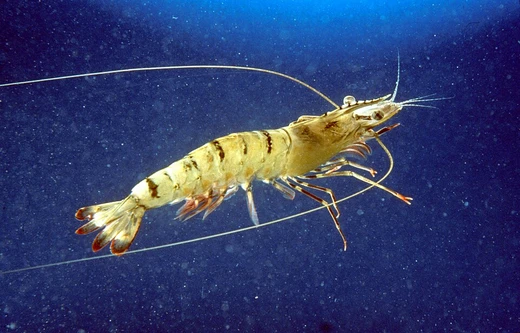
Palaemon serratus
Largest native prawn around the British Isles.

Palaemon serratus, known as the common prawn, lives in the Atlantic from Denmark down to Mauritania, as well as in the Mediterranean and Black Seas. These shrimp form groups in rocky crevices up to 40 metres deep, with a lifespan of three to five years. Females grow faster than males, and the population peaks sharply in autumn. They fall prey to fish from families like Mullidae, Moronidae, Sparidae, and Batrachoididae. Occasionally, a bulge on the carapace over the gills signals an isopod parasite such as *Bopyrus squillarum*.
This species stands out from other shrimp by its upward-curving rostrum, which splits at the tip and carries six to seven teeth on top and four to five underneath. In similar species, the dorsal teeth continue into the outer third of the rostrum, but in *P. serratus* that section is toothless. It is pinkish brown with reddish markings and typically reaches 100 millimetres in length, making it the largest native shrimp or prawn around the British Isles. Its hearing has been studied closely—it detects frequencies from 100 Hz to 3 kHz, with sensitivity comparable to generalist fish. While an individual’s hearing range shifts as it grows, all can hear tones at 500 Hz.
A small commercial fishery targets *P. serratus* along Great Britain’s west coast, mainly from Cemaes Head to the Llŷn Peninsula in West Wales, and increasingly north into parts of Scotland. In Ireland, fishing began in the 1970s at Baltimore, County Cork, and later spread. The peak landing of 548 tonnes came in 1999, with over 90% of the catch from Galway, Kerry, Cork, and Waterford. Current exploitation levels raise concerns about overfishing, and measures like a minimum landing size are under consideration.
Quick Facts
- Genus
- Palaemon
- Species
- serratus
Facts from the source article.
Lore & Background
Palaemon serratus lives for 3–5 years in groups in rocky crevices at depths of up to 40 metres. Females grow faster than males, and the population is highly seasonal, with a pronounced peak in the autumn. It is preyed upon by a variety of fish, including species of Mullidae, Moronidae, Sparidae and Batrachoididae. The shrimp can sometimes be found with a prominent bulge in its carapace over its gills, caused by the presence of an isopod parasite such as Bopyrus squillarum.
Palaemon serratus may be distinguished from other shrimp by its rostrum, which curves upward, is bifurcated at the tip, and has 6–7 teeth along its upper edge and 4–5 teeth on the lower edge. Other species may have a slightly curved rostrum, but then the teeth on its dorsal surface continue into the distal third, which is untoothed in P. serratus. It is pinkish brown with reddish patterns and typically 100 millimetres long.
A small commercial fishery exists for P. serratus on the west coast of Great Britain, chiefly in West Wales, but extending increasingly far north to include parts of Scotland. In Ireland, fishing began at Baltimore, County Cork in the 1970s and subsequently expanded. A peak landing of 548 t was recorded in 1999, and four counties account for over 90% of the catch: Galway, Kerry, Cork and Waterford. There is now concern that current levels of exploitation may represent overfishing, and measures are being considered to limit the catch, such as a minimum landing size.
Reader's Guide
Palaemon serratus holds significance as the largest native shrimp and prawn around the British Isles, reaching a typical length of 100 millimetres. Its hearing has been studied in detail, making it one of the few invertebrates for which auditory sensitivity is known; it is sensitive to frequencies between 100 Hz and 3 kHz, with an acuity similar to that of generalist fish, and all individuals can hear tones at 500 Hz. Ecologically, it forms groups in rocky crevices at depths up to 40 metres, with a highly seasonal population peaking in autumn, and is preyed upon by fish from several families. Its commercial fishery, though small, has expanded from West Wales into Scotland and from Baltimore, County Cork into other Irish counties, with a recorded peak landing of 548 t in 1999. The fishery now faces concerns of overfishing, prompting consideration of catch limits such as a minimum landing size. The species is also notable for its distinctive rostrum, which curves upward and is bifurcated at the tip, and for its susceptibility to the isopod parasite Bopyrus squillarum, which causes a bulge in the carapace over the gills.
Did You Know?
- Palaemon serratus is the largest native shrimp and prawn around the British Isles, typically 100 millimetres long.
- It is one of the few invertebrates to have its hearing studied in detail, with sensitivity between 100 Hz and 3 kHz.
- A peak landing of 548 t was recorded for this species in 1999.
- It can be parasitized by the isopod Bopyrus squillarum, causing a bulge in its carapace over the gills.
Taxonomic Identity & Historical Classification
Palaemon serratus, widely recognized as the common prawn, was formally categorized in 1777 by the naturalist Thomas Pennant. This species has long been a cornerstone of European crustacean taxonomy, alongside the common shrimp, Crangon crangon, which Carl Linnaeus described in 1758. Both species occur in enormous numbers along European coastlines, and their sheer abundance shaped early taxonomic thinking about what constitutes a shrimp versus a prawn. The common prawn is notably larger than its shrimp counterpart, a distinction that reinforced the popular association of prawns with bigger forms. In modern taxonomy, prawns of this kind typically belong to the suborder Dendrobranchiata, though some larger swimming crustaceans called prawns fall under Caridea within the suborder Pleocyemata. The phrase "true prawn" is occasionally used colloquially to signal what a particular individual considers a genuine prawn, but such labels carry no formal scientific standing and are rarely encountered in peer-reviewed literature.
The Nomenclature Dilemma
The words shrimp and prawn are vernacular labels with no fixed taxonomic meaning. As crustacean taxonomist Tin-Yam Chan observed, neither term points to a specific known group, and their application shifts from country to country and even within a single region. L. B. Holthuis, writing in 1980, documented this inconsistency, noting that in the United States larger commercially fished species tended to be called shrimp, while in other English-speaking nations the same animals were called prawns, though exceptions abounded. The word prawn itself first appeared in English records in the early 1400s in spellings like prayne, praine, and prane, yet its precise etymological origin remains unclear. Linguist Anatoly Liberman has pointed out that no other Germanic language links the shrimp concept to size, and no Romance language does either, leaving the circumstances under which the name attached to the crustacean genuinely unexplained. In contemporary usage, the two terms have become nearly interchangeable, despite occasional biologist attempts to restrict them to particular taxa.
Regional Naming Conventions
Because the terms originated in Britain, Commonwealth nations and Ireland largely follow the British convention: shrimp refers to smaller, dorsoventrally depressed species with a shorter rostrum, while prawn is reserved for larger, laterally compressed animals with a longer rostrum. Prawn is never applied to very small species. In the United States, however, shrimp is the dominant general term, and prawn appears less frequently, typically for larger or freshwater species. New Zealand authors offer a practical rule of thumb: shrimp are small, roughly three inches or less, harvested by netting in shallow water; prawns are larger, reaching up to twelve inches, and are caught by trapping or trawling. Australia presents notable exceptions, with some writers calling small Palaemonidae species prawns and Alpheidae members pistol shrimp, while others label Stenopus hispidus a banded coral shrimp. Canada and South Africa generally mirror the British pattern, though local variations persist.
Physical Form & Commercial Significance
Palaemon serratus exemplifies the larger, laterally compressed body plan that distinguishes prawns from the smaller, dorsoventrally flattened shrimp. While many shrimp species measure only about two centimetres in length, some exceed twenty-five centimetres, as seen in Penaeus monodon. This size range creates a linguistic oddity: the phrase jumbo shrimp reads as a contradiction, a problem that simply does not arise with the commercial label jumbo prawns. Larger crustaceans like the common prawn are the ones most often targeted by the fishing industry, and in Commonwealth markets they are routinely marketed under the prawn designation. The common prawn and common shrimp, both found in vast numbers along European shores, have historically anchored the commercial and culinary vocabulary of the region. Some prawns are indeed edible and form a significant part of human diets, though the terms themselves remain informal labels of convenience rather than precise biological categories.
Frequently Asked Questions
Who is Palaemon serratus?
The common prawn is the largest native prawn found around the British Isles, ranging from Danish waters south to Mauritania and across the Mediterranean and Black Seas. It typically measures about 100 millimetres in length and is instantly recognisable by its distinctly upward-curving rostrum.
What are Palaemon serratus's powers or unique traits?
It possesses a surprisingly broad hearing range of 100 Hz to 3 kHz, giving it a sharp sensory edge in coastal waters compared to many other small crustaceans. It also holds the distinction of being the biggest indigenous prawn in British coastal ecosystems.
Why is Palaemon serratus important?
It anchors coastal food webs as a staple prey item for numerous fish families and supports commercial fisheries that peaked at 548 tonnes of landings in 1999. Its sharp autumn population surge makes it a seasonal linchpin for both marine ecology and local economies.
Where can I find Palaemon serratus in the wild?
These prawns favour rocky crevices and sheltered substrates down to roughly 40 metres (about 130 feet) across the eastern Atlantic, Mediterranean, and Black Sea. They tend to cluster in groups rather than roam solo, making rocky reef habitats their natural home base.
More in Marine Shrimp, Part 2 1-24
Spotted an error? Know more?
Reader corrections go straight into our review queue. Suggest an edit · How this site is sourced