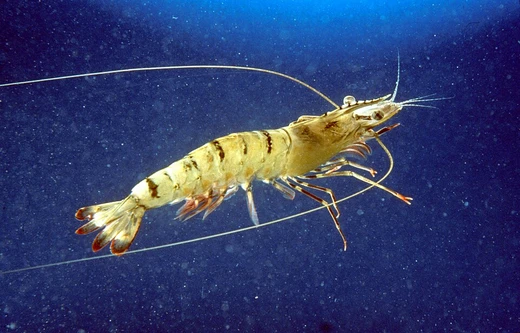
Periclimenes pholeter
A cave-dwelling shrimp known only from Ras Muhammad Crack.

Periclimenes pholeter is a species of shrimp in the family Palaemonidae, known only from the Ras Muhammad Crack. It is notable for its morphological similarities to Periclimenes indicus, P. obscurus, and P. toloensis, particularly in the presence of an epigastric tooth and unarmed fingers of the first chelipeds, while differing in features such as rostrum height and eye length.
Quick Facts
- Taxon
- Periclimenes pholeter
Facts from the source article.
Lore & Background
The rostrum reaches to or slightly beyond the end of the antennular peduncle, failing to reach the tip of the scaphocerite. It is straight with the tip directed slightly upward, bearing nine or ten teeth on the upper margin, four behind the orbit. A small epigastric tooth is present on the carapace, and a hepatic spine is placed below and behind the antennal spine. The abdominal somites are smooth with rounded pleura; the sixth somite is about twice as long as the fifth. The telson is 1.5 times as long as the sixth somite and carries two pairs of dorsal spinules. The eyes are well developed but relatively small, reaching only slightly beyond the middle of the basal segment of the antennular peduncle. The scaphocerite reaches distinctly beyond the antennular peduncle and is a little more than twice as long as wide. The mandible bears no palp; the incisor process ends in three or four teeth. The second legs are equal and reach with the carpus beyond the antennular peduncle. The dactylus is slender and bifid, less than 1/5 the length of the propodus. The endopod of the fifth pleopod of the male is widened distally; the second male pleopod has the appendix masculina slightly longer than the appendix interna. The exopod of the uropod has a straight outer margin ending in a tooth with a movable spine. The colour is pale yellowish green with red chromatophores forming red bands along the anterior margin of the first and posterior margins of all somites; the tail fan is light, and the appendages are pale pink.
Reader's Guide
Periclimenes pholeter is significant as a species known exclusively from the Ras Muhammad Crack, a highly restricted locality. Its description provides detailed morphological comparisons with related species, highlighting distinctions such as greater size, a much higher rostrum with more ventral rostral teeth, shorter eyes, less slender antennular peduncle, more deeply cleft upper antennular flagellum, more robust scaphocerite, and longer fingers of the first pereiopods. The species also exhibits more slender pereiopods, especially the fifth, which is much longer than the ischium. These features help clarify the taxonomic boundaries within the genus Periclimenes. The article notes that its colour is less intensely red than that of Calliasmata collected under the same circumstances, suggesting a shared habitat. The detailed description of appendages, including the male pleopods and uropod, contributes to the understanding of sexual dimorphism and morphological variation in palaemonid shrimp. As a species with a very limited known distribution, it underscores the importance of localized cave or crack habitats for marine biodiversity.
Did You Know?
- The species is known only from the Ras Muhammad Crack.
- The rostrum bears nine or ten teeth on the upper margin, four of which are behind the orbit.
- The fingers of the first pereiopods are about twice as long as the palm.
- The colour is pale yellowish green with red chromatophores, less intensely red than Calliasmata from the same location.
Frequently Asked Questions
What is Periclimenes pholeter?
Periclimenes pholeter is a cave-dwelling shrimp belonging to the family Palaemonidae. It is recognized as a distinct species despite its close morphological resemblance to several other Periclimenes species.
Where is Periclimenes pholeter found?
This shrimp is known exclusively from the Ras Muhammad Crack, a cave environment, making it a highly localized and geographically restricted species.
How large does Periclimenes pholeter grow?
Males reach a total length of 28–33 mm with a carapace of 13–14 mm, while females are slightly larger at 35–36 mm total and 14–15 mm carapace. The telson measures about 1.5 times the length of the sixth somite.
How does Periclimenes pholeter differ from similar species like P. indicus or P. toloensis?
While it shares traits such as an epigastric tooth and unarmed first-cheliped fingers with those relatives, P. pholeter sets itself apart through its specific rostrum height, eye length, and a rostral upper margin bearing 9 or 10 teeth.
Why is Periclimenes pholeter notable to marine invertebrate fans?
Its status as a species known from a single cave locality, combined with its subtle but diagnostically important differences from look-alike species, makes it a compelling example of how small morphological details define biodiversity in isolated habitats.
More in Marine Shrimp, Part 2 1-24
Spotted an error? Know more?
Reader corrections go straight into our review queue. Suggest an edit · How this site is sourced