Palaemon cummingi
A blind, colorless cave shrimp known only from one Florida sinkhole.

Palaemon cummingi, called the Squirrel Chimney Cave shrimp or Florida cave shrimp, is a threatened cave-dwelling shrimp from the family Palaemonidae. It has only been seen in one sinkhole—Squirrel Chimney—in Alachua County, Florida, near Gainesville. No one knows exactly how many remain, but the population is thought to be very small.
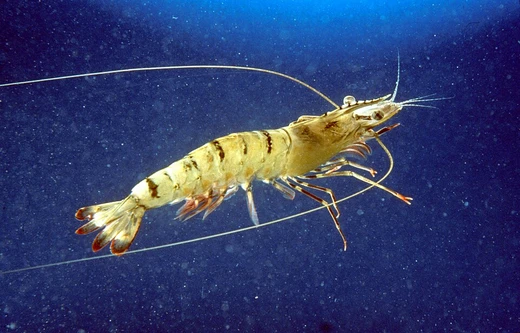
The shrimp is about 30 mm (1.3 inches) long. It is blind, with unpigmented eyes, and has a long, serrated rostrum—the shell extension that sticks out in front of the eyes—with six teeth on its upper side. Its first and second pairs of legs are nearly the same length. P. cummingi is almost completely colorless, with just a bit of white, and its internal organs are visible through its translucent exoskeleton.
Very little is known about its life history and reproduction. One female collected from Squirrel Chimney Cave was carrying about 30 to 35 bright green eggs. When the eggs hatched, the larvae were roughly 4.8 mm long and a dull yellow. Larval development goes through three zoea stages and is thought to closely resemble that of the glass shrimp (Palaemon paludosus). The larvae metamorphosed into a post-larval stage nine days after hatching.
The shrimp eats nitrogen-rich bat droppings and decaying organic matter. No information exists on its behavior, but the redeye chub, a predator, has been spotted in the cave system connected to Squirrel Chimney.
Researchers have only ever seen P. cummingi at Squirrel Chimney Cave. Inside the cave are vertical holes, or "chimneys," 3 to 6 feet wide and up to 50 feet deep. The shrimp lives in the water at the bottom of these chimneys, which lead to a larger underwater cave system formed from Ocala Limestone and linked to the Crystal River Formation. Though this connection opens up similar ecosystems nearby, the shrimp has only been found in Squirrel Chimney. The dark cave environment is why it lacks color and eyesight.
P. cummingi may have descended from a species in southern Texas, but it is only found in northern Florida. Squirrel Chimney Cave is the sole location with recorded sightings, giving the species very low redundancy—meaning a single major catastrophe could wipe it out. It might also live in Alachua, Columbia, and Gilchrist Counties, but surveys of Cherry Pits Cave, Herzog Cave, Hog Sink, and Bat Cave found no evidence of it.
In August 1990, the U.S.
Quick Facts
- Taxon
- Palaemon cummingi
Facts from the source article.
Lore & Background
Palaemon cummingi was first discovered in 1953, and between that year and the latest observation in 1973, no more than a dozen collections were made. The shrimp is blind and unpigmented, with a long, serrated rostrum bearing six teeth on its dorsal surface. Its first and second pairs of legs are almost equal in length, and its nearly colorless body allows internal organs to be seen through the translucent exoskeleton.
Life history information is very limited. A single female collected from Squirrel Chimney Cave was carrying 30–35 bright green eggs; larvae hatched at about 4.8 mm and were a dull yellow color. Larval development involves three zoeal stages, thought to be very similar to that of the glass shrimp (Palaemon paludosus), and larvae metamorphosed into a post-larval state nine days after hatching.
The shrimp relies on a diet of nitrogen-rich bat droppings and decaying organic matter. Its only known predator is the redeye chub (Notropis harperi), an invasive species that has been spotted in the cave system connected to Squirrel Chimney. The cave environment and absence of sunlight are responsible for the shrimp's lack of color and eyesight.
Reader's Guide
Palaemon cummingi holds significance as a narrowly endemic species restricted to a single sinkhole in Alachua County, Florida. Its listing as threatened under the Endangered Species Act in August 1990, and as critically endangered by the IUCN in 2012, underscores its precarious status. The U.S. Fish and Wildlife Service noted in 2008 that no federal recovery plan was warranted because the species occurs only on privately owned land. The shrimp's very low redundancy means any major catastrophe could cause extinction.
Threats identified include human activity, habitat loss, ground-water contamination, aquifer withdrawals, saltwater intrusion, and predation by the invasive redeye chub. Natural droughts and water withdrawals can lower cave water levels; a survey between 1994 and 1996 found no individuals at Squirrel Chimney or four other sites, and the water level had dropped 2.5 metres (8.2 ft) from 1940s measurements. As of 2021, the species' current status remains unknown, and the U.S. Fish and Wildlife Service recommends it remain classified as threatened until another survey is conducted. The shrimp's legacy is that of a fragile, isolated cave dweller whose survival hinges on the protection of a single, vulnerable aquifer system.
Did You Know?
- Palaemon cummingi is blind and its eyes are unpigmented.
- The shrimp's larvae hatch from bright green eggs and are a dull yellow color.
- The redeye chub, an invasive species, is a predator of P. cummingi.
- No more than a dozen collections of P. cummingi were made between its discovery in 1953 and 1973.
Frequently Asked Questions
What is Palaemon cummingi?
Palaemon cummingi is a small, blind cave shrimp in the family Palaemonidae, commonly called the Squirrel Chimney Cave shrimp or Florida cave shrimp. It is a threatened species known exclusively from a single sinkhole in Florida.
Where does Palaemon cummingi live?
This shrimp is documented only from Squirrel Chimney, a sinkhole in Alachua County near Gainesville, Florida. No other populations have been found anywhere else in the world.
What does Palaemon cummingi look like?
The shrimp grows to roughly 30 mm (about 1.3 inches) and has unpigmented, non-functional eyes adapted to permanent darkness. Its most distinctive feature is a long, serrated rostrum bearing six teeth along the upper edge.
How does Palaemon cummingi reproduce?
Females carry around 30 to 35 embryos per brood, and the young emerge at roughly 4.8 mm in length. The larvae pass through three zoeal stages before reaching the post-larval form about nine days after hatching.
Why is Palaemon cummingi considered threatened?
Because the entire known population is restricted to one sinkhole, the species is extremely vulnerable to localized disturbances such as water contamination or shifts in cave hydrology. Its exact numbers remain unknown, but it is believed to be very small.
More in Marine Shrimp, Part 2 1-24
Spotted an error? Know more?
Reader corrections go straight into our review queue. Suggest an edit · How this site is sourced