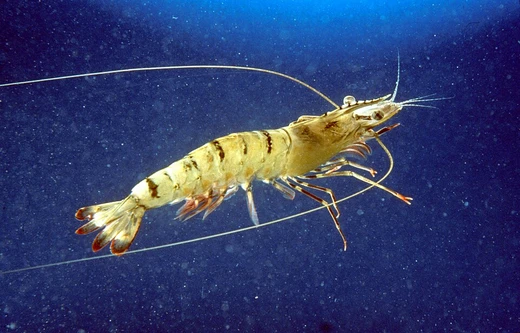
Palaemon affinis
Endemic New Zealand tide-pool shrimp with transparent, striped body.

**Palaemon affinis**, called the tide-pool shrimp or glass shrimp, belongs to the family Palaemonidae and lives only in New Zealand waters. It is the most common prawn found in the intertidal zone around the North and South Islands.
**Taxonomy** French zoologist Henri Milne-Edwards first described it in 1837, giving it two names: *Palaemon affinis* and *Palaemon quoianus*. In 1876 it was placed in the subgenus *Leander* (a subgroup of *Palaemon*), then moved to the subgenus *Palaemon* in 1954, at which point *P. quoianus* was recognized as the same species. Early researchers sometimes used the name *Palaemon affinis* for specimens that actually belong to other species.
**Description** This shrimp has a transparent, prawn-like body. Males average about 6.1 mm in carapace length and 15–36 mm total length; females have a carapace length around 13.3 mm and total length from 5 to 57.2 mm. The body is striped, often red and green, with orange-black dots along the tail and legs—camouflage that suits rocky pool environments. The rostrum (a sharp, saw-like projection) is usually longer than the carapace and is used for foraging and defense; its shape helps tell *Palaemon* species apart. Like others in the genus, *P. affinis* typically has about six body segments. It has both chelate (pincered) and non-chelate legs. Females carrying eggs use their chelate legs to clean the eggs and keep water moving around them.
**Distribution and habitat** Found at depths up to 300 m in water temperatures of 16–20°C, this shrimp occurs along rocky intertidal shores and in estuaries. It tolerates a wide salinity range (5–43%). Although once thought to live in many countries, it is now considered restricted to New Zealand, though some specimens from subantarctic islands and Australia may belong to this species. At McCormacks Bay in Canterbury, it is most abundant at high tide, at night, and in summer, with numbers changing across tidal cycles and seasons.
**Ecology** *Diet*: Mostly carnivorous. Stomach contents show it feeds mainly on amphipods, but also eats polychaetes, gastropods, and bivalves, and may take plant material when available. Diet does not differ between sexes, though smaller males eat less than larger females. No seasonal shifts in diet have been reported. Individuals feed mainly at night and keep their stomachs about half full during the day.
Quick Facts
- Taxon
- Palaemon affinis
Facts from the source article.
Lore & Background
Palaemon affinis was first described in 1837 by Henri Milne-Edwards under two names: Palaemon affinis and Palaemon quoianus. In 1876 it was placed in the Leander subgenus, then moved to the Palaemon subgenus in 1954, at which time P. quoianus was recognized as a synonym. Early authors used the name Palaemon affinis for specimens now considered to belong to other species. The species is now considered to occur only in New Zealand, though some specimens from subantarctic islands and Australia may also be this species.
The shrimp has a transparent body striped in red and green, with orange-black dots along the tail and legs, providing camouflage in rocky pool environments. The rostrum is saw-like, usually longer than the carapace, and is important for distinguishing between Palaemon species. Females use their chelate legs to clean eggs and promote water flow. The species is mostly carnivorous, feeding primarily on amphipods, and can also consume polychaetes, gastropods, bivalves, and plant material. Diet does not differ by sex, but smaller males consume less than larger females.
Reproduction involves females reaching maturity at 33–41 mm total body length in late spring to early summer. Egg number depends on individual fertility (110–690 eggs per cycle), carried under the abdomen for 2–3 weeks. The species can display sequential hermaphroditism, switching between female and male forms. Molting frequency varies with age and environment; juveniles molt up to 2–4 times per week. Predators include fish, larger shrimps, crabs, and other crustaceans. The shrimp uses fucoid seaweed to evade predation, and population density is up to 3-fold higher in algae-rich habitat.
Reader's Guide
Palaemon affinis holds significance as the most common intertidal prawn in New Zealand, dominating rocky shores and estuaries. Its tolerance of wide salinity changes (5–43%) and occurrence at depths up to 300 m illustrate its adaptability. The species' reliance on chemoreception for predator avoidance, habitat selection, and conspecific finding is notable, especially given the limited visibility in tide pools. Its ability to distinguish between conspecific and heterospecific chemical cues may enhance mating success. The shrimp's preference for algae-rich habitats, driven by olfactory cues, links its population density directly to seaweed presence, with up to 3-fold increases in such environments. This habitat also provides prey, conspecific encounters, thermal regulation, and higher oxygen content. The species exhibits low aggression, using pushing or claw flicking rather than fighting. Egg-carrying females maintain small territories for protection. Although mostly solitary or in loose aggregations, individuals live in close proximity in rocky areas. The species is sometimes kept as an aquarium pet, especially in Australia, requiring a tank of about 50 liters. Its reproductive strategy differs from other Palaemon species, with egg number dependent on individual fertility rather than body size, and it can undergo sequential hermaphroditism, switching between sexes based on carapace length.
Did You Know?
- The species can switch back and forth between female and male forms (sequential hermaphroditism).
- Egg number per breeding cycle depends on individual fertility, ranging from 110 to 690 eggs.
- The shrimp uses fucoid seaweed to evade predation, with population density up to 3-fold higher in algae-rich habitats.
Taxonomic History and the Identity Puzzle
Palaemon affinis has a checkered taxonomic past that reflects how difficult it was to pin down a single, coherent identity for this little creature. Henri Milne-Edwards first described the species back in 1837, and in that same publication he also named a second form, Palaemon quoianus, which would later be folded into the same species. For nearly two decades the taxonomy sat relatively still, but in 1876 the organism was reassigned into the Leander subgenus within Palaemon. It was not until 1954 that researchers moved it back into the Palaemon subgenus and formally declared P. quoianus a synonym, consolidating what had been treated as two separate names into one. Complicating matters further, early naturalists had applied the label Palaemon affinis to specimens that we now recognize as belonging to entirely different species, so the name carried baggage well beyond the true glass shrimp. Today the species is understood to be endemic to New Zealand's waters, though some subantarctic and Australian specimens have been tentatively linked to it.
A Living Camouflage: Form and Function
The glass shrimp earns its common name from a body that is largely see-through, yet it is far from plain. Red and green stripes run along its prawn-like frame, punctuated by orange-black dots scattered across the tail and legs—a coloration that blends seamlessly into the algae-streaked rocks of intertidal pools. Sexual dimorphism is striking: males average a carapace of roughly 6.1 mm with total lengths between 15 and 36 mm, while females boast a carapace near 13.3 mm and can stretch from 5 to over 57 mm. One of the most diagnostic features is the rostrum, a sharp, saw-edged projection that typically extends beyond the carapace and serves both in foraging and in defense. The body comprises about six segments, and the legs split into two functional groups: pincered chelate limbs and non-chelate ones. When a female is brooding eggs, those chelate legs take on a caretaking role, gently cleaning the clutch and stirring water around it to keep the developing embryos oxygenated.
Sex-Switching, Egg Brooding, and a Reproductive Strategy of Its Own
Palaemon affinis departs from the reproductive norm seen in most of its Palaemon relatives. Where other species in the genus can carry up to 2,750 eggs per cycle, the glass shrimp's clutch size is governed by each female's individual fertility, typically ranging from 110 to 690 eggs. Females reach sexual maturity at a total body length of 33 to 41 mm, usually in late spring or early summer. The eggs are tucked beneath the abdomen on the pleopods and remain there for two to three weeks, during which the mother continuously fans and cleans them to ward off fungal infection. Once hatched, the larvae drift as plankton, moulting through several stages before juveniles settle onto rock beds once their limbs are fully formed. Perhaps most remarkably, the species exhibits sequential hermaphroditism: a female can transition to a male at a carapace length of 12 to 13 mm and revert back to female at around 16 mm, a fluid identity that sets it apart from its congeners. During breeding periods, a female's molt itself acts as a visual signal to attract males.
Hiding in Seaweed: Predation, Chemistry, and Microhabitat Choice
Life in a tide pool is a constant negotiation with predators—fish, larger shrimps, crabs, and other crustaceans all keep watch. The glass shrimp is most exposed immediately after molting, when its new shell is still soft, and it retreats beneath rocks for safety, especially during mating season. A key survival trick is its reliance on fucoid seaweed as a living shield; population densities can triple in algae-rich patches compared to bare rock. The shrimp identifies suitable seaweed species through olfactory cues, and its microhabitat choice shifts with perceived risk: when predation pressure is low it roams more freely, but under high threat it clusters in dense algal cover. That same habitat also delivers a richer prey supply, more encounters with potential mates, a patchwork of micro-temperatures that aids body-temperature regulation, and elevated oxygen levels. Socially the shrimp is largely solitary or found in loose groups, and conflicts are rare—disputes are settled with a push or a quick claw flick rather than a full fight, while chemical signals broadcast warnings about nearby predators.
Frequently Asked Questions
What is Palaemon affinis?
Palaemon affinis is a small, transparent, striped shrimp in the family Palaemonidae, widely known as the tide-pool or glass shrimp. It is the most commonly encountered prawn in New Zealand's intertidal zones.
Where does Palaemon affinis live?
The species is found exclusively in New Zealand waters, populating the intertidal zone along both the North and South Islands. It can also be encountered at depths reaching up to 300 metres.
How big does Palaemon affinis get?
Males average about 6.1 mm in carapace length while females reach roughly 13.3 mm, with total body lengths spanning 15 to 57.2 mm. This clear size gap between the sexes is a hallmark of the species.
Who first described Palaemon affinis?
French zoologist Henri Milne-Edwards published the species in 1837, originally assigning it two names. The synonym Palaemon quoianus was formally merged into P. affinis in 1954 after taxonomic revisions.
What environmental range can Palaemon affinis tolerate?
It copes with salinity levels from as low as 5 percent up to 43 percent, giving it a broad osmotic tolerance. Combined with its ability to inhabit depths up to 300 metres, this flexibility lets it occupy a wide variety of coastal and subtidal habitats.
More in Marine Shrimp, Part 2 1-24
Spotted an error? Know more?
Reader corrections go straight into our review queue. Suggest an edit · How this site is sourced