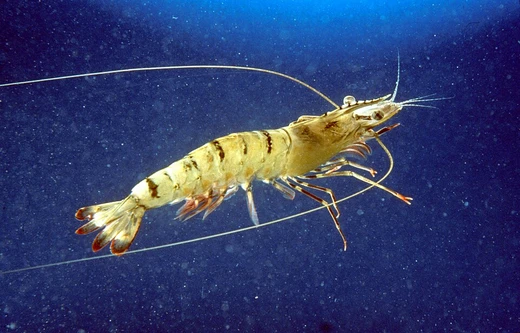
Urocaridella antonbruunii
A cleaner shrimp with transparent body and red-white markings.

Urocaridella antonbruunii goes by the common names clear cleaner shrimp or red-white cleaner shrimp. This shrimp, a member of the family Palaemonidae, was first described by A. J. Bruce in 1967. It belongs to the group of species known as cleaner shrimps.
These shrimp are found across a broad area of the Western Central Indo-Pacific, ranging from the Maldives and Thailand through Indonesia, the Philippines, Taiwan, and Papua New Guinea, and as far east as Fiji and Hawaii. They live in warm, shallow waters within coral reef environments, at depths between 2 and 66 meters (7 to 217 feet), where they locate their preferred hosts.
Adults reach a body length of roughly 25 to 30 millimeters (0.98 to 1.18 inches). Like others in the genus *Urocaridella*, they have very long rostrums that curve upward, transparent bodies, and numerous bright red and yellow spots covering the carapace and abdomen. Their internal organs are clearly visible through the translucent body, which serves as effective camouflage. The abdomen bends at a characteristic right angle, marked by a red spot with a white spot just before it. Their antennae are long and transparent, unlike the white antennae seen in many other cleaner shrimp species. The pereiopods (walking legs) are banded in red and white. To move toward a client fish, the shrimp rapidly beat the pleopods under their abdomen, which makes them appear to hover.
*Urocaridella antonbruunii* is gonochoric, meaning individuals are either male or female. They commonly perform a precopulatory courtship ritual. As cleaner shrimps, they remove external parasites from client fish. Notably, this was the first shrimp reported to clean sleeping rabbitfish (*Siganus canaliculatus*) at night. To attract clients, they display stereotypical behavior: when a potential client approaches, they position themselves in a conspicuous spot near their cleaning station. During cleaning sessions, they feed on parasites and mucus from the host, but they also capture copepods, small microorganisms, and debris from the seafloor.
Quick Facts
- Taxon
- Urocaridella antonbruunii
Facts from the source article.
Lore & Background
Urocaridella antonbruunii was described by A. J. Bruce in 1967. It belongs to the family Palaemonidae and is one of the species known as cleaner shrimps. Its common names include clear cleaner shrimp and red-white cleaner shrimp.
The species has a wide distribution throughout the Western Central Indo-Pacific, from the Maldives to Thailand, Indonesia, Philippines, Taiwan, Papua-New Guinea, Fiji, and Hawaii. It occurs in tropical shallow waters in coral reef environments at depths of 2 to 66 meters.
Urocaridella antonbruunii can reach a body length of about 25–30 mm. Like other species in the genus Urocaridella, it has a very long rostrum curved upwards, a transparent body, and numerous brightly colored red and yellow spots on the carapace and abdomen. Internal organs are clearly visible, and the translucency provides effective camouflage. The abdomen forms a characteristic right angle where there is a red spot preceded by a white spot. The antennae are long and transparent, not white as in many cleaning shrimp. The pereiopods are banded in red and white, and the pleopods are beaten rapidly to move the shrimp toward client fish, making it appear to hover.
Reader's Guide
Urocaridella antonbruunii is notable as a cleaner shrimp, removing external parasites from client fish. It is the first shrimp reported cleaning sleeping rabbitfish Siganus canaliculatus at night. The species exhibits stereotypical behavior to attract clients, positioning itself in a conspicuous location near its cleaning station when a potential client is nearby. It feeds on parasites and mucus from hosts during cleaning sessions, and also captures copepods, small microorganisms, and debris on the bottom. The species is gonochoric and commonly performs a precopulatory courtship ritual. Its transparent body with red and white markings, along with its hovering movement, are distinctive characteristics. The species was described by A. J. Bruce in 1967 and is included in several taxonomic works, including those by Liu, Liang & Yan (1990), Fransen (1994), and De Grave & Fransen (2011).
The Observed Cleaning Event
The most concrete piece of information about Urocaridella antonbruunii comes from a single field observation: a cleaner shrimp removing material from a sleeping rabbitfish. The client in this interaction was Siganus canaliculatus, a member of the twenty-nine-species genus Siganus, the sole surviving genus within the family Siganidae. What makes the observation notable is the timing. Rabbitfishes are strictly diurnal creatures, and S. canaliculatus was found resting in a crevice of the reef matrix during the night hours. The shrimp approached this vulnerable, stationary fish and performed its cleaning role. The event was recorded as a direct observation rather than inferred from behavior patterns, lending it particular weight in documenting the shrimp's ecological function. The interaction places Urocaridella antonbruunii squarely within the cleaning-symbiosis niche of Indo-Pacific reef communities, where it services a fish that is otherwise active, herbivorous, and equipped with venomous dorsal and pelvic fin spines.
Habitat and Geographic Range
The geographic and habitat context in which Urocaridella antonbruunii has been documented is broad. Its known cleaning interaction with Siganus canaliculatus takes place within the Indo-Pacific realm, a region stretching from the Red Sea and the eastern African coast across to Pitcairn Island in the Pacific. Within this vast expanse, the relevant microhabitats are inshore tropical and subtropical waters. The specific structural environments where these interactions occur include coral reefs, lagoons, mangrove forests, and seagrass beds. The rabbitfish client is a laterally compressed, oval-bodied fish that occupies these same shallow-water settings. The fact that the cleaning event was witnessed in a reef crevice at night situates the shrimp within the complex three-dimensional architecture of living reef systems, where crevices provide shelter for diurnal species during their resting period and create the microscale niches in which a small cleaner organism can operate safely alongside a venomous-spined fish.
The Sleeping Client
Understanding Urocaridella antonbruunii's role requires understanding the fish it services. Siganus canaliculatus, the white-spotted spinefoot, belongs to a genus first described in 1775 by Danish zoologist Johan Christian Fabricius, based on notes from Peter Forsskål's Danish Arabia expedition. The genus name itself derives from the local Arabic word Sidjan, meaning rabbitfish. All members of Siganus are diurnal, meaning they are active during daylight and retreat to rest at night. S. canaliculatus specifically sleeps tucked into crevices within the reef matrix. During this vulnerable resting phase, the fish is stationary and less able to defend itself, yet it still bears venomous spines in its dorsal and pelvic fins, spines equipped with well-developed venom glands. The observation of Urocaridella antonbruunii cleaning the fish during this exact window of inactivity highlights a remarkable trust dynamic: the shrimp works on a sleeping, venom-armed client in the confined space of a reef crevice, undisturbed by the fish's usual daytime vigilance.
Taxonomic and Ecological Context
Urocaridella antonbruunii occupies a specific functional role as a cleaner shrimp within a reef ecosystem dominated by organisms like the Siganidae. The family Siganidae contains only one extant genus, Siganus, which in turn holds twenty-nine recognized species ranging from the small blotched foxface at twenty centimeters to the streaked spinefoot at fifty-three centimeters. These fish are commercially important food species, used in the preparation of dishes such as bagoong, and two Red Sea species have even established populations in the eastern Mediterranean through Lessepsian migration via the Suez Canal. Against this backdrop of a diverse, ecologically and economically significant fish group, the cleaner shrimp represents a small but essential service organism. The documented interaction with S. canaliculatus confirms that Urocaridella antonbruunii participates in the mutualistic cleaning networks that characterize healthy Indo-Pacific reef communities, providing a maintenance service to a fish that is simultaneously a foraging herbivore, a venom-bearing species, and a commercially harvested resource.
Frequently Asked Questions
What is Urocaridella antonbruunii?
Urocaridella antonbruunii is a small cleaner shrimp in the family Palaemonidae, commonly called the clear cleaner shrimp or red-white cleaner shrimp. It was first formally described by A. J. Bruce in 1967.
Where can you find Urocaridella antonbruunii in the wild?
This species inhabits warm, shallow coral reef waters across the Western Central Indo-Pacific, stretching from the Maldives and Thailand through Indonesia, the Philippines, and Taiwan, all the way to Papua New Guinea, Fiji, and Hawaii. It ranges from roughly 2 to 66 meters in depth.
How big does Urocaridella antonbruunii get?
Adults of this species typically measure between 25 and 30 millimeters, which is about one inch in total body length.
What does Urocaridella antonbruunii look like?
The shrimp has a largely transparent body accented with distinctive red and white markings, the coloration that gives it its 'red-white cleaner shrimp' common name.
What role does Urocaridella antonbruunii play on coral reefs?
As a member of the cleaner shrimp group, it provides cleaning services to other reef organisms, helping maintain the overall health of the coral reef ecosystems it inhabits across its wide Indo-Pacific range.
More in Marine Shrimp, Part 2 1-24
Spotted an error? Know more?
Reader corrections go straight into our review queue. Suggest an edit · How this site is sourced