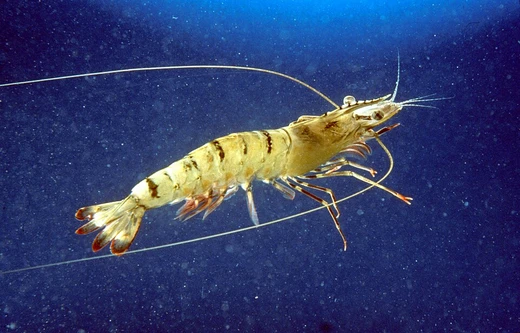
Zenopontonia rex
A commensal shrimp that varies color with its host.

Zenopontonia rex, commonly known as the emperor shrimp or imperial shrimp, is a species of shrimp in the family Palaemonidae. It is found in shallow water in the tropical Indo-Pacific region, where it lives in association with a sea cucumber, a nudibranch, or other large mollusc. Notable for its variable coloration and commensal lifestyle, this shrimp often perches on the back of its host as it moves around.
Quick Facts
- Genus
- Zenopontonia
- Species
- rex
Facts from the source article.
Lore & Background
Zenopontonia rex was first described by A. J. Bruce in 1967 based on eight specimens ranging from 4 mm to 7.6 mm. The shrimp is robust, growing to about 3 cm, with females being larger and slightly less colorful. Its antennae are modified into a series of plates extending forward, and the rostrum has a crest-like extension. The cephalothorax bears a small spine on either side, and the first two pairs of legs have pincers with short sensory hairs. The basic color is orange-yellow to orange-red, with purple antennal plates, claws, and walking legs. During the day, white chromatophores expand and may cover much of the dorsal surface and tail fan, or appear as a median band. The coloring also varies depending on the host; the classic coloring usually occurs when associated with a sea cucumber, but it sometimes matches the host's color, particularly when associated with an opisthobranch.
Reader's Guide
Zenopontonia rex lives as a commensal on a variety of hosts, including sea cucumbers such as Bohadschia, Opheodesoma, Stichopus, Synapta maculata, or Thelenota, and on nudibranchs and other large molluscs including Asteronotus, Ceratosoma, Chromodoris, Cypraea, Dendrodoris, Hexabranchus, Hypselodoris, and Pleurobranchus. Occasionally it has been observed with starfish such as Echinaster or Gomophia. Often a pair or even three shrimps share a single host, and they usually have identical coloring. They keep to the dorsal surface or flanks, moving to the far side if danger threatens. The shrimp feeds on detritus on the seabed, cleans the host's surface, and feeds on mucus and feces. This species is gonochoric; the male uses his first two pairs of walking legs to deposit sperm on the underside of the female's thorax, where eggs are incubated until hatching. Larvae are planktonic. Recent studies have shown predatory habits: in two cases in Tulamben, Bali, Indonesia, a shrimp attacked a small palaemonid shrimp, and two shrimps living with an echinasterid sea star attacked a small post-larval fish, indicating that Z. rex claws are strong enough to grip relatively large prey and that it is an opportunistic hunter.
Did You Know?
- The emperor shrimp's color can vary to match its host, especially when associated with an opisthobranch.
- It has been observed living in association with starfish such as Echinaster or Gomophia.
- Recent studies in Tulamben, Bali, showed that Z. rex can act as an opportunistic hunter, attacking small fish and other shrimp.
Frequently Asked Questions
What is Zenopontonia rex?
Zenopontonia rex is a small commensal shrimp in the family Palaemonidae, often called the emperor or imperial shrimp. It is best known for its shifting coloration and its habit of perching on the backs of larger marine animals as they move through the water.
Where can you find Zenopontonia rex in the wild?
The species ranges across the tropical Indo-Pacific, stretching from the Red Sea and Réunion eastward to Hawaii and French Polynesia, and from southern Japan down through New Caledonia to northern Australia. It occupies shallow waters, generally no deeper than about 40 metres (130 ft).
How does Zenopontonia rex survive in its habitat?
Instead of foraging independently, the shrimp rides on a host animal—such as a sea cucumber, a nudibranch, or a large mollusc—and travels with it through the water column. Its coloration adjusts to match whichever host it is attached to, providing natural camouflage against predators.
How large does Zenopontonia rex grow?
Adults reach a maximum total length of roughly 3 centimetres (about 1.2 inches). The original type specimens measured between 4 and 7.6 millimetres, underscoring just how diminutive this shrimp is in the broader reef ecosystem.
Who first described Zenopontonia rex and when?
The species was formally named and described by A. J. Bruce in 1967. Despite being known to science for only a little over half a century, its striking color variation and commensal lifestyle have made it a popular subject among reef divers and marine invertebrate researchers.
More in Marine Shrimp, Part 2 1-24
Spotted an error? Know more?
Reader corrections go straight into our review queue. Suggest an edit · How this site is sourced