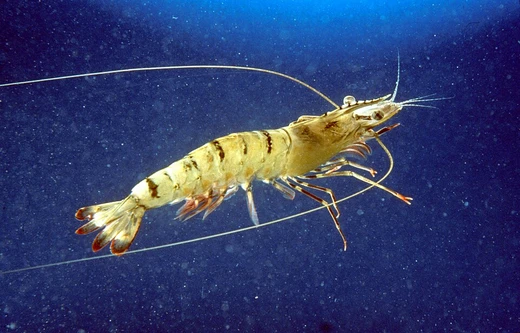
Synalpheus regalis
First known eusocial marine animal, living in sponge colonies.

Synalpheus regalis is a snapping shrimp that lives its entire life inside the internal canals of sponges on tropical West Atlantic coral reefs. It is a major part of the region’s marine cryptofauna. The shrimp use the sponge for both food and shelter. Colonies can have more than 300 individuals, but only one female reproduces. Larger colony members, which almost never breed, defend the colony against other species. This was the first known case of eusociality in a marine animal. The name “regalis” comes from Latin for “royal,” likely referring to the colony’s hierarchy, where a single female produces all offspring.
Taxonomy: S. regalis belongs to the genus Synalpheus, the second-largest genus in the snapping shrimp family Alpheidae, with over 150 species worldwide. It was discovered by J. Emmet Duffy in 1996 on the Belize Barrier Reef. As of 2013, it is one of at least seven recognized eusocial shrimp species, along with Synalpheus brooksi, Synalpheus chacei, Synalpheus elizabethae, Synalpheus filidigitus, Synalpheus microneptunus, and Synalpheus rathbunae.
Appearance: S. regalis is translucent orange. The tip of its major claw is brighter orange than the rest of its body. Its embryos and ovaries are pale green. Red chromatophores are scattered on the facial region of its carapace, between and beside the eyes. Its rostrum, a forward extension of the carapace, is thin and about as long as the triangular ocular hood covering the eyestalks. Ovigerous females are usually 2.6–3.7 mm long; males and juveniles are about 2.8 mm. Females can be told from males by their ovaries, but males and juveniles look alike. S. regalis looks similar to S. elizabethae, S. rathbunae, and S. filidigitus. It differs from S. elizabethae because its non-ovigerous members have rounded abdominal pleura, while S. elizabethae has pointed ones. Compared to S. rathbunae, S. regalis has more acute abdominal pleura, fewer fixed teeth, and no secondary armature on its major claw. S. filidigitus males have much rounder abdominal pleura and longer scaphocerites than S. regalis.
Habitat: S. regalis lives only in sponges, but only in three species: Neopetrosia proxima, Neopetrosia subtriangularis, and Hyatella intestinalis. In Jamaica, it is found in H. intestinalis at depths over six meters. In Belize, the only other known location, it is more common in N. proxima and N.
Quick Facts
- Taxon
- Synalpheus regalis
Facts from the source article.
Lore & Background
Synalpheus regalis was discovered by J. Emmet Duffy in 1996 on the Belize Barrier Reef. Its species name comes from the Latin regalis meaning 'royal', likely referring to the colony hierarchy where a single female produces all offspring. The shrimp are translucent orange with brighter orange pincers, pale green embryos and ovaries, and scattered red chromatophores on the facial region of the carapace. Ovigerous females are 2.6–3.7 mm in length, while males and juveniles are about 2.8 mm. Externally, females can be distinguished by their ovaries, but males and juveniles cannot be told apart. S. regalis is morphologically similar to several other Synalpheus species, including S. elizabethae, S. rathbunae, and S. filidigitus, but differs in features such as abdominal pleura shape and chela armature.
The shrimp live exclusively in three sponge species: Neopetrosia proxima, Neopetrosia subtriangularis, and Hyatella intestinalis. In Jamaica they are found in H. intestinalis at depths over six meters; in Belize they also inhabit N. proxima and N. subtriangularis. They rarely cohabit sponges with other shrimp, suggesting fierce competition. When co-occurring, S. regalis dominates the sponge, leaving other species under-represented. In the Bocas del Toro Archipelago, it co-occurs with its close relative S. elizabethae. The shrimp feed on host tissues and detritus.
Reader's Guide
Synalpheus regalis is significant as the first documented case of eusociality in a marine animal. Its colonies exhibit multigenerational cooperation, strong reproductive skew (usually a single breeding female), and cooperative defense of the host sponge. Colonies can contain up to 350 individuals, all related with an average relatedness of r=0.50, with one queen. The queen is not aggressive and relies on other colony members for protection. The non-breeding workers are more closely related to the queen's offspring (siblings, r=0.50) than to offspring of another worker (nieces/nephews, r=0.25), which may explain why they forgo reproduction. The species fits the 'fortress defender' model of eusociality: food and shelter coincide in an enclosed habitat, the resource is valuable and under strong competition, and the shrimp can defend it effectively using their snapping claws. Experiments show that residents respond to heterospecific intruders with intense battles and coordinated snapping, while contacts with natives are peaceful. Larger residents are the most active defenders. The discovery of eusociality in S. regalis challenged earlier theories that eusociality evolved only through kin selection, and alternative hypotheses such as group selection or standard natural selection have been considered, though a unifying theory remains in progress.
Did You Know?
- Synalpheus regalis was the first eusocial marine animal discovered.
- Colonies can contain up to 350 individuals but only one reproductive female.
- The species name 'regalis' means 'royal' in Latin, referring to the colony hierarchy.
- Larger non-breeding colony members defend the sponge against heterospecific intruders using their snapping claws.
More in Marine Shrimp, Part 2 1-24
Spotted an error? Know more?
Reader corrections go straight into our review queue. Suggest an edit · How this site is sourced