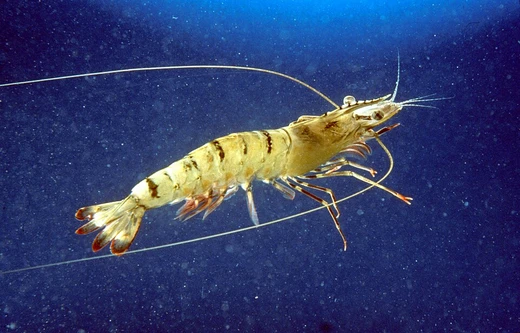
Synalpheus microneptunus
A eusocial snapping shrimp living exclusively in Barbados sponges.

Synalpheus microneptunus is a species of small snapping shrimp native to the waters off the island of Barbados. It is notable as one of at least seven known species of eusocial shrimp, the only marine animals known to exhibit eusociality. These shrimp are cryptofauna, living exclusively within the network of tunnels in the sponges Neopetrosia proxima and Neopetrosia subtriangularis, forming small colonies of six to fifteen individuals, usually with only a single breeding female.
Quick Facts
- Taxon
- Synalpheus microneptunus
Facts from the source article.
Lore & Background
Synalpheus microneptunus was first described in 2011 from specimens collected at the Cement Factory Reef off Barbados. It belongs to the genus Synalpheus of the snapping shrimp family Alpheidae, and is one of five closely related and morphologically very similar species in the Synalpheus paraneptunus species complex. It can be distinguished from other members of the complex by the presence of four carpal segments on each of the second pair of walking legs, whereas other species have five. Its specific name reflects its affinity to the S. paraneptunus complex and its status as the smallest member of the group in terms of body size.
These shrimp are small, with a carapace length of only 2.2 to 2.9 mm. The carapace is smooth with sparsely distributed setae, and the posterior end has a distinct cardiac notch. The major first pereopod (snapping claw) is very large, with the carpus more than twice as long as the fingers. The minor first pereopod (feeding claw) has a blade-like dactyl with three teeth near the tip and a trowel-like fixed finger with a single tooth. In life, they have pale undistinguished coloration with dull yellow-orange tips; the ovaries and embryos of breeding females are green.
Ecologically, Synalpheus microneptunus is exclusively associated with sponges, living as cryptofauna within the tunnels of Neopetrosia proxima and Neopetrosia subtriangularis. Colonies average six individuals, with a maximum of fifteen, and usually contain a single breeding female (the queen). The remaining individuals are non-ovigerous defenders who cooperatively defend the queen and nest from invaders, typically conspecifics or congeners. Like other alpheid shrimps, they use specialized enlarged claws to produce jets of water capable of stunning small animals.
Reader's Guide
Synalpheus microneptunus holds significance as one of at least seven known eusocial shrimp species, representing the only marine animals known to exhibit eusociality. This social structure, with a single breeding queen and non-reproductive defenders, is a rare phenomenon in marine environments and provides a key example for studying the evolution of social behavior. The species is also notable for its strict association with two specific sponge hosts, Neopetrosia proxima and Neopetrosia subtriangularis, and its cryptofaunal lifestyle, which makes it rarely seen despite relative abundance. Its discovery in 2011 added to the understanding of the Synalpheus paraneptunus species complex, with the four-segmented carpus on the second walking legs serving as a clear distinguishing feature. The species is only known from waters off Barbados, including the type locality Cement Factory Reef and other western coast reefs, highlighting its restricted distribution. Its small colony size and cooperative defense behavior contribute to the broader knowledge of social organization in crustaceans.
More in Marine Shrimp, Part 2 1-24
Spotted an error? Know more?
Reader corrections go straight into our review queue. Suggest an edit · How this site is sourced