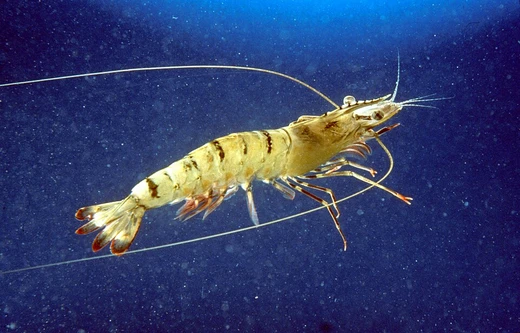
Stenopus scutellatus
A shy cleaner shrimp with spiny yellow body and red-and-white claws.

Stenopus scutellatus, also called the gold coral banded shrimp or golden coral shrimp, is a type of boxer shrimp in the family Stenopodidae. It lives in appropriate habitats across the western Atlantic and the Caribbean Sea.
This shrimp reaches up to 4 centimeters (1.6 inches) long. Its carapace and abdomen are yellow and spiny, and it has long white antennae. The third pair of walking legs are much larger than the others, spiny, and tipped with long claws; these legs are boldly striped in red and white, while the other legs are yellow. The tip of the abdomen, along with the uropods and telson, also show orangeish-red and white markings.
The species is common in shallow waters of the western Atlantic, from Bermuda and the West Indies through the Gulf of Mexico and south to northern Brazil, at depths between 10 and 113 meters (33 to 371 feet). It lives on coral reefs, in caves, among coral rubble, on rocks near turtle grass meadows, and on seabed detritus.
These shrimps usually appear in pairs, one male and one female, and have elaborate mating rituals. They hide in crevices with their long antennae visible and waving to signal their presence. They act as cleaners for fish, which approach and adopt special poses while the shrimp remove and eat parasites like isopods and pieces of dead skin. More timid than the banded cleaner shrimp (Stenopus hispidus), they approach visiting fish more cautiously and sometimes stay inside their niches, picking at the fish’s side just outside the opening.
Quick Facts
- Taxon
- Stenopus scutellatus
Facts from the source article.
Lore & Background
Stenopus scutellatus has a yellow spiny carapace and abdomen, long white antennae, and a third pair of pereiopods that are spiny, bear long claws, and are much larger than the other legs. These large claws are boldly barred in red and white, while the other legs are yellow. The tip of the abdomen, uropods, and telson are marked with orangeish-red and white.
These shrimps are usually found in pairs, one of each sex, and have elaborate mating behaviors. They lurk in crevices with their long antennae visible and waving to advertise their presence. They offer cleaning services to fish, which approach and adopt special attitudes while parasites such as isopods and pieces of dead skin are removed and eaten by the shrimp.
Stenopus scutellatus is rather more shy than the banded cleaner shrimp (Stenopus hispidus) and approaches the fishes that attend the cleaning station more cautiously. They sometimes just remain inside their niches picking at the side of the visiting fish immediately outside.
Reader's Guide
Stenopus scutellatus is notable as a cleaner shrimp in western Atlantic and Caribbean reef ecosystems. The source article describes it as a boxer shrimp that provides cleaning services to fish, removing parasites like isopods and dead skin. Its shy behavior distinguishes it from the more familiar banded cleaner shrimp (Stenopus hispidus); it approaches fish more cautiously and may clean from within its crevice. The species is typically found in pairs, one male and one female, and engages in elaborate mating behaviors. Its striking coloration—a yellow spiny body with red-and-white barred claws and orangeish-red tail markings—makes it visually distinctive. The shrimp inhabits shallow waters from Bermuda to northern Brazil, at depths between 10 and 113 meters, in coral reefs, caves, and near turtle grass meadows. Its long white antennae are waved from crevices to advertise its cleaning station. The article does not mention any conservation status or economic importance, focusing instead on its ecological role as a cleaner and its behavioral traits.
Did You Know?
- Stenopus scutellatus is a boxer shrimp belonging to the family Stenopodidae.
- They are more shy than the banded cleaner shrimp (Stenopus hispidus) and approach fish more cautiously.
More in Marine Shrimp, Part 2 1-24
Spotted an error? Know more?
Reader corrections go straight into our review queue. Suggest an edit · How this site is sourced