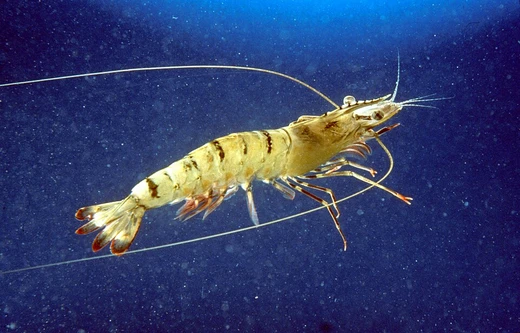
Stenopus pyrsonotus
A cryptic Indo-West Pacific shrimp with a red dorsal stripe.

Stenopus pyrsonotus is a shrimp-like crustacean from the Indo-West Pacific, belonging to the infraorder Stenopodidea. It goes by several common names, such as flameback coral shrimp, ghost boxing shrimp, and cave shrimp, and is occasionally kept in reef aquariums.
This species is relatively large for its group, reaching lengths of 30 to 70 mm (1.2 to 2.8 in). Its body is slender and compressed, covered in short, blunt spines. The claws are long and narrow, with several blunt, peg-like teeth along the cutting edge. The rostrum, eyestalk, and carapace are pinkish-white, while the third maxillipeds and the coxa, basis, ischia, and mer joints of the pereiopods are translucent pink. The long antennules and other appendages are white, and the abdomen is white except for a broad, longitudinal red stripe along the top. The telson is white, and the uropods are pink.
Found in the tropical Indo-West Pacific, including the Hawaiian archipelago and Mauritius, this shrimp is benthic and cryptic. It lives in coral reef systems, hiding in crevices, caves, and under overhangs, at depths down to about 130 m (430 ft).
Shrimps in this family often live in pairs and perform elaborate courtship displays. Several specimens of *Stenopus pyrsonotus* have been observed near yellow-edged moray eels (*Gymnothorax flavimarginatus*), suggesting it may engage in cleaning symbiosis with certain fish, much like other members of its genus. This idea is supported by its showy white antennules and pincers, which it could use to signal its availability.
Quick Facts
- Genus
- Stenopus
- Species
- pyrsonotus
Facts from the source article.
Lore & Background
Stenopus pyrsonotus is a fairly large stenopodidean shrimp, with a slender compressed body covered with short blunt spines. Its chelae are long and narrow, the cutting edge having several blunt, peg-like teeth. The rostrum, eyestalk and carapace are pinkish-white, while the third maxillipeds, and the coxa, basis, ischia and mer joints of the pereiopods are translucent pink. The long antennules and the other appendages are white, and the abdomen is white apart from a broad longitudinal red stripe on the dorsal surface. The telson is white while the uropods are pink.
It is a benthic, cryptic species found in coral reef systems, typically in crevices, in caves and under overhangs, at depths down to about 130 m. It occurs in the tropical Indo-West Pacific region, with records from the Hawaiian archipelago and Mauritius.
Shrimps in this family are usually found in pairs and display elaborate courtship rituals. Several specimens of Stenopus pyrsonotus were found near a yellow-edged moray eel (Gymnothorax flavimarginatus), and it may be that this shrimp enters into a cleaning symbiosis with certain fish, as do several other members of its genus; this theory is supported by the showy white antennules and pincers, with which it may signal its availability.
Reader's Guide
Stenopus pyrsonotus is notable as a fairly large stenopodidean shrimp that is sometimes kept in reef aquariums. Its cryptic nature and occurrence in coral reef crevices, caves and under overhangs at depths down to about 130 m highlight its adaptation to sheltered marine environments. The species is known by multiple common names—flameback coral shrimp, ghost boxing shrimp and cave shrimp—reflecting its appearance and habitat. Its ecological significance is suggested by observations of several specimens near a yellow-edged moray eel, leading to the theory that it may enter into a cleaning symbiosis with certain fish, similar to other members of its genus. The showy white antennules and pincers are thought to signal its availability for such interactions. The species is documented from the Hawaiian archipelago and Mauritius, indicating a broad Indo-West Pacific distribution. Its presence in the aquarium trade underscores its appeal to marine enthusiasts, though its cryptic habits and potential symbiotic relationships add to its biological interest.
Did You Know?
- Stenopus pyrsonotus varies in length from about 30 to 70 mm.
- It has a broad longitudinal red stripe on the dorsal surface of the abdomen.
- It occurs at depths down to about 130 m in coral reef systems.
More in Marine Shrimp, Part 2 1-24
Spotted an error? Know more?
Reader corrections go straight into our review queue. Suggest an edit · How this site is sourced