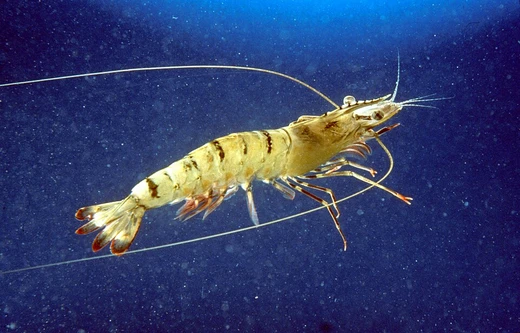
Stenopus hispidus
A pan-tropical cleaner shrimp with banded red-and-white coloration.

The coral banded shrimp, also known as the banded boxer shrimp or banded cleaner shrimp, is a shrimp-like decapod crustacean from the infraorder Stenopodidea. It can be found across tropical oceans and into some temperate waters, including the Atlantic, Indian, and Pacific. In the Atlantic, it lives near Canada, West Africa, Brazil, and the Gulf of Mexico; in the Indian Ocean, it appears around Madagascar, India, Sri Lanka, and Southeast Asia; and in the Pacific, its range stretches from eastern China down to Australia, reaching as far south as Sydney and New Zealand.
This species grows to a total length of about 60 millimeters (2.4 inches). Its body is transparent underneath, but the carapace, abdomen, and large third pair of legs are boldly banded in red and white. The antennae and other legs are white, and the abdomen, carapace, and third legs are covered in spines. Unusually for an invertebrate, it can recognize others of its own species, likely through chemical signals.
Living below the intertidal zone on coral reefs, down to depths of 210 meters (690 feet), *Stenopus hispidus* is a cleaner shrimp. To attract fish, it performs a dancing behavior near its home, slowly waving its long white antennae from side to side—a signal first observed in a lab that tells fish it is ready to feed and clean. Using its three pairs of claws, it removes parasites, fungi, and damaged tissue from visiting fish. This shrimp is monogamous, with females generally larger than males, and each pair occupies a territory about 1–2 meters in diameter.
Quick Facts
- Taxon
- Stenopus hispidus
Facts from the source article.
Lore & Background
Stenopus hispidus has a pan-tropical distribution, found in the Atlantic, Indian, and Pacific Oceans, including areas such as Canada, West Africa, Brazil, the Gulf of Mexico, Madagascar, India, Sri Lanka, Southeast Asia, Eastern China, Australia, and New Zealand. It reaches a total length of 60 mm and has a transparent ground color, with the carapace, abdomen, and large third pereiopod banded red and white; the antennae and other pereiopods are white. The abdomen, carapace, and third pereiopods are covered in spines. It has the ability to detect individuals of its species, an uncommon trait in invertebrates likely explained through chemical signals.
Reader's Guide
Stenopus hispidus lives below the intertidal zone on coral reefs at depths up to 210 meters. It is a cleaner shrimp that advertises to passing fish by slowly waving its long, white antennae. To achieve this, it performs a dancing behavior, staying close to its home in the reef and whipping its antennae side to side. This behavior was first observed in a lab and acts as a signal to inform surrounding fish that the shrimp is ready to feed and clean. It uses its three pairs of claws to remove parasites, fungi, and damaged tissue from fish. The species is monogamous, with females typically larger than males, and each pair occupies a territory 1–2 meters in diameter. Its significance lies in its specialized cleaning role on coral reefs, contributing to fish health through parasite removal.
Did You Know?
- Stenopus hispidus can detect individuals of its own species, an uncommon ability in invertebrates.
- Females are typically larger than males in this monogamous species.
- Its dancing behavior, first observed in a lab, involves whipping its antennae side to side to signal fish.
More in Marine Shrimp, Part 2 1-24
Spotted an error? Know more?
Reader corrections go straight into our review queue. Suggest an edit · How this site is sourced