Macromaxillocaris
Troglobitic shrimp with an enlarged third maxilliped, sole member of its family.

Macromaxillocaris is a genus of stenopodidean shrimp, containing the single species Macromaxillocaris bahamaensis. It is notable as the only member of the family Macromaxillocarididae and as the first troglobitic (cave-adapted) species discovered among the Stenopodidea. The genus is distinguished from other stenopodideans by the greatly enlarged third maxilliped, which is the strongest of all its appendages.
Quick Facts
- Grandparent Authority
- Alvarez, Iliffe & Villalobos, 2006
- Genus
- Macromaxillocaris
- Species
- bahamaensis
Facts from the source article.
Lore & Background
Macromaxillocaris bahamaensis was described in 2006 by Fernando Alvarez, Thomas M. Iliffe and José Luis Villalobos in the Journal of Crustacean Biology. The authors erected a new family, Macromaxillocarididae, within the infraorder Stenopodidea, marking the first major addition to the taxonomy of that infraorder since the family Spongicolidae was created by Frederick Schram in 1986. The genus name derives from Greek macros ('long'), Latin maxillaris ('jaw'), and Greek karis ('shrimp'), referring to the exceptional length of the third maxilliped. The specific epithet bahamaensis refers to the Bahamas, where the species was found.
The species is a troglobite, known only from an anchialine pool in Oven Rock Cave on Great Guana Cay, west of Exuma Cays in the Bahamas. The cave entrance leads to a small lake 1.5 m deep, connected to an underwater room and further passages, with over 300 m explored. Water salinity ranges from 28.3 ppt at the surface to 33–35 ppt at 12 m depth. The shrimp is thought to live on the cave ceiling or in bedrock fissures, as divers observed it only when returning to the surface, presumably dislodged by exhaust bubbles.
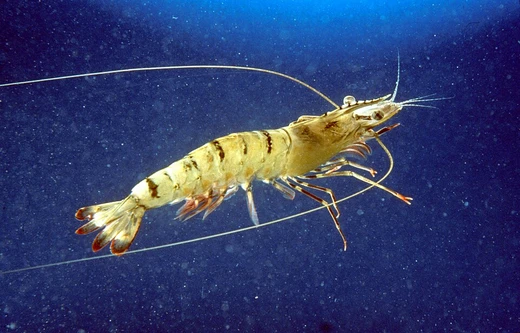
Like other troglobitic species, the body lacks pigments and the eyes are vestigial. The holotype has a total length of 14.4 mm (carapace length 4.5 mm); the paratype is smaller at 9.7 mm (carapace length 3.0 mm). Like other stenopodideans, it has chelae on the first three pairs of pereiopods, but differs by the greatly enlarged third maxilliped, which is the strongest appendage.
Reader's Guide
Macromaxillocaris bahamaensis holds significance as the first troglobitic species discovered among the Stenopodidea, a group of shrimp that typically inhabit marine environments. Its discovery in an anchialine pool in Oven Rock Cave on Great Guana Cay, Bahamas, expanded the known ecological range of the infraorder. The cave itself is a hotspot of subterranean biodiversity, containing at least 20 species of stygobionts. The species is the sole member of the family Macromaxillocarididae, which was erected in 2006, representing the first new family added to the Stenopodidea since Spongicolidae in 1986. Its most distinctive feature is the greatly enlarged third maxilliped, which is the strongest of all its appendages, a trait reflected in its genus name. The species was described by Fernando Alvarez, Thomas M. Iliffe, and José Luis Villalobos, and its discovery highlights the unique adaptations of cave-dwelling crustaceans, including loss of pigmentation and vestigial eyes. The shrimp's behavior—observed only when dislodged by divers' bubbles—suggests it inhabits cave ceilings or fissures, adding to the understanding of anchialine cave ecosystems.
Did You Know?
- Macromaxillocaris bahamaensis is the only species in the family Macromaxillocarididae.
- The third maxilliped is greatly enlarged and is the strongest of all its appendages.
- The species was described in 2006 in the Journal of Crustacean Biology.
More in Marine Shrimp, Part 2 1-24
Spotted an error? Know more?
Reader corrections go straight into our review queue. Suggest an edit · How this site is sourced