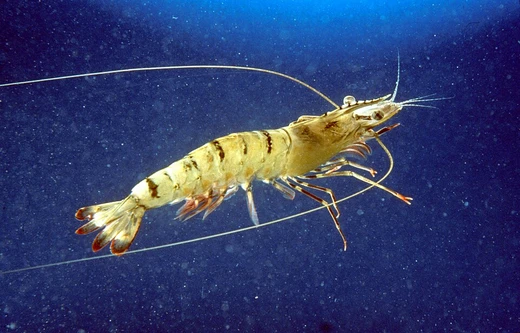
Lysmata wurdemanni
A peppermint shrimp now recognized as a narrowly distributed western Atlantic species.

Here is the rewritten encyclopedia entry:
**Lysmata wurdemanni** is a saltwater shrimp from the family Lysmatidae. In the marine aquarium trade, it was historically called the peppermint shrimp. Its translucent body is marked with bright red stripes that look like peppermint candy, and it can grow to about 7 centimetres long. Its eggs, however, are a vivid green.
For a long time, many shrimp sold under this name were actually different species. Genetic and morphological studies have since split the group, showing that shrimp previously labeled as *L. wurdemanni* often belong to species such as *Lysmata boggessi*, *Lysmata rathbunae*, and others found in the western Atlantic. As a result, *L. wurdemanni* now has a much smaller natural range and is not the shrimp most commonly used in reef aquariums to control *Aiptasia* anemones. That role belongs to *Lysmata boggessi*, which has been confirmed through both scientific research and aquarist experience as a reliable and consistent predator of those pests.
The species was first described from specimens collected at Key West, Florida, and Charleston, South Carolina. Its confirmed range runs along the U.S. Atlantic coast from Long Island down to Florida, and along the Gulf of Mexico from Florida to Port Aransas, Texas. It may also live in the northern Caribbean Sea, though this has not been verified.
Reproduction in *Lysmata wurdemanni* is unusual. It is a protandric simultaneous hermaphrodite: it starts life as a male, goes through four molts as a male, and then may become a euhermaphrodite. Under certain conditions, some males never make this change. In the hermaphroditic stage, the shrimp acts as a male between molts and as a female right after a molt. Over time, the male organs shrink, likely because more energy goes into developing female reproductive organs.
Males find mates using a "pure searching" strategy, constantly looking for receptive females. They rely on olfactory organs called aesthetascs on their antennules to detect soluble sex pheromones released by females 2 to 8 hours before molting. Guided by these chemical signals, a male approaches a female and "tastes" her contact pheromones with his aesthetascs to confirm she is suitable. If the signals are right, courtship may begin, and copulation happens very quickly right after the female molts, while her new cuticle is still soft.
Quick Facts
- Genus
- Lysmata
- Species
- wurdemanni
Facts from the source article.
Lore & Background
Lysmata wurdemanni was originally described from specimens collected at Key West, Florida and Charleston, South Carolina. Its range extends along the Atlantic seaboard of the United States from Long Island to Florida, and along the Gulf of Mexico from Florida to Port Aransas, Texas. It may also occur in the northern Caribbean Sea, but this has not been confirmed. The species reaches 7 centimetres in length and is named for the bright red stripes on its otherwise translucent body, which are reminiscent of peppermint candies such as a candy cane. Its eggs, by contrast, are bright green.
Reproduction in L. wurdemanni is complex: it is a protandric simultaneous hermaphrodite, meaning it begins as a male but may later become a hermaphrodite. It has four moults as a male before changing sexes to become a euhermaphrodite, though under certain conditions some males never change. In the euhermaphrodite stage, the shrimp act as a male between moults and as a female immediately following a moult. During this hermaphroditic stage, the shrimp gradually lose their male organs, likely because more energy is being allocated to the development of female reproductive organs.
Mate-finding employs a 'pure searching' tactic in which males constantly search for receptive females. Males use olfactory organs (aesthetascs) on their antennules to detect soluble female sex pheromones released 2–8 hours prior to female moulting. Guided by these chemical signals, males approach the female and 'taste' her contact pheromones to ensure suitability. Courtship and copulation occur immediately post-moult, while the female's cuticle is new and soft.
Reader's Guide
Lysmata wurdemanni has undergone significant taxonomic reclassification. The species was historically referred to as the peppermint shrimp in the marine aquarium trade, but genetic and morphological data have revealed that many shrimp previously identified as L. wurdemanni actually belong to distinct species, including Lysmata boggessi, Lysmata rathbunae, and others native to the western Atlantic. As a result, L. wurdemanni is now recognised as a more narrowly distributed species and is not the shrimp most commonly used in reef aquariums for Aiptasia control. That role is more accurately attributed to Lysmata boggessi, which has demonstrated reliable and consistent predation on Aiptasia and is widely regarded as the preferred species for natural pest control in reef systems.
In aquaria, L. wurdemanni is considered reef safe and functions as a cleaner shrimp, feeding on parasites, necrotic tissue, and detritus from other animals. While it has occasionally been reported to consume Aiptasia anemones, most shrimp previously identified as L. wurdemanni in the aquarium trade are now recognised as other species. Like other species in the genus, L. wurdemanni is a protandric simultaneous hermaphrodite and reproduces readily in captivity, with moulting and copulation cycles similar to those observed in other cleaner shrimp such as Lysmata debelius, producing weekly batches of planktonic zoea larvae under favourable conditions. The species L. wurdemanni has been divided into four distinct species – L. wurdemanni, L. ankeri, L. bahia and L. boggessii – and more recent molecular phylogenetic work found that it is a cryptic species with at least 5 (and potentially 9) morphologically identical species being present across its range.
Did You Know?
- Lysmata wurdemanni reaches 7 centimetres (2.8 in) in length and has bright green eggs.
- It is a protandric simultaneous hermaphrodite, beginning as a male and potentially later becoming a hermaphrodite after four moults.
- Males use olfactory organs called aesthetascs on their antennules to detect female sex pheromones released 2–8 hours before moulting.
- Taxonomic revisions have split L. wurdemanni into at least four distinct species, with up to 9 morphologically identical cryptic species possible across its range.
More in Marine Shrimp, Part 2 1-24
Spotted an error? Know more?
Reader corrections go straight into our review queue. Suggest an edit · How this site is sourced