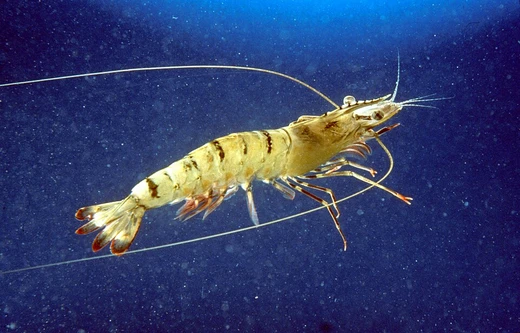
Lysmata grabhami
A cleaner shrimp of the tropical and subtropical Atlantic.

Lysmata grabhami is a species of saltwater shrimp in the family Hippolytidae, first described by Gordon in 1935. It is notable as a cleaner shrimp that operates cleaning stations in the tropical and subtropical Atlantic Ocean, where fish come to have parasites removed.
Quick Facts
- Genus
- Lysmata
- Species
- grabhami
Facts from the source article.
Lore & Background
Lysmata grabhami was first described by Gordon in 1935. Its appearance is distinctive: the antennae are white, as are the third pair of maxillipeds; the body is yellow with a continuous white dorsal stripe bordered by a longitudinal red stripe on either side; the legs are yellow, and the external branches of the uropods have a white stripe on the outer edge. It occurs in shallow water on both sides of the tropical and subtropical Atlantic Ocean, typically in reef environments. In the West Atlantic it is found along the coast of North America, the Caribbean Sea, Gulf of Mexico, and around Bermuda; in the East Atlantic it occurs in the Canary Islands, Madeira, and Cape Verde.
Reader's Guide
Lysmata grabhami is a cleaner shrimp, engaging in a symbiotic relationship with client fish. It waves its long white antennae to attract fish, which then pose by extending a fin or opening its mouth. The shrimp hops onto the fish and picks at external parasites until the fish disengages. The shrimp may occupy a single cleaning station for extended periods. Client fish include groupers, parrotfishes, and tangs. This arrangement benefits the fish by removing parasites and provides extra nutrition for the shrimp. Six species of shrimp from three different families have developed this practice, an example of convergent evolution. In aquaria, Lysmata grabhami is sometimes kept in a reef aquarium, though its Pacific sister species Lysmata amboinensis is seen much more often in the trade; both species will clean other fish in the aquarium.
Did You Know?
- Lysmata grabhami can grow to a length of 6 cm (2.4 in).
- Six species of shrimp from three families have independently evolved cleaning behavior.
More in Marine Shrimp, Part 2 1-24
Spotted an error? Know more?
Reader corrections go straight into our review queue. Suggest an edit · How this site is sourced