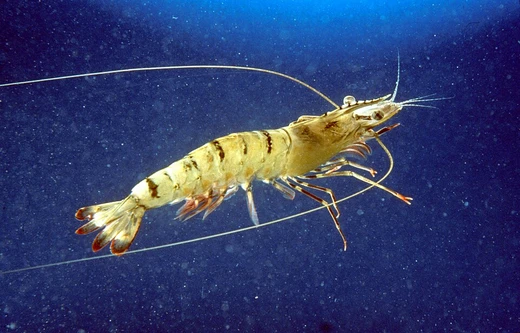
Lysmata amboinensis
A cleaner shrimp with striking bands and protandric hermaphroditism.

**Lysmata amboinensis**, commonly called the Pacific cleaner shrimp or skunk cleaner shrimp, is an omnivorous species that feeds largely on parasites and dead tissue from fish. It is a natural component of coral reef ecosystems, widespread across tropical waters, and typically found at depths between 5 and 40 metres.
Adults reach 5–6 centimetres in length, with long white antennae. Their bodies are pale with longitudinal bands on the carapace: a central white stripe flanked by wider scarlet red bands. The tail bears several symmetrical white spots. The most anterior pair of antennae forks, making the shrimp appear to have three pairs. Like all decapods, they have ten pairs of walking legs, the front pair equipped with pincers, plus a pair of white maxillipeds used for feeding. Under the thorax are paired pleopods used for swimming and brooding eggs. Their stalked eyes provide coarse, colour-blind vision.
Native to coral reefs from the Red Sea to the Indo-Pacific, they inhabit caves and ledges at depths of 5–40 metres.
Eggs are attached to the pleopods and hatch into nauplii, which develop into free-floating zoeae. Over 5–6 months, larvae pass through 14 moult stages, reaching about 2 centimetres before settling and metamorphosing. After several further moults every 3–8 weeks, they become adult. Each shrimp starts as a male but, after a few moults, becomes a functional hermaphrodite—able to act as either male or female—with no pure female form. This protandric simultaneous hermaphroditism is unique among decapod crustaceans to *Lysmata* shrimp. A single spawning produces 200–500 greenish eggs that swell and lighten before hatching at dusk, releasing 3–4 millimetre larvae into the pelagic zone.
In the wild, they are usually found in pairs rather than large groups. Mating involves little ritual: a pair of hermaphrodites alternate moulting, and after one moults, the other (acting as male) follows the freshly moulted shrimp (acting as female), which broods the eggs. When the other moults, roles reverse. In captivity, they are socially monogamous; groups larger than two often result in one pair killing the rest. It is unknown if this monogamy occurs in nature.
Like other cleaner shrimp, *L. amboinensis* forms a symbiotic relationship with client fish: the shrimp gain food from parasites and dead tissue, while fish benefit from parasite removal.
Quick Facts
- Genus
- Lysmata
- Species
- amboinensis
Facts from the source article.
Lore & Background
Lysmata amboinensis was described and named by Johannes Govertus de Man, published in 1888. In the same year it was also described as Hippolysmata vittata var. amboinensis, now considered a synonym. The shrimp has a long larval stage and unusual sexual maturation: each shrimp starts out as a male, but after a few moults becomes a functional hermaphrodite, a form described as 'protandric simultaneous hermaphroditism' unique to Lysmata among decapod crustaceans. Mature shrimp are pale in colour with longitudinal bands on the carapace—one central white band with wider scarlet red bands on either side—and have long white antennae. They have a pair of stalked eyes, though experiments suggest coarse vision and colour blindness.
Reader's Guide
Lysmata amboinensis is widely kept in salt water aquaria because it is safe and beneficial, cleaning both the tank and fish without harming corals. It is often used in home and public aquaria for educational purposes, sometimes in 'touch pools' where visitors can put their hand in the water for the shrimp to clean. Despite significant efforts, the species remains difficult to culture in captivity; adults regularly spawn eggs, but the cycle from spawning to adult takes about 6 months, during which the vast majority of larvae die. As a result, most shrimps sold are wild-caught, raising concern about negative effects on natural reefs, though there is currently no evidence of an effect. The shrimp's cleaning services aid wound healing of injured fish, supporting the symbiosis hypothesis, and it has been suggested as potentially useful to aquaculture. In captivity, L. amboinensis has been observed to be socially monogamous, with pairs showing aggression that can kill other shrimp if kept in groups larger than two.
Did You Know?
- Lysmata amboinensis has a long larval stage with 14 identified stages over 5–6 months.
- Each shrimp starts as a male and becomes a functional hermaphrodite after several moults.
- In captivity, pairs of L. amboinensis may kill other shrimp if kept in groups larger than two.
- The shrimp's eggs are initially greenish and attached to the pleopods, hatching around dusk.
More in Marine Shrimp, Part 2 1-24
Spotted an error? Know more?
Reader corrections go straight into our review queue. Suggest an edit · How this site is sourced