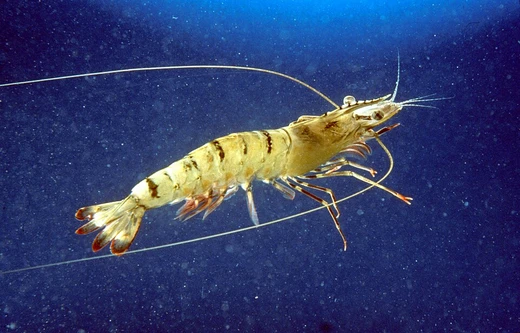
Crangon septemspinosa
A nocturnal, camouflaged shrimp with a versatile diet.

Crangon septemspinosa, commonly known as sand shrimp or seven-spined bay shrimp, is a species of shrimp found along the Atlantic coast of North America from Newfoundland to eastern Florida. It inhabits eelgrass beds, salt marshes, and estuaries, and can be found at depths up to 450 m. The species is notable for its sand-like coloration, which provides camouflage, and its nocturnal, temperature-sensitive behavior.
Quick Facts
- Genus
- Crangon
- Species
- septemspinosa
Facts from the source article.
Lore & Background
Sand shrimp is a nocturnal species, more active in dark environments and at higher temperatures, with respiration increasing at 20°C, where it adopts a bimodal activity pattern. As a prey resource for many predators, it has limited prey availability but compensates with an unspecialized, diverse diet; when more active, it may shift to carnivorous feeding on animal tissues for higher energy. Hydration levels are inversely proportional to satiety, with water replacing tissues lost to metabolism.
Reader's Guide
The species has two major reproductive periods, though their timing varies by location. In the Mystic River estuary, these occur in early spring and late autumn; in the Southern Gulf of St. Lawrence estuary, they occur in spring and late summer, with additional smaller reproductive rates in summer and early fall, suggesting a more continuous cycle in southern populations. Mature two- or three-year-old sand shrimp immigrate from offshore to shallow shorelines in early spring to mate. Temperature strongly influences growth: in the Gulf of Maine, shrimp hatched in warmer seasons grow faster (0.42–1.25 mm/week) than those in colder seasons (0.31–0.83 mm/week). However, in Rhode Island (summer average 20°C), growth rates are up to four times higher than in Delaware Bay (summer average 27°C), indicating optimal temperatures vary by habitat. Eggs hatch when water temperatures are optimal.
Did You Know?
- Sand shrimp can reach depths of up to 450 m.
- At 20°C, the species adopts a bimodal activity pattern rather than a uni-modal one.
- Spring reproductive periods produce about twice as many eggs as autumn periods.
- Growth rates in Rhode Island can be four times higher than in Delaware Bay.
More in Marine Shrimp, Part 2 1-24
Spotted an error? Know more?
Reader corrections go straight into our review queue. Suggest an edit · How this site is sourced