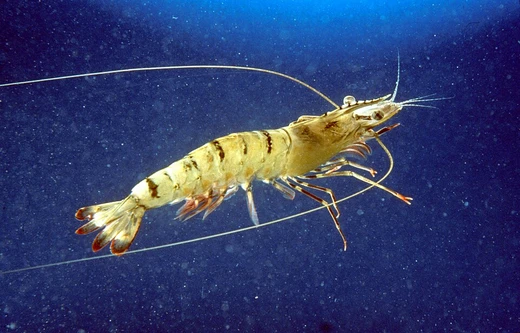
Crangon allmani
A northeast Atlantic shrimp named after naturalist George J. Allman.

Crangon allmani (sometimes written as Crangon allmanni) is a shrimp species from the northeast Atlantic Ocean. Its scientific name honors Irish natural historian George J. Allman; according to J. A. Allen, the spelling *allmanni* is a mistake, and *allmani* is correct.
The shrimp grows up to 77 mm long and is brownish-gray to reddish-gray. Its short rostrum is small, rounded at the tip, and about half the length of its eyes. The carapace is smooth except for a few small features. To tell it apart from the North Sea shrimp *Crangon crangon*, look for a longitudinal furrow along the back of the sixth and last pleon segment, with a ridge on each side. The telson has two pairs of small thorns. Males and females differ in their swimmerets: the male’s second swimmeret has a clamp-like appendix masculina on its endopodite.
This species lives only in the east boreal zone of the Atlantic, from the White Sea to the Bay of Biscay, including the North Sea, Kattegat, and around Iceland, Shetland, and the Faroe Islands. It is found at depths of 20 to 250 m, occasionally down to 360 m, on sandy or muddy sea bottoms.
*Crangon allmani* mainly eats crustaceans and ringworms (Annelida), and sometimes mollusks, Foraminifera, or brittle stars (Ophiuroidea). Whiting scales have turned up in some stomachs. Behavior partly depends on sex. The first egg-laying females appear in small numbers in early December, peaking at 26% in April and May, with another peak in offshore populations in July. New eggs are translucent gold, round, and 0.39 mm across; as they develop, they elongate to about 0.69 mm before hatching. Females carry an average of up to 2,500 eggs, with larger individuals holding up to 7,000. Larval development takes about seven weeks. Most shrimp live three years, some four. Males may die shortly after mating.
The species has no commercial value and is not fished.
Quick Facts
- Genus
- Crangon
- Species
- allmani
Facts from the source article.
Lore & Background
Crangon allmani has a brownish-gray to reddish-gray body up to 77 mm long. Its short rostrum is about half as long as the eyes, small and rounded. The carapace is smooth except for some small items. It can be distinguished from the North Sea shrimp Crangon crangon by a longitudinal furrow along the back on the sixth and hindmost pleon segment, with a ridge along each side of the furrow. Two pairs of small thorns are on the telson. Males and females are distinguished by examining the swimmerets: the male has a clamp-like appendix masculina on the endopodite of the second swimmeret.
The species is restricted to the east boreal zone of the Atlantic, from the White Sea to the Bay of Biscay, including the North Sea, Kattegat, around Iceland, Shetland, and the Faroe Islands. It inhabits sandy or muddy sea bottoms at depths between 20 and 250 m, occasionally to 360 m.
Its diet primarily consists of crustaceans and ringworms (Annelida), and occasionally mollusks, Foraminifera, and brittle stars (Ophiuroidea). Scales of Merlangius (whiting) have been found in some stomachs. Behaviour is partly determined by sex: first egg-laying females appear in small numbers at the end of the first weeks of December, reaching a maximum of 26% in April and May, with a further maximum in offshore populations in July. Newly laid eggs are translucent gold, round, and 0.39 mm in diameter, becoming longer to about 0.69 mm before hatching. Females carry on average up to 2500 eggs, larger individuals up to 7000. Larval development takes about seven weeks. Most shrimp reach three years of age; some live four years. Males may die shortly after copulation.
Reader's Guide
Crangon allmani is not commercially fished and has no commercial value, according to the source article. Its significance lies in its biological and taxonomic details: it is a distinct species within the genus Crangon, differentiated from the commercially important North Sea shrimp Crangon crangon by a longitudinal furrow on the sixth pleon segment. The species also carries a nomenclatural note: the spelling allmanni is considered a writing error by J. A. Allen, with the correct spelling being allmani. The specific name honors Irish natural historian George J. Allman. Its distribution across the northeast Atlantic, from the White Sea to the Bay of Biscay and around Iceland, and its depth range of 20–250 m (occasionally to 360 m) define its ecological niche. Reproductive data—such as egg size, development time, and fecundity—provide baseline information for understanding its life history. The species' diet, including crustaceans, annelids, and occasional fish scales, indicates its role in benthic food webs. Despite lacking commercial value, Crangon allmani contributes to the biodiversity of boreal Atlantic waters and serves as a subject for taxonomic and ecological study.
Did You Know?
- The specific name allmani honors Irish natural historian George J. Allman.
- Females carry on average up to 2500 eggs, with larger individuals carrying up to 7000.
More in Marine Shrimp, Part 2 1-24
Spotted an error? Know more?
Reader corrections go straight into our review queue. Suggest an edit · How this site is sourced