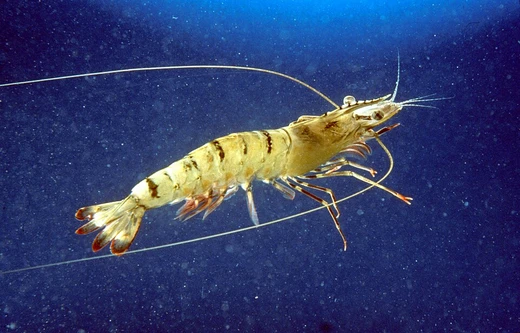
Cinetorhynchus rigens
A red-and-white shrimp with a foldable rostrum and jerky movements.

Cinetorhynchus rigens is a species of shrimp in the family Rhynchocinetidae, known by common names including mechanical shrimp, Atlantic dancing shrimp, red night shrimp, and red coral shrimp. It occurs in shallow water in the tropical Atlantic Ocean and is notable for its upward-hinging, foldable rostrum and distinctive red-and-white coloration.
Quick Facts
- Genus
- Cinetorhynchus
- Species
- rigens
Facts from the source article.
Lore & Background
Cinetorhynchus rigens has a robust body, especially the cephalothorax, with a length of up to 8 cm. Its rostrum bears three large and two small teeth dorsally and eight or nine teeth ventrally. The eyes are particularly noticeable, with corneas rounded and much larger than the eyestalks. The third abdominal segment is prominently humped. The first pair of walking legs are tipped with pincers, while the other walking legs are more slender. The general color is red and white: the rostrum white with red blotches, the abdomen transversely striped, and the legs banded. At night, some white pigment is withdrawn into chromatophores at the base of the legs, making the coloring more subdued. Eggs are yellow or orange, and may make the cephalothorax appear yellowish while maturing in the ovary, and the abdomen yellowish while incubated.
The species was first described in 1936 by Scottish marine biologist Isabella Gordon, with the type locality being Madeira. Further specimens recorded from the Ryukyu Islands by Japanese zoologist Takahiro Fujino in 1975 are likely a different species, now named Cinetorhynchus erythrostictus. C. rigens is usually found at depths less than 10 m, in crevices and caves on rocky shores and coral reefs. Its common name 'dancing shrimp' comes from its habit of constantly engaging in jerky movements. Its diet has not been studied, but it is likely a detritivore, also consuming small invertebrates and organic particles; examination of its feces reveals sponge spicules, fragments of mollusc shells, and algae. It is nocturnal, concealing itself during the day, sometimes in large numbers, in fissures among boulders. Its association with the sea urchin Diadema antillarum varies with the phase of the Moon, and it is often associated with sea anemones such as Telmatactis cricoides, Bartholomea annulata, Condylactis gigantea, and Lebrunia neglecta. In Brazil, it has been found sharing crevices with the brown spiny lobster Panulirus echinatus. The shrimp is preyed on by predatory fish, cephalopods, and larger crustaceans; in the Caribbean, it forms part of the diet of the invasive lionfishes Pterois volitans and Pterois miles.
Reader's Guide
Cinetorhynchus rigens holds significance as a distinctive member of the Rhynchocinetidae family, characterized by its upward-hinging rostrum and robust body. Its range spans the tropical Atlantic Ocean from Portugal south to the equator, including the Azores, Madeira, the Canaries, Cape Verde Islands, Gulf of Mexico, Caribbean Sea, and from Bermuda to Brazil. The species was first described in 1936 by Scottish marine biologist Isabella Gordon, with Madeira as the type locality. A later record from the Ryukyu Islands by Takahiro Fujino in 1975 was reassigned to a different species, Cinetorhynchus erythrostictus, highlighting taxonomic refinement. Its common name 'dancing shrimp' derives from its constant jerky movements. Ecologically, it is nocturnal and likely a detritivore, with fecal evidence of sponge spicules, mollusc fragments, and algae. It associates variably with the sea urchin Diadema antillarum depending on lunar phase, and frequently with several sea anemone species. In Brazil, it shares crevices with the brown spiny lobster Panulirus echinatus. It serves as prey for predatory fish, cephalopods, larger crustaceans, and notably the invasive lionfishes Pterois volitans and Pterois miles in the Caribbean. Its legacy includes being a well-documented example of a shallow-water Atlantic shrimp with notable coloration and behavior.
More in Marine Shrimp, Part 2 1-24
Spotted an error? Know more?
Reader corrections go straight into our review queue. Suggest an edit · How this site is sourced