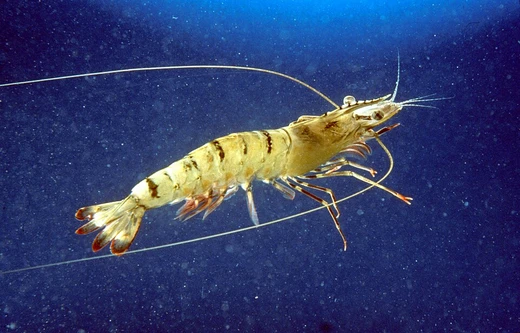
Calliasmata pholidota
A color-changing shrimp of anchialine pools.

Calliasmata pholidota, a shrimp from the family Barbouriidae, ranges from 15 to 30 millimeters in total length. Its body color varies from pale pink to brilliant red, often with red banding, while its legs range from red to pale. A transverse red band frequently runs along the base of the telson. Like others in its family, this shrimp can alter the intensity of its red pigment, which is why they are called chameleon shrimp. Black pigments are associated with the eyes, and its chelipeds are conspicuous. It moves by walking across the substrate. The species is thought to be an opportunistic feeder, taking live prey or scavenging.
Within the Hawaiian Islands, *C. pholidota* is found in anchialine pools with mid-to high salinity. It has a disjunct Indo-Pacific distribution, reported from the Red Sea–Sinai Peninsula, Funafuti Atoll, and the Hawaiian Islands of Maui and Hawaii. On the island of Hawaii, it inhabits one pool at Ka Lae at Lua o Palahemo and one pool group in the Manuka Natural Area Reserve. On Maui, it occurs in four pool groups in Ahihi-Kinau. At Lua o Palahemo, it shares its habitat with three other candidate species of anchialine pool shrimp: *Antecaridina lauensis*, *Procaris hawaiana*, and *Vetericaris chaceorum*. In these sightings, specimens were not abundant, and the species has been considered for endangered status due to its presumably small numbers. Like other anchialine pool shrimp, it is believed to live in an extensive network of water-filled interstitial spaces connected to the pool.
Quick Facts
- Taxon
- Calliasmata pholidota
Facts from the source article.
Lore & Background
Calliasmata pholidota varies in size from 15 to 30 millimeters in total length. Its body color ranges from pale pink to brilliant red, with red banding, and its legs are red to pale. A traverse red band frequently appears along the base of the telson. Like other shrimp in the family Barbouriidae, this species can change the intensity of its red pigment, which is why they are called chameleon shrimp. Black pigments are associated with the eyes, and its chelipeds are conspicuous. Locomotion is achieved by walking over the substrate.
Within the Hawaiian Islands, C. pholidota is known to occur in mid-to high salinity anchialine pools. It has a disjunct Indo-Pacific distribution, reported from the Red Sea-Sinai Peninsula, Funafuti Atoll, and the Hawaiian Islands of Maui and Hawaii. On the island of Hawaii, it inhabits one pool at Ka Lae at Lua o Palahemo and one pool group in the Manuka Natural Area Reserve. On Maui, it is found in four pool groups in Ahihi-Kinau. At Lua o Palahemo, it co-occurs with three other candidate species of anchialine pool shrimp: Antecaridina lauensis, Procaris hawaiana, and Vetericaris chaceorum.
Specimens were not abundant in the aforementioned sightings, and as such this species has been considered for endangered species status, as their numbers are assumed to be considerably small. Like other anchialine pool shrimp species, it is believed that this species inhabits an extensive network of water-filled interstitial spaces leading to and from the actual pool.
Reader's Guide
Calliasmata pholidota is significant as a member of the family Barbouriidae, noted for its chameleon-like ability to change the intensity of its red pigment. This trait, along with its pale pink to brilliant red coloration and red banding, makes it a distinctive inhabitant of anchialine pools. Its disjunct Indo-Pacific distribution—spanning the Red Sea-Sinai Peninsula, Funafuti Atoll, and the Hawaiian Islands—highlights its ecological specialization in mid-to high salinity anchialine environments. The species is considered for endangered species status due to its assumed small population numbers, as specimens were not abundant in the known pool groups on Maui and Hawaii. At Lua o Palahemo, it co-occurs with three other candidate species of anchialine pool shrimp, indicating a shared habitat within an extensive network of water-filled interstitial spaces. Its opportunistic feeding behavior, taking live prey or scavenging, further defines its role in these isolated ecosystems. The species' limited distribution and low abundance underscore its vulnerability and the need for conservation attention.
Did You Know?
- Calliasmata pholidota can change the intensity of its red pigment, earning it the name chameleon shrimp.
- It is an opportunistic feeder, taking live prey or scavenging for food.
- This species achieves locomotion by walking over the substrate.
- It co-occurs with three other candidate anchialine pool shrimp species at Lua o Palahemo.
More in Marine Shrimp, Part 2 1-24
Spotted an error? Know more?
Reader corrections go straight into our review queue. Suggest an edit · How this site is sourced