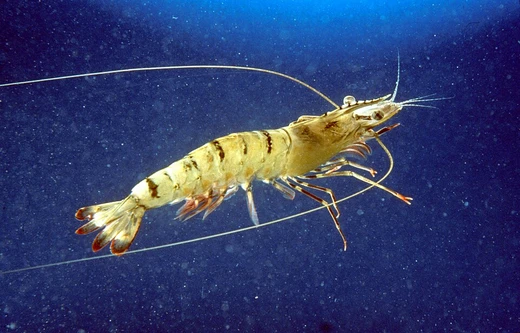
Ancylomenes pedersoni
A small cleaner shrimp found in Caribbean waters, often with sea anemones.

Ancylomenes pedersoni, commonly called Pederson's shrimp or Pederson's cleaner shrimp, belongs to the genus Ancylomenes. Fenner A. Chace Jr. first described it in 1958, originally naming it Periclimenes pedersoni. This shrimp lives in the Caribbean Sea, typically alongside sea anemones, at depths ranging from 1 to 15 meters (3 to 49 feet). It is frequently spotted on reefs near Bermuda.
This small, see-through shrimp has bluish and violet markings on its body and long white antennae. Within its habitat, it is hard to mistake for any other species.
It associates with either Bartholomea annulata or Condylactis gigantea anemones, moving safely among their tentacles. To gain this immunity, it must gradually press its body and limbs against the tentacles for longer periods each time. Once acclimated, it can move freely without being stung, but if separated from its host for a few days, it must repeat the whole process. While up to 26 shrimp have been found living with one anemone, usually only one or two are present.
The shrimp cleans passing fish, waving its antennae to get their attention. Fish that stop at this cleaning station stay still while the shrimp removes and eats external parasites, even reaching inside gill covers and mouths. If a neon goby sets up a nearby cleaning station, the shrimp will clean fish alongside it. Researchers have found that fish recognize the anemone Bartholomea annulata as a reliable place to find these cleaning services, and larger anemones attract more fish.
Quick Facts
- Genus
- Ancylomenes
- Species
- pedersoni
Facts from the source article.
Lore & Background
Pederson's shrimp is a small transparent shrimp with bluish and violet markings on the body and long white antennae. Within its range it is unlikely to be confused with other species. It lives in association with a sea anemone, either Bartholomea annulata or Condylactis gigantea, living among the tentacles with impunity. Before it can do this it needs to acclimatise itself to the anemone by progressively pressing its body and appendages against the tentacles for increasing periods of time. After this it is able to move between the tentacles without getting stung, but if it is separated from its host for a few days, it will need to repeat the immunizing procedure. Up to 26 shrimps have been found associated with one sea anemone, but usually there are just one or two.
Reader's Guide
The shrimp offers cleaning services to passing fish and attracts their attention by lashing its antennae about. Fish visiting the cleaning station will remain stationary while their external parasites are removed and eaten by the shrimp, which even cleans inside the gill covers and the mouth. If a neon goby sets up a cleaning station nearby, the shrimp will clean the client fish at the same time as the goby does. Researchers have shown that fish recognise the sea anemone Bartholomea annulata as being a place at which the shrimps' services are likely to be available. The larger the sea anemone, the more likely fish are to visit it. This species is notable for its symbiotic relationship with sea anemones and its role as a cleaner shrimp in Caribbean reef ecosystems.
Did You Know?
- Ancylomenes pedersoni was originally described as Periclimenes pedersoni in 1958 by Fenner A. Chace Jr.
- It lives among the tentacles of sea anemones such as Bartholomea annulata or Condylactis gigantea without being stung.
- Fish recognise the sea anemone Bartholomea annulata as a place where cleaning services are likely available.
More in Marine Shrimp, Part 2 1-24
Spotted an error? Know more?
Reader corrections go straight into our review queue. Suggest an edit · How this site is sourced