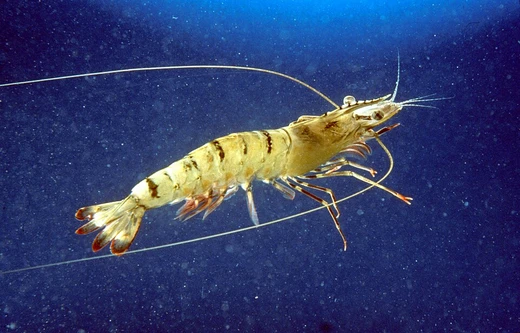
Alpheus heterochaelis
Largest snapping shrimp in its range, uses cavitation bubble snap.

Alpheus heterochaelis, called the bigclaw snapping shrimp, belongs to the Alpheidae family of snapper or pistol shrimp. It lives in the western Atlantic Ocean and the Gulf of Mexico.
This shrimp has a small rostrum and no spines along the edge of its carapace. Its oversized claw—which can be either the right or left one—gives the species its common name and measures half the length of its body. Below the finger joint, each side of this claw has a deep notch. The other claw is normal-sized and unmodified. Within its range, it is the largest snapping shrimp, reaching up to 5.5 centimeters (2.2 inches) long, though most adults are much smaller. Its body is a translucent dark green, with orange and blue tips on the uropods.
The species occurs in tropical and semitropical waters of the Gulf of Mexico, the West Indies, Bermuda, and the western Atlantic from Cape Hatteras south to Florida and Brazil. It stays near the seabed in shallow areas, favoring reefs, seagrass meadows, salt marshes, and muddy spots. During the day it often hides in natural openings, though it is not clear if it can dig its own burrow.
The bigclaw snapping shrimp makes a loud, staccato noise by snapping its big claw shut very fast, which shoots out a high-speed jet of water. This creates a tiny, short-lived cavitation bubble, and the sound comes from that bubble collapsing instantly. A spark also forms at the same time. The snap helps scare off predators, stun prey, and is used for display. How long the shrimp keeps its claw cocked does not change how far the stun travels; there is a maximum distance, and cocking beyond that point has no extra effect.
It eats worms, small crustaceans, and fish like gobies and pearlfish. Weakfish (Cynoscion regalis) prey on it. The shrimp often shares burrows with the black-clawed mud crab (Panopeus herbstii) without being eaten, even though that crab eats other shrimp of similar size. Bigclaw snapping shrimp usually live in monogamous pairs. The female is only receptive for a short time right after molting. Eggs hatch about four weeks after being laid, and the larvae do not feed, relying on their egg yolks. They develop quickly, passing through three larval stages in about five days. Newly metamorphosed juveniles have equal-sized claws; one claw enlarges later.
Quick Facts
- Taxon
- Alpheus heterochaelis
Facts from the source article.
Lore & Background
The bigclaw snapping shrimp has a small rostrum and no spines on the edge of its carapace. Its big claw, which can be either the right or left, is disproportionally large, measuring half the length of the body, and has a deep notch on either side beneath the finger joint. The other claw is unmodified and of normal size. Its colour is translucent dark green with orange and blue tips to the uropods. It lives close to the seabed in shallow waters, favoring reefs, seagrass meadows, salt marshes, and muddy areas, and often conceals itself in a natural aperture during the day, though it is unclear whether it can dig its own burrow. It is often associated with the black-clawed mud crab (Panopeus herbstii), sharing the crab's burrow and remaining uneaten even though this crab eats similar-sized shrimps of other species.
Reader's Guide
The bigclaw snapping shrimp is significant for its unique snapping mechanism, which produces a loud, staccato concussive noise when the claw snaps shut at great speed, creating a high-speed water jet and a small, short-lived cavitation bubble. The immediate collapse of this bubble creates the sound and a spark. The snapping serves to deter predators, stun prey, and for display. Notably, the duration the claw is cocked does not affect the distance the stun travels; there is a limit beyond which further cocking has no effect. It feeds on worms, small crustaceans, and fish such as gobies and pearlfish, and is itself eaten by the weakfish (Cynoscion regalis). Bigclaw snapping shrimps mostly live as monogamous pairs. The female is receptive only shortly after moulting. Eggs hatch about four weeks after being laid, and the larvae do not feed but rely on egg yolks, developing through three larval stages in about five days. Newly metamorphosed juveniles have equal-sized chelae, with one enlarging later.
Did You Know?
- The bigclaw snapping shrimp's snapping claw can be either the right or left and is half the length of its body.
- The snapping sound is produced by the collapse of a cavitation bubble, not by the claw itself.
- The bigclaw snapping shrimp is the largest snapping shrimp species in its home range, reaching up to 5.5 cm.
- It shares burrows with the black-clawed mud crab without being eaten.
More in Marine Shrimp, Part 2 1-24
Spotted an error? Know more?
Reader corrections go straight into our review queue. Suggest an edit · How this site is sourced