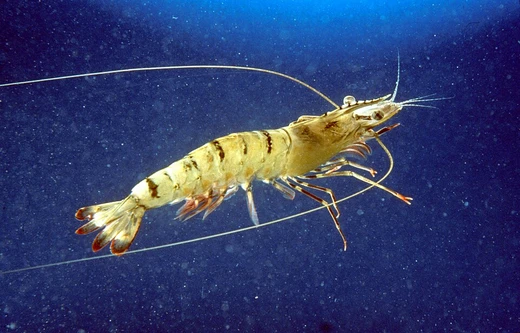
Alpheus armatus
A snapping shrimp that lives with a sea anemone.

Alpheus armatus, a moderate-sized snapping shrimp in the family Alpheidae, reaches 2 to 5 cm in length. Its body is brown, orange, or red with white spots, and its antennae are white with dark bands. One front leg bears an enormous pincer used for hunting and defense, capable of producing a loud click; the other front leg has a small claw.
This species lives in shallow waters of the Caribbean Sea and Gulf of Mexico, typically deeper than 10 m. It forms a species complex with the very similar *Alpheus immaculatus*, which mostly occurs between 13 and 25 m. Both shrimps associate with a sea anemone, usually *Bartholomea annulata*, which inhabits caves, overhangs, crevices, and coral rubble. The anemone hides its foot and column in a concealed spot, extending its tentacles to feed. When disturbed, it contracts into its lair, where its stinging tentacles provide defense. Anemones near sandy seabeds or in turbulent areas are more likely to host one or a pair of these symbiotic shrimps.
*Alpheus armatus* is a predator of small crustaceans, molluscs, and tiny fish. It approaches prey with its large pincer open, then snaps it shut with a loud click, sending a jet of water that stuns the target. The click results from the bursting of a cavitation bubble formed as the claw closes. The stunned prey is carried to the shrimp’s lair and eaten. If the snapping claw is lost, the other claw enlarges and takes on its function, though never reaching the original size; at the next molt, a new small claw develops on the damaged limb but does not regain its original role.
This shrimp is an obligate symbiont of a sea anemone, commonly *Bartholomea annulata*, and can acclimatize to the anemone’s toxins. It actively searches out the anemone even when both are buried in sand, and clears sand from the entrance to the anemone’s lair using three distinct behaviors: digging, tossing sand, and tamping. The anemone benefits by being able to contract more effectively into its lair for protection, while the shrimp gains shelter from the anemone’s stinging tentacles.
Quick Facts
- Taxon
- Alpheus armatus
Facts from the source article.
Lore & Background
Alpheus armatus is a moderate-sized shrimp with a body colored brown, orange or red, spotted with white, and antennae that are white with dark bands. One of its front legs bears an enormous pincer used as a hunting and deterrent weapon, capable of producing a loud click; the other front leg bears a small claw. It occurs in the tropical and subtropical western Atlantic Ocean, the Caribbean Sea and the Gulf of Mexico, usually at depths greater than 10 m. The very similar Alpheus immaculatus, with which it forms a species complex, mostly occurs between 13 and 25 m. Both shrimps live in association with a sea anemone, usually Bartholomea annulata, which inhabits caves, overhangs, crevices, and coral rubble. Where the sea anemone lives close to a sandy seabed or in a turbulent location, it is more likely to have one or a pair of symbiotic shrimps living with it.
Reader's Guide
Alpheus armatus is a predator that feeds on small crustaceans, molluscs, and even tiny fish. When potential prey approaches, it opens its large pincer wide and advances, snapping the claw shut with a loud click. This sends out a jet of water that stuns the prey; the click is caused by the bursting of a cavitation bubble formed as the claw closes. The stunned prey is carried to the shrimp's lair and consumed. If the snapping claw is lost, the other claw enlarges and takes on its shape and function, though never attaining the original size. At the next moult, a new small claw develops on the damaged limb but does not resume its original function. The shrimp is an obligate symbiont of a sea anemone, commonly Bartholomea annulata, and can acclimatise to its toxins. It actively clears away sand obstructing the entrance to the sea anemone's lair, using three separate behaviors: digging, tossing sand, and tamping. The sea anemone benefits by being able to better contract into its lair for protection, while the shrimp benefits from the protection of the anemone's stinging tentacles.
Did You Know?
- Alpheus armatus grows to a length of 2 to 5 cm.
- Its snapping claw produces a loud click caused by the bursting of a cavitation bubble.
- It actively clears sand from the sea anemone's lair using digging, tossing, and tamping behaviors.
More in Marine Shrimp, Part 2 1-24
Spotted an error? Know more?
Reader corrections go straight into our review queue. Suggest an edit · How this site is sourced