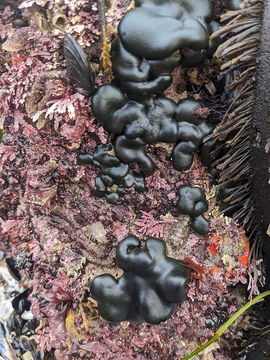
Udoteaceae
Morphologically complex green algae family in reef ecosystems.

Udoteaceae is a family of green algae within the order Bryopsidales. It stands out as the most morphologically complex family in that order, also showing high species diversity. The family includes fourteen genera, eight of which are still living, though only four are officially recognized. Twenty-four species are currently described, but since genetic data is limited, classification relies mainly on physical features.
The algae have a siphonous structure made of a single, giant multinucleate tubular cell. Some species are calcified, others are not. Their forms range from simple filaments to complex multiaxial structures, including tufts of uncalcified free filaments, brush-like calcified thalli, and compact, fan-shaped blades.
Reproduction in Udoteaceae is mostly sexual, as is typical for the order Bryopsidales. This involves meiosis to produce gametes, which fuse to form a zygote. In more complex multicellular green algae, sperm are small and motile while eggs are large and immotile, but in simpler forms the gametes are isogamous (same size). Since Udoteaceae belongs to the class Ulvophyceae and order Bryopsidales, which are multinucleate, it is assumed to be multinucleate as well. For the genus *Udotea*, fertilization can occur up to ninety-six hours after gametes are released.
The family originated around 216 million years ago, during the Late Triassic. Most of its genera appeared between 66 and 23 million years ago, in the Paleogene period. Fossil evidence points to an origin in the western Tethys Sea, which existed until 66 million years ago between the continents Gondwana and Laurasia. The center of diversity later shifted from the Western Tethys to the Central Indo-Pacific as archipelagos formed. Three main centers of diversity are recognized: the Central Indo-Pacific (center of origin), the Western Indian Ocean (center of origin and accumulation), and the Greater Caribbean (a more recent center of origin).
Udoteaceae is widespread, mostly in tropical and subtropical waters, but also in temperate regions of the Atlantic, Pacific, and Indian Oceans, as well as the Red and Mediterranean seas. It is abundant in reef ecosystems, where it plays key roles as a primary producer, contributor to carbonate fluxes, and as food or shelter for other marine organisms. Because it relies on light for photosynthesis, it is more common in shallow, clear waters.
Quick Facts
- Taxon
- Udoteaceae
Facts from the source article.
Lore & Background
Udoteaceae's origin dates back about 216 million years ago, around the Late Triassic period, with most genera originating between 66 and 23 million years ago (Paleogene period). Fossil evidence suggests the family originated from the western Tethys Sea, which was located between the continents Gondwana and Laurasia. The center of diversity shifted from the Western Tethys to the Central Indo-Pacific once archipelagos were formed. Three centers of diversity have been identified: the Central Indo-Pacific (center of origin), the Western Indian Ocean (center of origin and accumulation), and the Greater Caribbean (more recent center of origin).
Udoteaceae's structure is siphonous, composed of a giant, multinucleate tubular cell. It contains taxa that are either calcified or non-calcified, with species ranging from simple siphonous filaments to complex multiaxial structures. Genera include tufts of uncalcified and free filaments, a brush-like calcified thallus, or calcareous compact fan-shaped blades. Because genetic information is limited, species are classified primarily from morphological features.
Reproduction in Udoteaceae is assumed to be primarily sexual, as is common in the order Bryopsidales. Sexual reproduction involves meiosis producing gametes that fuse to form a zygote. The class Ulvophyceae, to which Udoteaceae belongs, contains both multicellular and multinucleated organisms, and the order Bryopsidales includes multinucleated organisms. The genus Udotea can take up to ninety-six hours after gamete release before fertilization occurs.
Reader's Guide
Udoteaceae holds significant ecological and evolutionary importance as described in the source article. Ecologically, it is most abundant in reef ecosystems, where it serves as a primary producer, contributes to carbonate fluxes, and provides food or protection for other marine organisms. Its role in the food chain and as a habitat for smaller organisms underscores its value in maintaining reef biodiversity. Access to light is critical for these primary producers, so they are more common in shallow, clearer waters.
Evolutionarily, Udoteaceae is the most morphologically complex family in the order Bryopsidales, with high species diversity. Its fossil record traces back to the Late Triassic period, about 216 million years ago, with origins in the western Tethys Sea. The family's center of diversity shifted over geological time from the Western Tethys to the Central Indo-Pacific, with additional centers in the Western Indian Ocean and the Greater Caribbean. This distribution pattern highlights the family's long history and adaptation to tropical and subtropical regions, though it also occurs in temperate waters of the Atlantic, Pacific, and Indian Oceans, as well as the Red and Mediterranean seas. The limited genetic information means that species classification relies heavily on morphological features, indicating ongoing research needs.
More in Marine Green Macroalgae 1-24
Spotted an error? Know more?
Reader corrections go straight into our review queue. Suggest an edit · How this site is sourced