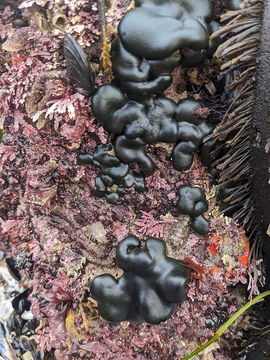
Halimeda kanaloana
A sand-anchored green alga endemic to Hawaiian islands.

Halimeda kanaloana is a green alga belonging to the class Ulvophyceae and the family Halimedaceae. It is found only in the Maui Nui island complex, which includes Molokai, Maui, Lanai, Oahu, and Kahoolawe.
The alga has a large, bulbous holdfast that anchors it in sand. Its lower thallus is made up of massive, cylindrical to slightly flattened segments. Toward the middle and top, the segments become large, obovoid to wedge-shaped, and trilobed, averaging 9–14 mm in length, 6–11 mm wide, and 1.5–2.9 mm thick. At the segment nodes, the medullar siphons fuse into a single unit, with visible pores connecting neighboring siphons; these pores have a median height of 47–69 μm, including cell walls. The plant has four to five layers of utricles. The large peripheral utricles are 56–73 μm in diameter and 69–98 μm tall, reaching 42% of their maximum width at a quarter of their height, and they have angular corners when viewed from the surface. The subperipheral utricles are notably inflated.
This species grows in sandy meadows. While a few individuals occur as shallow as 1–2 meters, dense stands begin at 15 meters and stop abruptly around 85 meters. The gritty, bulbous holdfast, up to 8 cm long, anchors the alga in sand, with rhizoids clinging tightly to the grains. Very rarely, specimens attach to rock.
Quick Facts
- Genus
- Halimeda
- Species
- kanaloana
Facts from the source article.
Lore & Background
Halimeda kanaloana is characterized by a large, bulbous holdfast that anchors the specimen in sand. The basal thallus region consists of massive cylindrical to slightly flattened segments, while the central and distal regions have large, obovoid to cuneate, trilobed segments. The medullar siphons fuse into a single unit at the segment nodes, with visible pores connecting neighboring siphons. The plant has 4–5 layers of utricles; the peripheral utricles have angular corners in surface view, and the subperipheral utricles are markedly inflated. This species is endemic to the Maui Nui island complex, including Molokai, Maui, Lanai, Oahu, and Kahoolawe. It occurs in meadows in sandy environments, with occasional individuals as shallow as 1–2 meters, dense stands beginning at 15 meters, and an abrupt end around 85 meters. Specimens are anchored in sand by a gritty, bulbous holdfast up to 8 cm in length, and very rarely are found attached to rock.
Reader's Guide
Halimeda kanaloana is significant as an endemic species restricted to the Maui Nui island complex, highlighting the unique marine biodiversity of the Hawaiian archipelago. Its distinctive morphology—including a large bulbous holdfast, trilobed segments, and multiple utricle layers—distinguishes it from other Halimeda species. The alga forms dense meadows in sandy substrates from 15 to 85 meters depth, providing habitat for associated fish and invertebrate communities, as documented in surveys by Langston and Spalding (2017) and Fukunaga (2008). Its narrow geographic range and specific depth distribution make it a species of interest for conservation and ecological studies. The description by Verbruggen et al. (2005) established its taxonomic identity, and subsequent research has examined its ecophysiology and associated fauna. The alga's reliance on sandy substrates and its anchoring holdfast underscore its adaptation to soft-bottom environments, contrasting with many other macroalgae that attach to hard surfaces.
Did You Know?
- Halimeda kanaloana is endemic to the Maui Nui island complex (Molokai, Maui, Lanai, Oahu, Kahoolawe).
- Its holdfast can be up to 8 cm long and is gritty and bulbous, anchoring the alga in sand.
- Dense stands of this alga begin at 15 meters depth and end abruptly around 85 meters.
- The plant has 4–5 layers of utricles, with subperipheral utricles that are markedly inflated.
Segmented Architecture and Calcium Deposition
The thallus of Halimeda presents one of the most architecturally distinctive features among marine macroalgae: a segmented body in which calcium carbonate is deposited directly within living tissue. Calcification can commence as early as thirty-six hours after new growth, and the mature segments end up composed of sixty to eighty percent aragonite, with non-calcified nodes acting as joints between them. Internally, the structure depends on siphons that ramify into medullary filaments, which then branch trichotomously to produce peripheral utricles. These utricles adhere to one another, enclosing the intersiphonal spaces within each segment, and it is precisely in those enclosed cavities that aragonite precipitates. The genus is coenocytic and siphonous, meaning its cells are not partitioned by cross walls but instead form a continuous, unbroken filament—a trait that distinguishes Halimeda from other calcified green seaweeds like Acetabularia. For anchorage, three holdfast morphologies exist: a loose sprawler form with scattered filaments, a matted rock-grower type that secures the thallus to hard surfaces, and a root-like sand-grower structure that grips fine sediment particles.
Reef Sediment and Carbon Cycling
Halimeda plays a disproportionately large role in shaping tropical reef landscapes. In the Great Barrier Reef off Queensland's north-east coast, the alga is responsible for distinctive circular deposits that form on the western or lee side of outer shield reefs, where nutrient-rich water flowing from the open sea sustains prolific growth. These represent the most extensive actively accumulating Halimeda beds known worldwide. In tropical lagoons, vigorous growth can produce sediment composed entirely of the alga's calcified remains, yielding what is termed Halimeda sand. Over geological time, some atoll systems are built largely from this accumulated material, making the genus the most common source of large green-algal grains in lower-latitude sediments. As a calcareous organism, Halimeda also functions as a meaningful carbon sink; for instance, H. opuntia has been measured producing up to 54.37 grams of calcium carbonate per square metre per year, contributing to the ocean's carbon budget while generating sediment across a wide particle-size range from coarse grains to silt and clay.
A Brief, Synchronous Life
The reproductive strategy of Halimeda is both rapid and dramatic. Sexual reproduction, though rarely witnessed in the field, unfolds within a single thirty-six-hour window. Gametangia first appear along the segment edges, and by the following day the entire thallus has been converted into these structures. After an overnight maturation, gametes are released the next morning, leaving the alga white and dead in a process called holocarpy. Some species coordinate their spawning in mass events spanning several months, with small fractions of the population releasing gametes each day—a pattern loosely analogous to coral spawning. Because of this compressed reproductive cycle, the genus likely lives only a few months to a year. Asexual propagation occurs through vegetative fragmentation and dispersal, allowing meadows to spread as a single connected individual linked by fine threads running through the substrate. The full life cycle remains incompletely understood; a haploid gametophyte phase is suspected, possibly followed by a sporophyte phase, though the timing of meiosis has not yet been determined.
Taxonomic Complexity and Cryptic Diversity
Despite its visually uniform segmented appearance, Halimeda is one of the best-studied examples of cryptic species pairs in marine macroalgae, a consequence of morphological convergence that makes closely related and distant lineages look nearly identical. The genus, placed in the family Halimedaceae under the order Bryopsidales, is divided into five monophyletic sections—Halimeda, Micronesicae, Opuntia, Pseudo-opuntia, and Rhipsalis—distinguished by differences in how medullary siphons fuse. Halimeda tuna serves as the type species for the genus. As of 2015, Algaebase lists seventy-one species and sixty-seven infraspecific names. Distribution ranges vary widely: several species, including H. copiosa, H. discoidea, H. gracilis, H. opuntia, H. simulans, and H. tuna, occur on a global scale, while H. tuna is restricted to the Mediterranean. The genus is highly abundant across the tropics, with notable populations in the Thai-Malay Peninsula and the Florida Keys.
Frequently Asked Questions
Who is Halimeda kanaloana?
It is a green macroalga classified in the family Halimedaceae under the class Ulvophyceae. It is a sand-dwelling species found exclusively in Hawaiian waters around the Maui Nui island group.
What does Halimeda kanaloana look like?
The lower thallus is composed of thick, cylindrical or slightly flattened segments, while the upper segments become large, obovoid to wedge-shaped, and trilobed, measuring roughly 9–14 mm long, 6–11 mm wide, and 1.5–2.9 mm thick. At the joints between segments, internal medullar siphons merge into a single unit with small visible pores.
Where does Halimeda kanaloana live?
It is endemic to the Maui Nui island complex, which spans Molokai, Maui, Lanai, Oahu, and Kahoolawe. It anchors itself into sandy seabed in those waters and is not found in the wild anywhere else.
How does Halimeda kanaloana stay in place?
A large, bulbous holdfast grips the surrounding sand, securing the alga against currents. The fused siphon structure at segment nodes adds internal reinforcement to the overall thallus.
Why is Halimeda kanaloana important?
Because its entire wild range is confined to a single island complex, it represents a uniquely Hawaiian marine species with no populations elsewhere on Earth. Its restricted distribution makes it a valuable indicator of local ecosystem health and a priority for conservation monitoring.
More in Marine Green Macroalgae 1-24
Spotted an error? Know more?
Reader corrections go straight into our review queue. Suggest an edit · How this site is sourced